Hallim Park — A 50-Year Garden on a Sand Dune Above the Hyeopjae Lava Cave
Bonsai, Palm Avenues, an Aboriginal Folk Village, and a Stalactite Cave Where the Beach Shells Above Drip Through the Rock as White Limestone
Hallim Park (한림공원) sits at 300 Hallim-ro in Hallim-eup on Jeju's west coast, a 5-minute walk from Hyeopjae Beach. The 100,000-pyeong (~33 hectares / 80 acres) garden complex began on a barren coastal sand dune in 1971 and was planted over roughly 30 years into Washington-palm and Canary-palm avenues, a 10,000-pyeong bonsai collection, a Jeolam folk village, and a subtropical conservatory holding around 2,400 plant species. Underground, the Hyeopjae and Ssangyong Caves (Natural Monument No. 236) are lava tubes whose ceilings carry white stalactites formed from beach shell-sand carbonate — an unusual combination not commonly found together. A comfortable loop takes 90 minutes to 2 hours, with the cave's 15–18°C interior offering a welcome midsummer rest. The drive to Galchibada in Aewol runs about 15 minutes east.
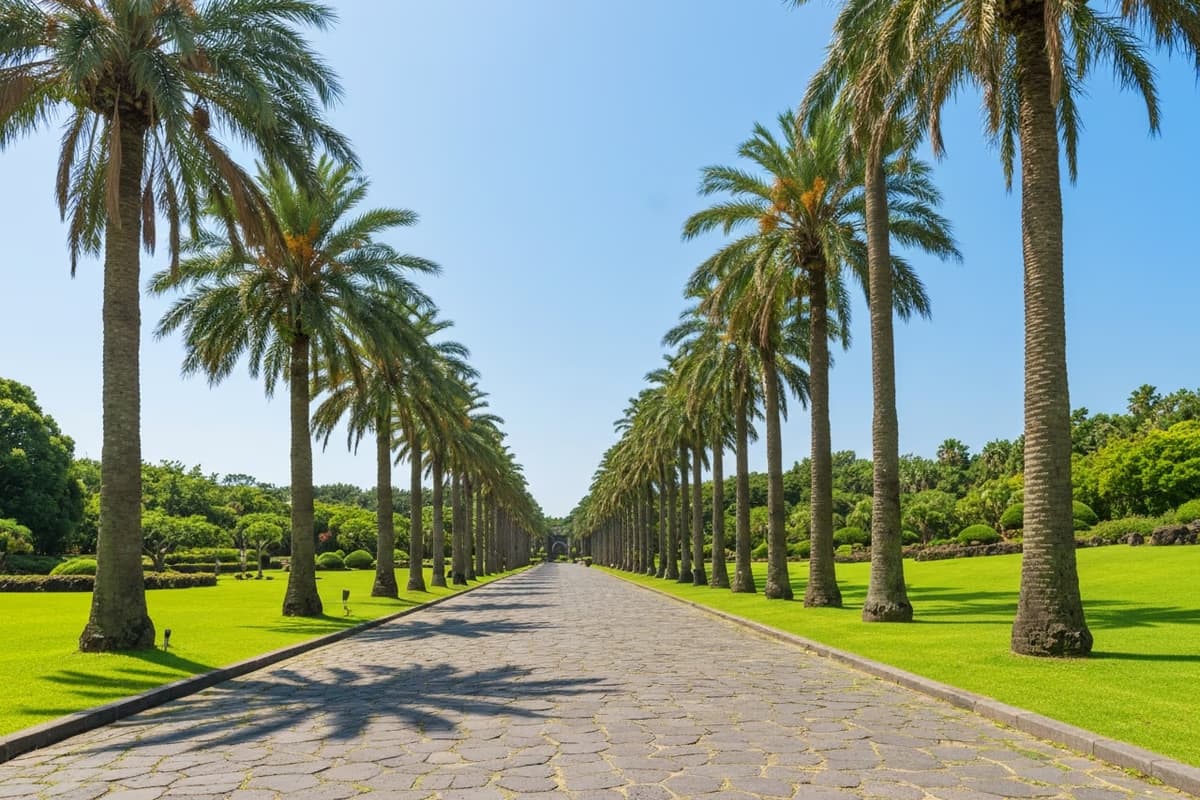
Cross a single road inland from Hyeopjae's white sand and a completely different landscape opens up within five minutes' walk. The shell sand underfoot is the same, the sunlight above is the same, and yet what fills the space between them is fifty years of patient human hands. This is Hallim Park.
The park opened in <strong>1971</strong>. The site was, at the time, an unproductive coastal sand dune where airborne shell sand from Hyeopjae's beach drifted across the flatland and nothing agricultural would take root. A single private founder began planting palms there, one tree at a time, and the slow act of that planting carried across roughly three decades — until the original sand dune had been transformed into one of Korea's most respected botanical complexes. The longer history that drives the visit is not in the brochure: it is the simple fact that someone chose to spend a working lifetime planting trees on a beach.
Thirty Years That Turned a Sand Dune Into a Garden
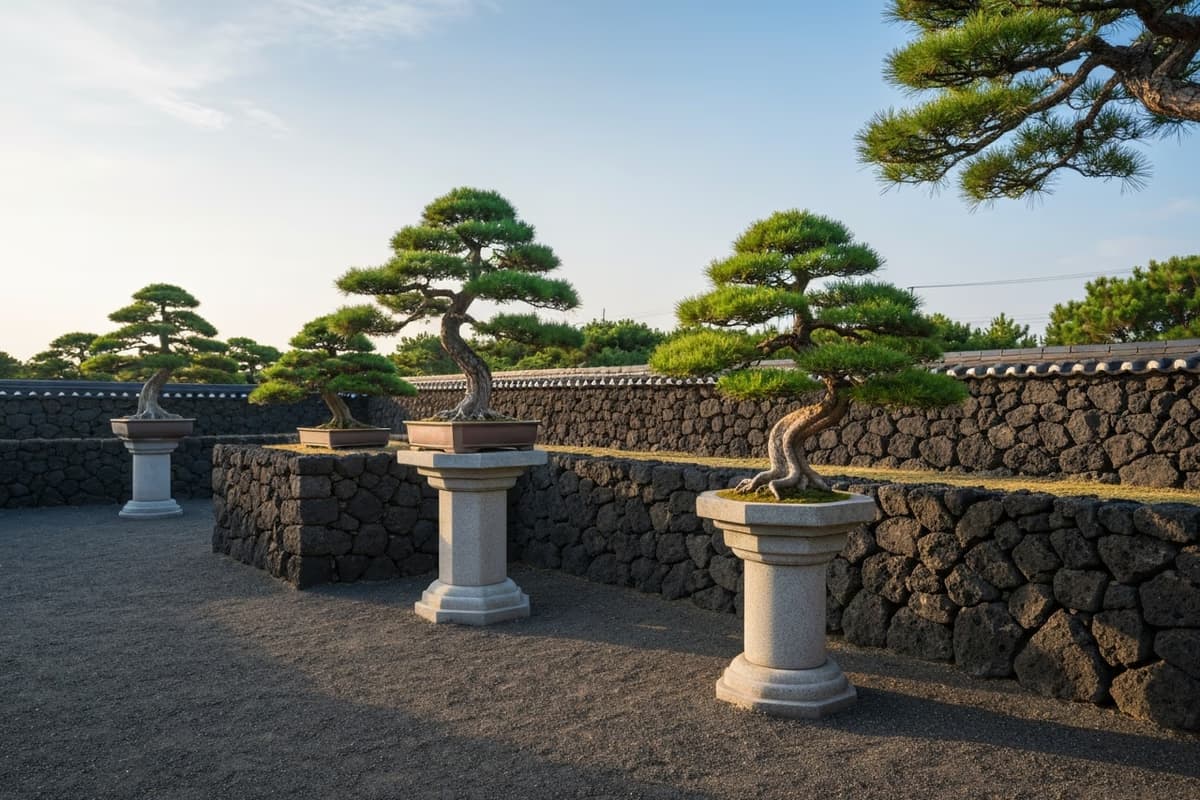
Walk in and the first thing to register is the palm avenue: tall Washington palms and Canary Island palms lined up in rows that mark the formal start of the loop. Beyond the palms opens a <strong>10,000-pyeong</strong> (roughly 3.3 hectares / 8 acres) bonsai collection. Each tree carries decades of training — the branch line, the leaf density, the curve of the trunk, all the small disciplines of a craft that does not hurry. For Western visitors who know the bonsai pavilion at the National Arboretum in Washington, D.C., or the Specimen Pine at Heronswood near Seattle, the level here is recognisable; the scale is larger.
Past the bonsai sits a small lake (Hyeopjae-badang), a constructed waterfall, and the <strong>Jeolam Folk Village</strong> — a small cluster of reconstructed Jeju vernacular houses. Black basalt walls, thatched roofs, a central yard with a small well: a quick reading of how an islander household actually arranged itself. The contrast within a single garden — the deliberate precision of bonsai beside the rougher honesty of a village house — is the texture that distinguishes Hallim Park from a straightforward botanical garden.
The full site runs about <strong>100,000 pyeong (~80 acres / 33 hectares)</strong>, and a slow loop takes 90 minutes to two hours. The paths are mostly flat — strollers and most mobility devices handle the surface gardens comfortably — but the cave sections involve stairs and narrow passages and are not wheelchair-accessible.
The Hyeopjae Cave — Stalactites on a Volcanic Island
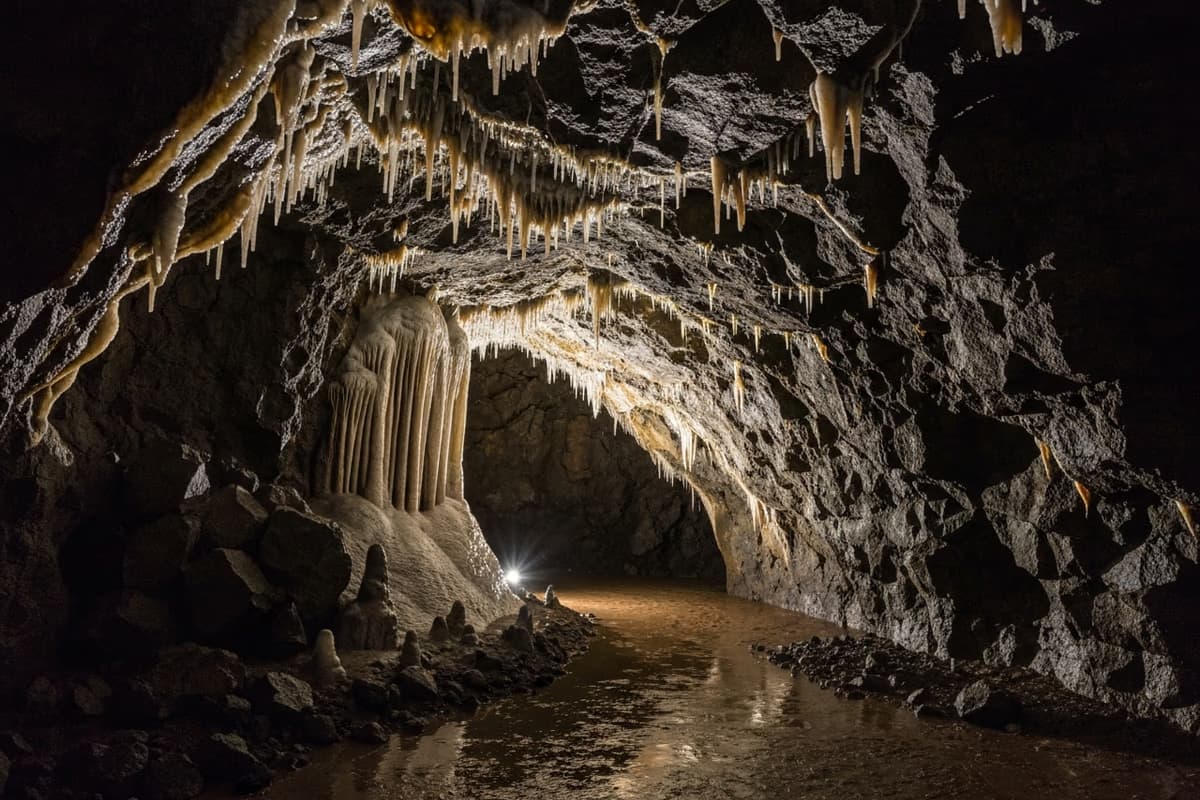
What lifts Hallim Park from a regional garden into something academically distinctive is the geology directly underneath it. Two caves — the Hyeopjae Cave and the Ssangyong Cave — sit beneath the park, jointly designated <strong>Natural Monument No. 236</strong>. The entrance to the cave system opens off the bonsai section, and the eye crosses from the planted surface above to the lava-formed darkness underneath without leaving the garden boundary.
What makes the two caves unusual is their formation history. Standard Jeju caves are lava tubes — pulled open during the volcanic activity around the formation of Hallasan some <strong>300,000 years ago</strong>, as molten rock flowed under a cooled crust and drained, leaving the void. Their surfaces show the flow lines and gas-escape marks of any cooled basalt lava tube; Manjanggul, on Jeju's northeast, is the textbook example. Hyeopjae and Ssangyong start out the same way — but they then acquired a second layer of geology that lava tubes elsewhere do not have. <strong>White stalactites hang from their ceilings.</strong>
Stalactites typically form only in limestone caves, where dissolved carbonate drips and re-crystallises. Jeju is a volcanic island and has no limestone. The reason stalactites grew here is the shell-sand layer on the surface. The sand at Hyeopjae Beach is pae-sa — finely broken shell and coral fragments — and is rich in calcium carbonate. Rainwater percolates down through that sand layer, dissolves the carbonate, drips through the cave roof, and re-crystallises on the underside as a slow-growing white stalactite. The white sand visible on the beach above and the white stalactites hanging in the cave below are, in a literal sense, the same material in two different states. Western visitors who have walked through the limestone caves at Carlsbad (New Mexico), Mammoth (Kentucky), or Postojna (Slovenia) will recognise the formations; the difference is that those caves sit inside limestone, and this one does not.
Ssangyong Cave — the name means "twin dragons" — runs through a longer, deeper passage with a darker register than the Hyeopjae section. The interior temperature holds steady at <strong>15–18 °C (59–64 °F)</strong> year-round, which makes the cave the obvious midsummer reset stop on a hot day at the park.
The Palm Avenue and Subtropical Conservatory
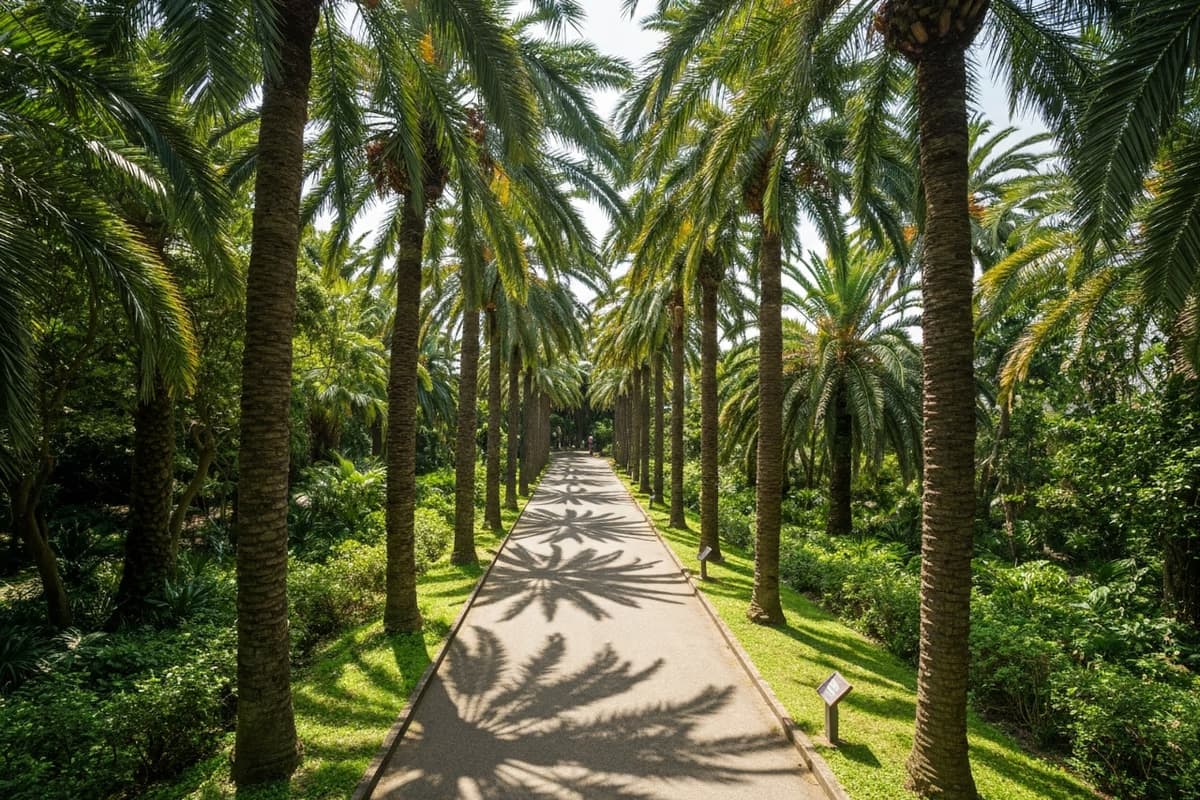
The subtropical section holds around <strong>2,400 plant species</strong>, many of which cannot grow naturally on the Korean mainland. Bougainvillea, multiple palm genera, banana, papaya, and a wide cactus collection sit together in a single space, reading as a family portrait of plants that share Jeju's latitude.
The palm avenue itself has long been a photographer's anchor. Roughly <strong>100 metres / 110 yards</strong> of tall palms lined in two parallel rows, with midday sun cutting striped shadows down the path and the late-afternoon golden hour filtering through the fronds into something noticeably softer. The same path renders differently every hour, and a slow visit through this stretch around 4 p.m. is what most landscape photographers come for.
Further inside the conservatory, a small aviary and a tropical aquarium operate alongside the planting beds — useful additions for visitors arriving with younger children.
The Jeolam Folk Village
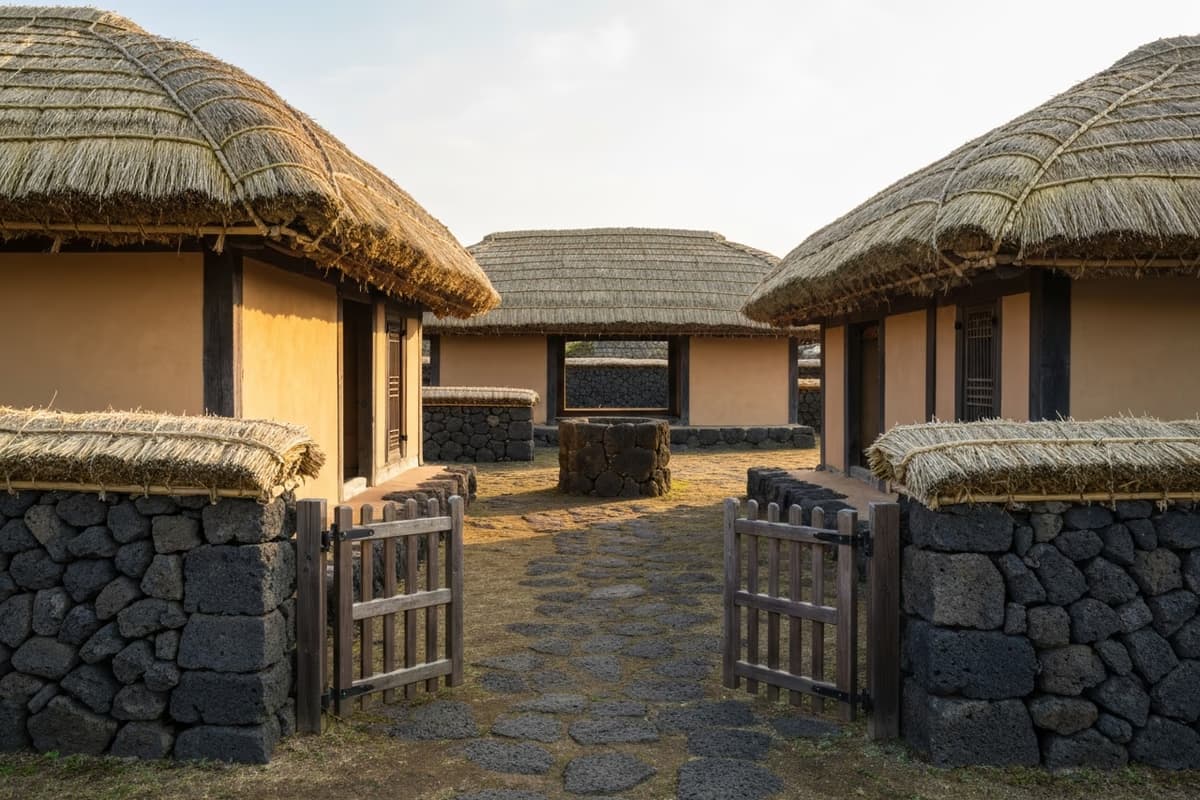
The Jeolam Folk Village reconstructs a small cluster of Jeju vernacular houses adjacent to the bonsai section. Black basalt walls, thatched roofs, a main hall, a kitchen, and a small yard well — the everyday architecture of an islander household, condensed into a walkable cluster. Old agricultural tools and kitchen implements sit on display inside the houses, and the yard plants the season: canola yellow in spring, cosmos pink in autumn.
The compositional contrast — the formal patience of the bonsai garden alongside the rougher daily-life vocabulary of an islander house — is what makes the village feel like a real part of the park rather than an add-on. The same hands that shape a 60-year pine into a pattern of branches also kept this kind of yard going for everyday life on this island; the park lays both of those hand-disciplines side by side.
Hyeopjae Beach and Hallim Park — The Same Sand, Two Faces
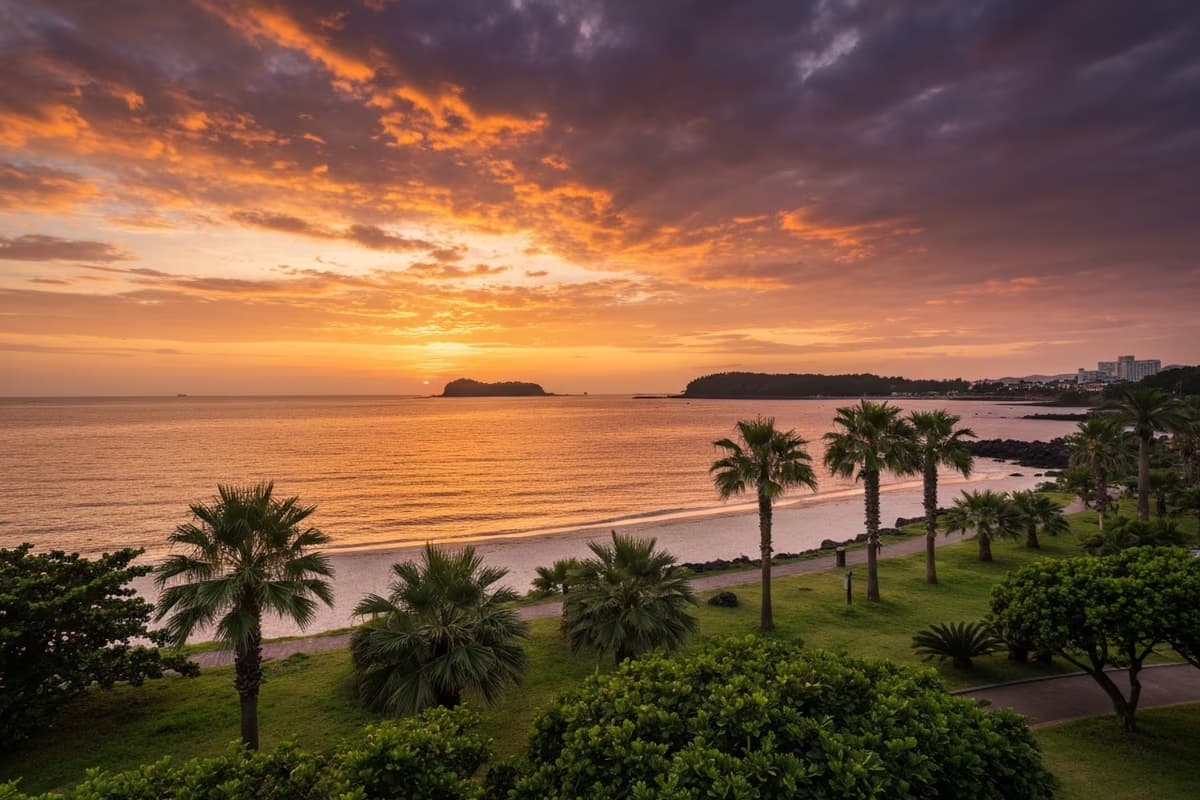
From the western edge of the park near Hyeopjae-badang, lift the eye and Hyeopjae's white crescent is right there — under 100 metres in straight-line distance. Yet the atmospheres separate sharply. On the beach, the same shell sand bounces light upward in the open sun and the colour reads bright. Inside the park, the same sand sits beneath palm canopy and bonsai shade and quiets down. Two faces of one substrate, separated by a single low road.
That single contrast is the reason locals tend to do both in one visit. The midday is best spent on the beach when the optical effect is strongest; the early afternoon transitions naturally into the shaded park; and the cave section runs neatly across the hottest 90 minutes when the 15–18 °C interior is a real relief rather than just a curiosity.
15 Minutes East — The Day Closes at the Coastal Table
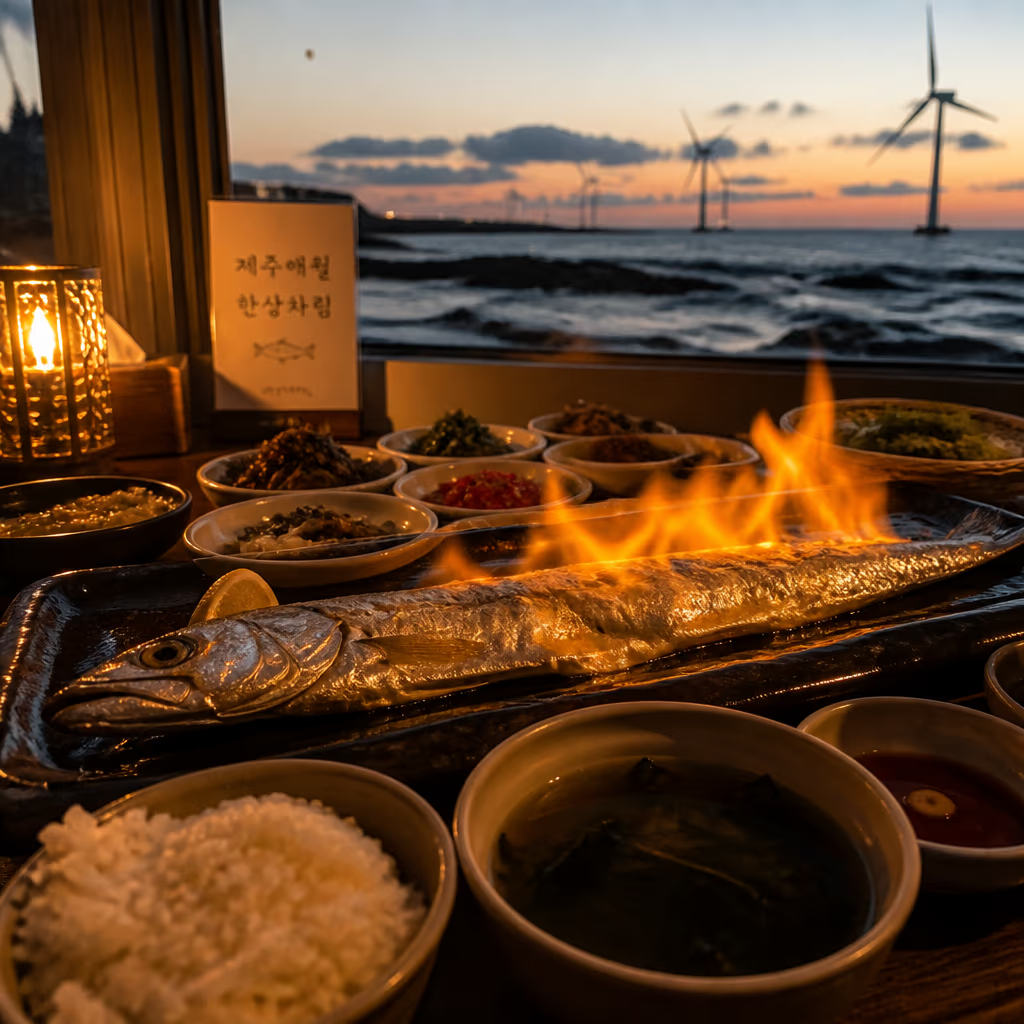
From the Hallim Park front gate, Route 1132 east along the coast carries you to Galchibada in Aewol → in about <strong>15 minutes</strong>. After a half-day balancing white-sand brightness, palm shade, the bonsai's patience, and the cave's steady cool, a floor-to-ceiling ocean-view table holds the day's final composition. A whole silver hairtail landed off this coast that morning sits on the plate — a single piece pulling cleanly along the grain in the braise, or the skin puffing up over the charcoal grill, much the way a 60-year pine has its branches placed one at a time in the bonsai garden you just left.
Getting There and Practical Notes
The address is 300 Hallim-ro, Hallim-eup, Jeju City. From Jeju International Airport, the drive runs about <strong>40 minutes</strong>; from Hyeopjae Beach, the park is a <strong>5-minute walk</strong>. Intercity bus 202 stops at the Hallim Park stop. Real-time bus position lives at the Jeju Bus Information System. Park hours and admission shift by season — confirm current information at the park information desk on arrival or at Visit Jeju in English before the drive.
A short itinerary note. The park is large enough that the "quick spin in an hour" plan is the usual mistake — 90 minutes is the realistic minimum for a complete loop, and 2.5 to 3 hours is the right budget if pairing with Hyeopjae Beach in the same visit. In midsummer, the cave window pairs well with the hottest part of the afternoon: the 15–18 °C interior is a genuine reset rather than a check-the-box stop. The palm avenue and the bonsai section both read most strongly in late-afternoon side-light, which makes a 4 p.m. circuit the cleanest for photography.
Fifty years ago, one person started planting palms on a sand dune. That same sand is still dripping through the cave roof underneath as white stalactites, while the trees above have grown into the rows you walk down. Fifteen minutes east, the next composition has already been plated. The shape of a Jeju west-coast day, at its richest, runs through the sand, the shade, the cave, the village houses, and lands on a table that holds the same coast in a third light.
Frequently Asked Questions
- How close is Hallim Park to Hyeopjae Beach?
- About 100 metres in straight-line distance — a 5-minute walk across a single road. The shell sand under the park is the same shell sand on the beach; the difference is what fifty years of planting has built on top of it. Locals commonly combine the two in one visit, with the beach taking the brighter midday hours and the park taking the shaded afternoon.
- How did stalactites form in the Hyeopjae and Ssangyong Caves?
- The two caves are roughly 300,000-year-old lava tubes — standard volcanic geology — that acquired stalactites later, which is unusual for Korea. Hyeopjae Beach's shell sand (pae-sa) is rich in calcium carbonate. Rainwater dissolves the carbonate, percolates through the sand layer to the cave roof, drips, and the carbonate re-crystallises on the underside as slow-growing white stalactites. The white sand on the beach and the white stalactites underneath are the same substance in two different states.
- How long does a Hallim Park visit take?
- Walking the full circuit through the palm avenue, bonsai collection, subtropical conservatory, both caves, and the Jeolam Folk Village takes 90 minutes to 2 hours at an easy pace. Combined with Hyeopjae Beach in a single visit, 2.5 to 3 hours is the realistic budget. The surface paths are mostly flat (stroller-friendly); the cave sections involve stairs and narrow passages.
- What are Hallim Park's opening hours and admission?
- Hours and admission shift by season — confirm current information at the park information desk on arrival or at Visit Jeju in English before the drive.
- How far is it from Hallim Park to Galchibada in Aewol?
- About 15 minutes east by car via Route 1132 along the coast. After a long-form garden visit, a floor-to-ceiling ocean-view table for a sit-down dinner of wild-caught silver hairtail closes the day on the same coast.
- Where are the best photo spots inside Hallim Park?
- The entrance palm avenue carries two distinct looks — sharp striped shadows at midday and softer golden-hour light through the fronds in late afternoon. The bonsai section and the small Hyeopjae-badang lake both reward slow walking. The Jeolam Folk Village's basalt walls and thatched roofs are the cleanest "old Jeju" composition in the park.
From a half-century garden to an ocean-view dinner — 15 minutes east
Carry the patience of the bonsai garden onto the plate
When the side-light lengthens through the palm avenue and the bonsai shade begins to soften, the park signals it is time to move on. Fifteen minutes east along the coast, a floor-to-ceiling window opens onto another stretch of the same emerald — now under different light — and a wild-caught silver hairtail carries the patience of a fifty-year garden onto the plate.
15 minutes east from Hallim Park to Galchibada Aewol via Route 1132 →