Iho Tewoo Pony Lighthouses — Jeju's First Skyline After the Runway
A 10-Minute Drive From the Airport to a Pair of Wooden Pony Lighthouses, Red and White, Built in the Shape of the Island's Native Horse
The Iho Tewoo Pony Lighthouses (이호테우 목마등대) stand at the end of the breakwater off Iho Tewoo Beach in Doduildong, Jeju City — about 5 km / 3 miles (10 minutes by car) from Jeju International Airport. Two wooden lighthouses each about 12 metres tall, carved into the shape of Jeju's native pony, mark the east-red and west-white channel entrance per international harbour signalling. Iho Tewoo Beach itself is the rare black-sand (heuksa) beach on Jeju, formed from ground basalt rather than coral shell — a clear visual contrast with the west-coast white beaches. The night-photography window opens about 15 minutes after sunset and runs through magic hour; the lights continue blinking until midnight. The drive to Galchibada in Aewol runs about 25 minutes west via Route 1132.
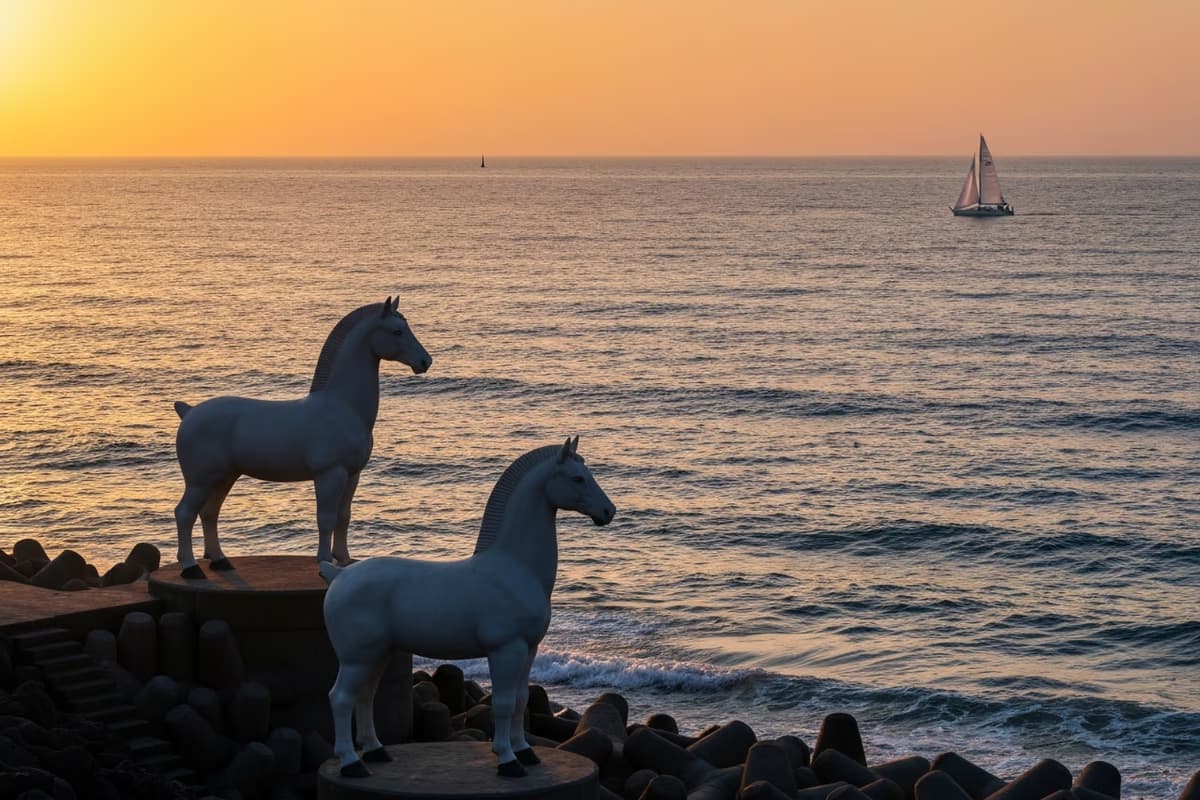
After a flight lands at Jeju International, the time from "wheels down" to "rental car keys in hand" usually runs about ninety minutes. The cleanest itineraries leave a clear first stop on the other side of that ninety minutes — and the cleanest of the clean is the one that sits ten minutes from the airport on the coast, just south of the runway. The lighthouses on the breakwater off Iho Tewoo Beach.
The Korean name is mok-ma (목마, 木馬) — literally "wooden horse." In this case it means two small wooden lighthouses, each carved in the shape of the island's native Jeju pony. One red, one white, facing each other across the entrance of a short channel at the end of a low breakwater. The composition is genuinely uncommon on the Korean peninsula, which is why this short coastal stop has become the standard first-day-after-landing or last-day-before-departure image of an entire generation of Jeju trips.
10 Minutes From the Runway to the First Coast Shot
The straight-line distance from Jeju International Airport to the Iho Tewoo Beach entrance runs about <strong>5 km / 3 miles</strong>; a quiet 10-minute drive on the city ring road, no fee, no parking puzzle. The beach sits inside the Jeju City limits rather than out on the rural west or east coast, which is what makes it work as either a first-day arrival shot or a last-evening departure shot. The schedule does not have to be padded with a long drive in either direction; an aircraft's 90-minute boarding window leaves enough room for a short visit here.
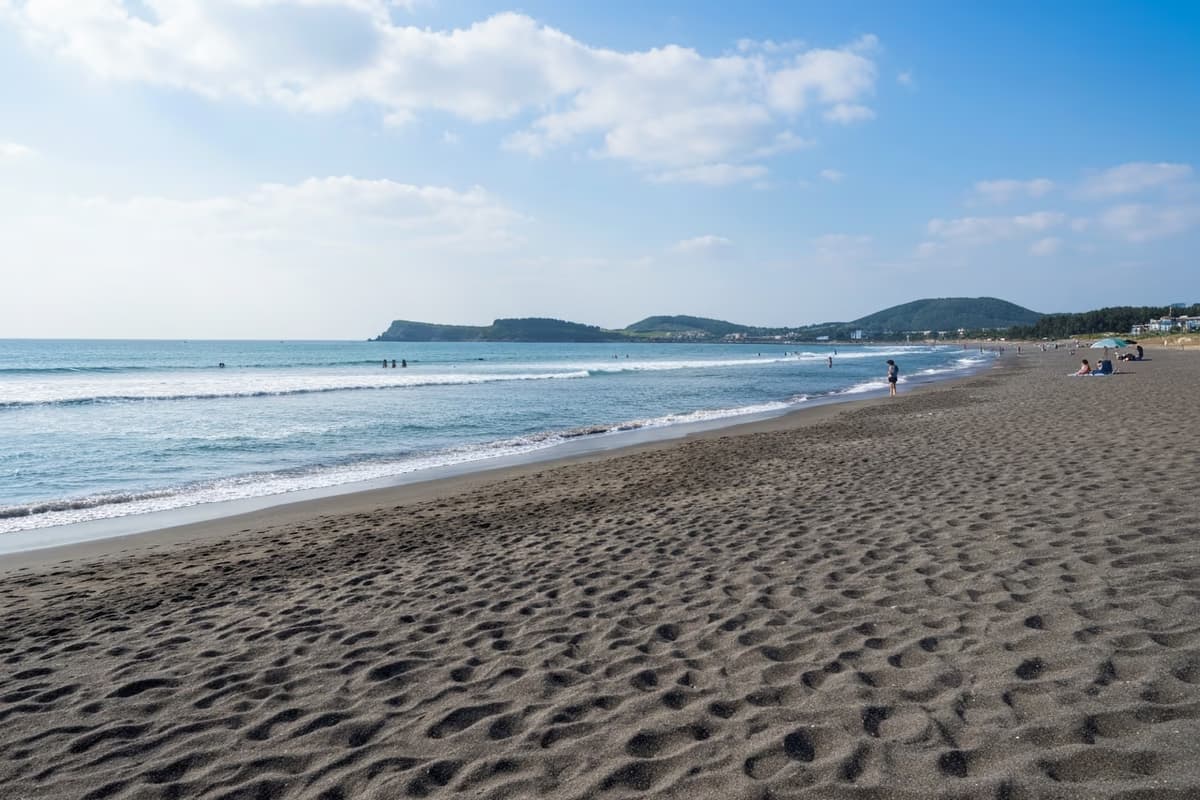
The beach itself reads differently from the white-shell coves of the western coast. The sand is dark grey, almost charcoal. This is heuksa (흑사, "black sand") — finely ground volcanic basalt rather than crushed coral and shell. The colour does not lift the water into the bright emerald that Hyeopjae and Geumneung produce at midday, but at sunset the dark surface holds the orange of the dying light a half-stop longer, and the dusk reads warmer here than on a white beach. For Western visitors who have walked the black-sand beaches of Iceland (Reynisfjara), Hawaii's Punaluʻu, or Tenerife's Playa Jardín, the registration of the colour is familiar; the calmer protected-cove conditions of Iho Tewoo make it a more wadeable version.
The beach is about <strong>250 metres (820 feet)</strong> across — modest relative to Hyeopjae's 900 m crescent. The compact size is offset by the proximity to the airport. As a family-friendly short swim spot, an arrival-day photograph, or a pre-flight last walk, the 250 metres are entirely sufficient.
Two Wooden Ponies — Red and White, Facing Each Other
From the beach, a short walk roughly 200 metres east lands at the start of the breakwater. The breakwater juts a short stretch into the open water, and at its two end-points — the points furthest from shore — the two small pony lighthouses stand. The eastern end carries the red pony; the western end carries the white.
Each lighthouse stands about <strong>12 metres (40 feet)</strong> tall, modest as marine signal structures go. The compactness, though, is what makes them work in the frame. Most lighthouses are concrete cylinders or whitewashed stone towers — functional, geometric, anonymous. The Iho Tewoo lighthouses are sculpted into the recognisable form of the Jeju native pony — head, mane, tail all clearly defined — and the silhouettes against the sky read as figurative rather than industrial. There is no other Korean coast that holds this image at this scale.
The red-and-white pairing is not stylistic. Korean harbour signalling follows the international IALA-A convention used across most of the world (excluding the Americas, Japan, the Philippines, and Korea's east coast which use IALA-B): a vessel entering the harbour sees the red light on its starboard (right) side and the white light on its port (left). The two ponies are not just sculpture — they are working navigation aids reading their assigned colours in the correct geometry.
The Night Window — Magic Hour Through Midnight
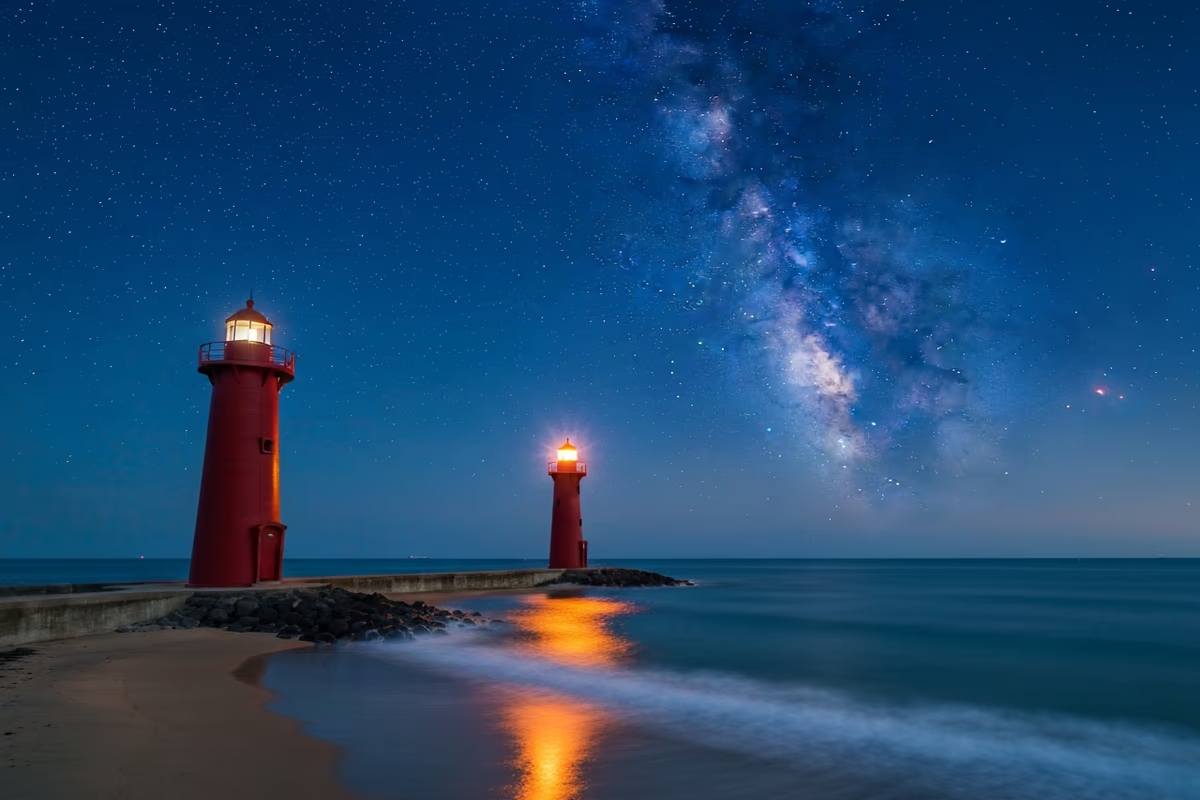
The headline image of Iho Tewoo is the night composition. About <strong>15 minutes after the published sunset</strong>, the lights on both lighthouses come on and begin their assigned blink pattern — red light on the red pony, white light on the white pony, at the regular intervals of standard harbour signal. The same blink pattern is everywhere in the world; what makes the Iho Tewoo version photograph differently is the pony silhouette wrapped around the light source.
The best window opens about 20 minutes wide. As the sky transitions from violet through cobalt into deep blue, the lighthouse lights gain visual weight against the darkening background and the breakwater catches short, defined shadows. Landscape photographers position cameras to put the sunset afterglow, both lighthouses, and both blinking lights all within a single frame; the alignment is geometrically narrow and the time window is short, which is why long-exposure tripods often line up across the breakwater end-point an hour before sunset.
The blink continues through to <strong>midnight</strong>. The composition holds even after the magic-hour colour fades — under city light from Jeju City spreading across the western horizon, the two compact lights pulsing in steady rhythm hold a quieter version of the same shot well into the night.
The Walk Along the Breakwater — And Where Photographers Set Up
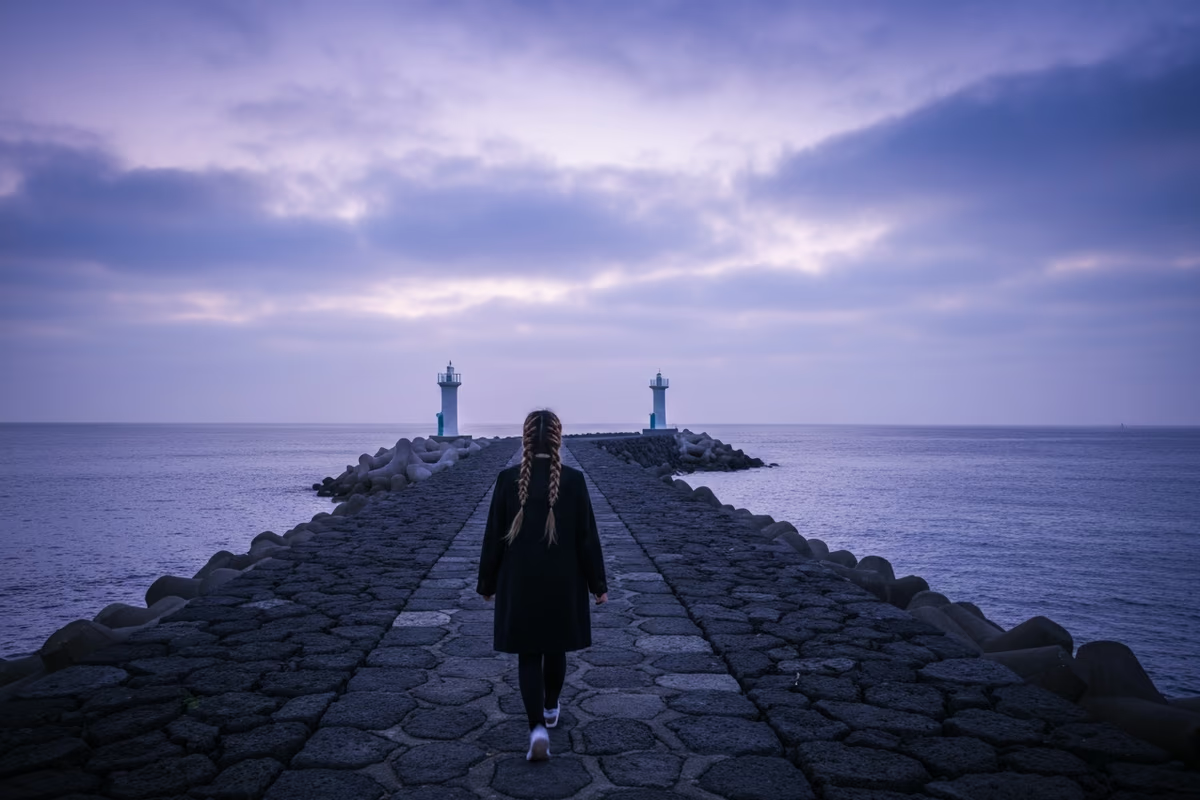
The breakwater itself is narrow and the open water sits on both sides; the walk is slow and steady rather than casual. On calm evenings, the walk between the two lighthouses is the right way to take the shot in — there is no comparable substitute for moving through the composition rather than standing outside it. The simple etiquette is to give space to tripods already in position and to keep the head torch low.
On days with strong wind or a high-seas advisory, the breakwater can take spray over the inner rail and the walk is closed off; haze and sea fog do the same. The Korea Meteorological Administration carries the day-of forecast at weather.go.kr, and a 30-second check before leaving the rental car is the right move on changeable evenings.
The most photographed spot is the end-point on the red side. From there, the red lighthouse foregrounds the frame and the white lighthouse aligns precisely behind it, with the sunset afterglow filtering between the two. Tripods commonly form a single line at this end-point by an hour before sunset on a calm evening; arriving early to claim a position is the conservative approach when the geometry of the shot matters.
25 Minutes West to Galchibada — The First Dinner on the Island
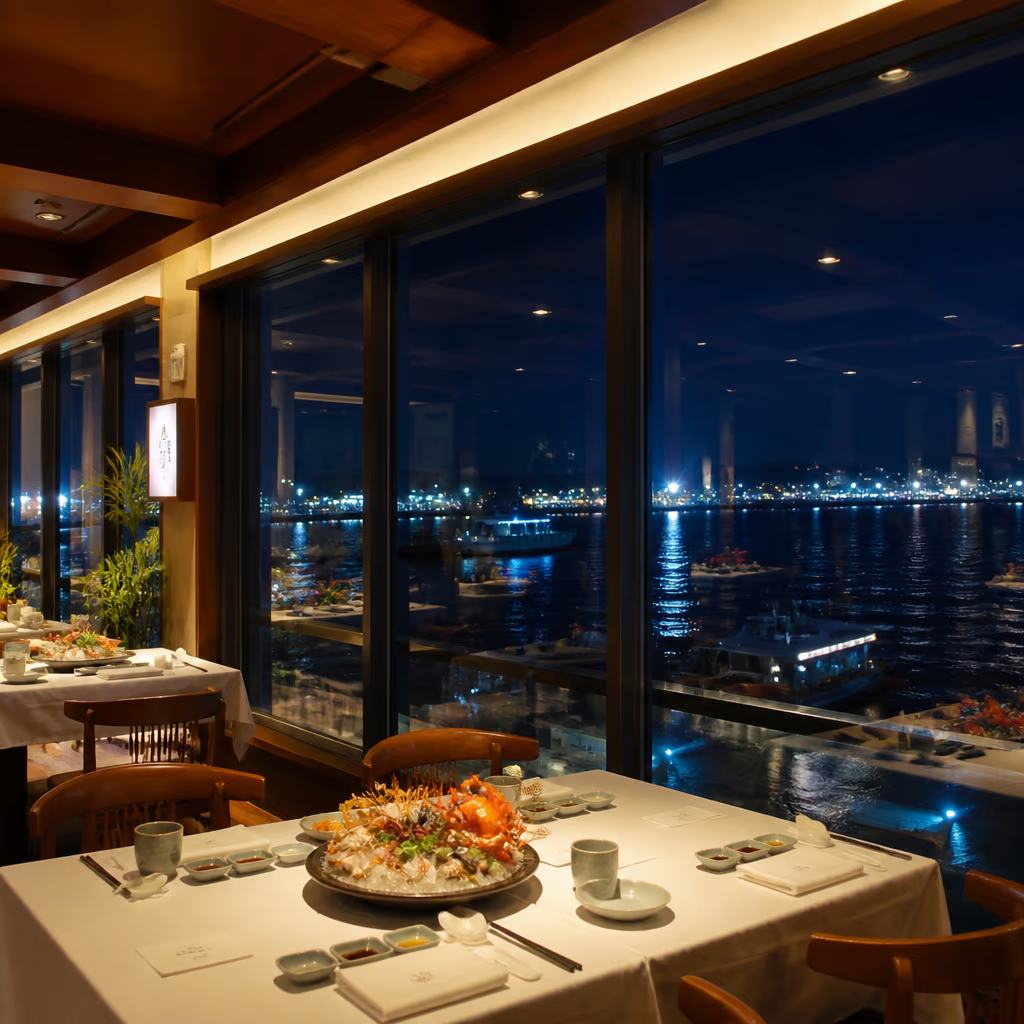
When the magic-hour colour has faded and only the two blink patterns remain visible against the night, the natural transition is to move west along the coast. From the Iho Tewoo parking lot, Route 1132 runs about <strong>20 km / 12 miles</strong> westward, putting the drive to Galchibada in Aewol → at about <strong>25 minutes</strong>.
After a short walk and a first photo on landing day, fatigue from the flight does begin to register in the legs. A floor-to-ceiling ocean-view table with the city lights and the dark water visible through the glass is the natural close — and a wild-caught silver hairtail landed off this coastline that morning sits on the plate. As either the opening dinner of the trip or the closing meal before tomorrow's departure, the timing fits without compromise.
Getting There, Practical Notes
The address is Doduildong, Jeju City. Drive time from Jeju International Airport runs about <strong>10 minutes</strong>; from the Jeju Intercity Bus Terminal, about 7 minutes by car. City bus route 444 (among others) stops at the Iho Tewoo Beach stop; real-time bus position lives at the Jeju Bus Information System. Seasonal night-access windows and any temporary breakwater closures update at Visit Jeju in English.
Parking sits at the public car park beside the beach. Off-season is free; peak summer may apply hourly fees. On the sunset window, the car park can fill quickly — <strong>arriving 30 minutes before published sunset</strong> is the right buffer.
A short packing list. For night photography, a tripod is functional rather than optional; the magic-hour window is short and exposure times stack up. The breakwater wind is meaningfully stronger than at the beach proper — a light windbreaker keeps the long-exposure window comfortable rather than just bearable. The concrete surface is rough and uneven in places; sneakers handle the walk better than sandals. On any day with a high-seas advisory, breakwater access can be closed at short notice, so a glance at the forecast before leaving the rental car is the cheap insurance.
A short coastline holds, simultaneously, the first photograph of an arrival day and the last photograph of a departure day. Two compact wooden lighthouses, shaped like the island's native pony, blinking in the assigned harbour rhythm across a dark grey beach. A short walk, a steady frame, and then 25 minutes west to a coastal table where the same coast carries a different register on the plate. The first arrival hour and the last departure hour, met by the same two lights pulsing on the same breakwater — and met one more time at the table.
Frequently Asked Questions
- What exactly are the Iho Tewoo pony lighthouses?
- A pair of working harbour lighthouses on the breakwater at Iho Tewoo Beach in Jeju City, each about 12 metres / 40 feet tall, carved in the figurative shape of the Jeju native pony. The eastern lighthouse is red, the western one white — following the international IALA-A harbour signalling convention (red on starboard, white on port for inbound vessels). They are working navigation aids, not just sculpture.
- How long does it take to get from Jeju International Airport to Iho Tewoo?
- About 10 minutes by car — roughly 5 km / 3 miles along the city ring road, no toll. The proximity is what makes the beach work as an arrival-day first stop or a departure-day last stop without padding the schedule with a long drive.
- When is the best time to photograph the Iho Tewoo lighthouses?
- About 15 minutes after sunset, the lights come on and begin their standard blink pattern. The 20-minute magic-hour window after that — sky transitioning from violet through cobalt into deep blue — is the window most landscape photographers actually wait for. The blink continues through to midnight, and the composition holds in deeper night under city light spreading across the horizon.
- Why is Iho Tewoo Beach sand dark grey rather than white?
- Iho Tewoo is the rare black-sand (heuksa) beach on Jeju — finely ground volcanic basalt rather than crushed coral and shell. The west-coast beaches (Hyeopjae, Geumneung) have white carbonate sand that lifts the water to bright emerald in midday sun; Iho Tewoo holds dusk light a half-stop warmer thanks to the dark surface, which is part of why the sunset and night composition reads strongly here.
- How long is the drive from Iho Tewoo to Galchibada in Aewol?
- About 25 minutes west via the coastal Route 1132 — roughly 20 km / 12 miles. As either the opening dinner of a trip or the closing meal before tomorrow's departure flight, the timing fits cleanly between the night-light photo session and a sit-down ocean-view table.
- Is the breakwater walk safe at night?
- On a calm evening, comfortably — the breakwater is paved with concrete and a low rail runs along the inner edge. On days with strong wind, a high-seas advisory in effect, or heavy fog, the breakwater can take spray over the rail and access may be closed at short notice. A 30-second check of the Korea Meteorological Administration marine forecast at weather.go.kr before leaving the rental car is the simple safety move.
From the first lighthouse to the first coastal table — 25 minutes west
Carry the harbour blink onto the plate
When the harbour blink has settled into rhythm and the magic-hour colour has faded into deep blue, the natural transition is west along the coast. Twenty-five minutes from the breakwater, a floor-to-ceiling window opens onto a dark stretch of the same sea, and a wild-caught silver hairtail braised in a spicy sauce closes the arrival night from the table — the first or last image of the trip carried onto the plate.
25 minutes west from Iho Tewoo to Galchibada Aewol via Route 1132 →