Handam Coastal Walk at Golden Hour — Jeju Aewol Sunset Guide
A Photographer's Field Notebook for the 1.2-km Aewol Sunset Trail
Handam Coastal Trail in Aewol, Jeju is a 1.2-km flat walk from Gwakji Beach to Aewol Harbor (20-30 minutes one way), facing due west on the island's sunset coast. The golden hour begins 40 minutes before posted sunset, with three distinct light phases — high-angle gold, low-angle amber, and cobalt blue hour. Free admission, year-round access, wheelchair-accessible boardwalk sections.
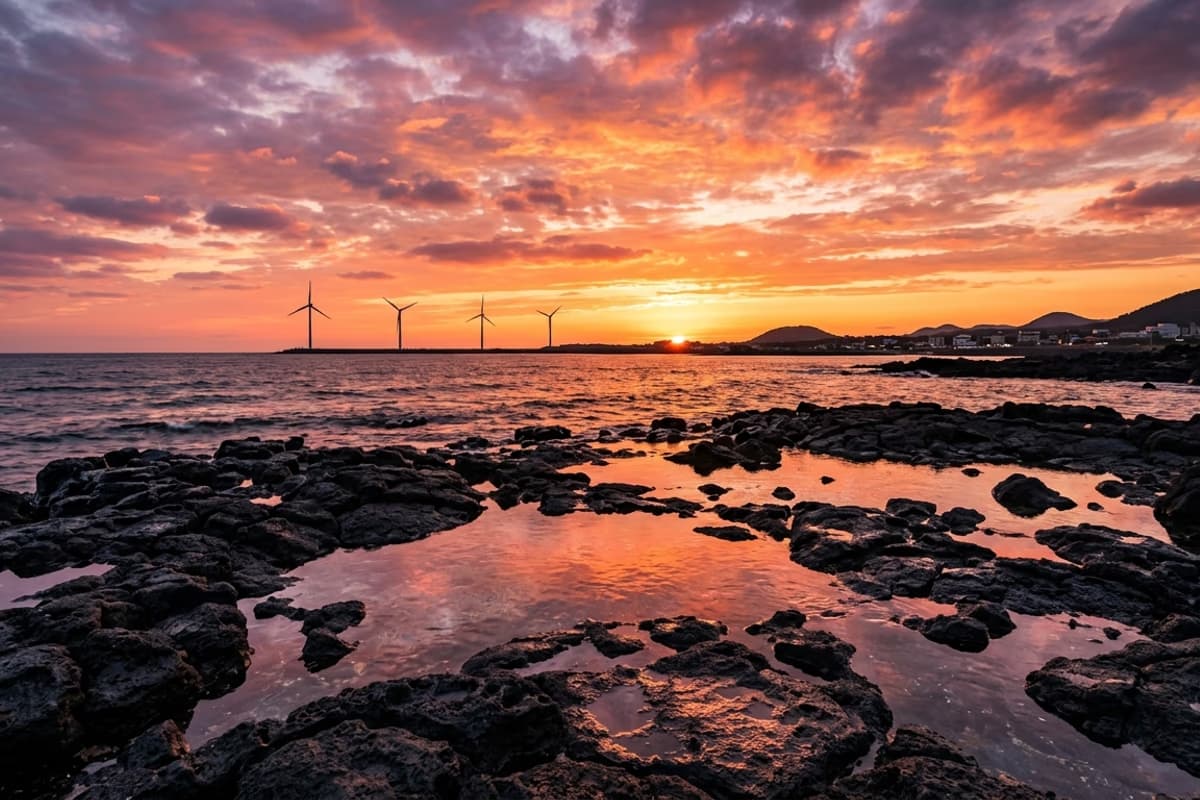
The light at Handam doesn't arrive all at once. It builds in three phases — high gold, low amber, and the cobalt blue that comes after the sun is technically gone — and the 1.2-kilometer trail along Jeju's west coast happens to be one of the few places in Korea where a single hour of walking takes you through all three, on a flat boardwalk, without a tripod if you don't want one.
This piece is for travelers who want to time the walk to the light rather than treat the coastline as a checkmark. I'll explain how the shore's due-west orientation creates a longer-than-usual golden hour, why volcanic basalt holds shadow differently from sand or concrete, and which 200-meter midsection gives you the sun, the open sea, and the distant Hallim wind turbines in a single frame.
The 1.2-Kilometer Walk: Topography of a Geologic Coastline
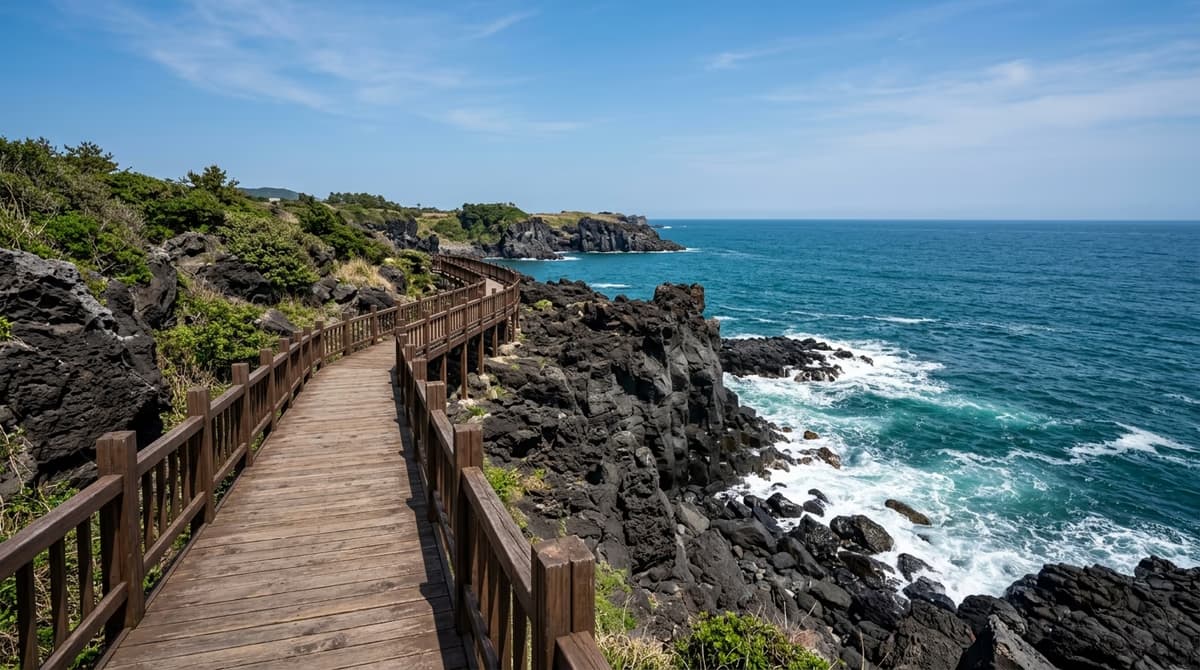
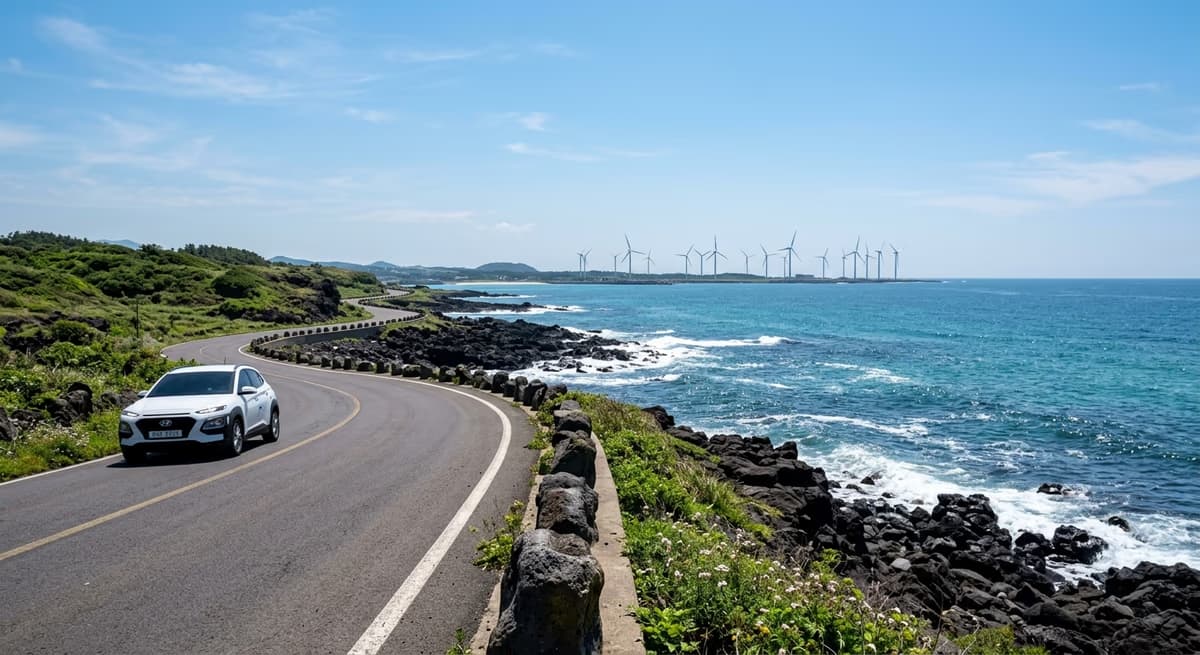
Handam Coastal Trail runs 1.2 kilometers (0.75 miles) between Gwakji Beach and Aewol Harbor, on the west coast of Jeju Island. Most of the path is wooden boardwalk; intermittent sections cross bare basalt — the volcanic stone that defines this stretch of coastline. The trail is flat from end to end and takes 20 to 30 minutes one way at a casual pace.
Boardwalk sections are wheelchair-accessible; bare basalt sections require uneven footing. Admission is free, the trail is open year-round, and the closest free public parking is at Gwakji Gwamul Beach lot, a 2-minute walk from the trailhead.
What gives the coastline its character isn't height but pattern. The basalt here was formed by lava flows that hit the sea and cooled into irregular columns. Walking slowly, you'll notice hexagonal cross-sections where columns broke off cleanly, and tide pools where seawater carved smooth basins into the rock over centuries. According to the Korea Tourism Organization English portal, this stretch belongs to the broader Jeju volcanic landscape inscribed on the UNESCO World Heritage list in 2007.
There's a small but consistent pleasure to the surface change. Five steps on boardwalk, three on raw rock, four more on boardwalk — the rhythm of foot textures keeps a 30-minute walk from feeling like a hallway.
Golden Hour at Handam — A Photographer's Three-Phase Notebook
Because the trail faces due west, the sun crosses your sightline rather than passing behind you or in front. This produces a longer effective golden hour than most coastal trails: roughly 40 minutes from the moment the light turns warm to the moment it shifts blue.
Three phases worth knowing in order:
Phase 1 — High-angle gold (40 to 25 minutes before sunset). The sun is still above 10 degrees over the horizon. Basalt reads as deep brown rather than black; water shifts from emerald to gold-tinged teal. Best for wide compositions that include the whole coastline. Camera starting point: ISO 100, f/8, 1/250.
Phase 2 — Low-angle amber (25 to 5 minutes before sunset). The sun touches the upper edge of the wind turbine line on the Hallim peninsula in the distance. Long shadows fall from the basalt onto the boardwalk. Best for portraits and contrast-heavy shots; the shoreline becomes a graphic black silhouette against the lit sky. Adjust to ISO 200, f/5.6, 1/125 as the light drops.
Phase 3 — Blue hour (sunset to 25 minutes after). The sun is technically gone but the sky holds deep cobalt for another 20 to 30 minutes. Long-exposure territory if you brought a tripod. Water turns metallic silver-blue. Best for minimal compositions with one rock and one horizon. Shift to ISO 400-800, f/4, 2-second exposure or longer.
Exact daily sunset times for your travel date are at the Korea Astronomy and Space Science Institute. Plan to arrive at the trailhead 50 minutes before posted sunset — 10 minutes to walk to a position you like, 40 minutes for the full light arc, 25 minutes more for the blue hour. A full visit is closer to 90 minutes than 30.
Four Seasons, Four Shorelines
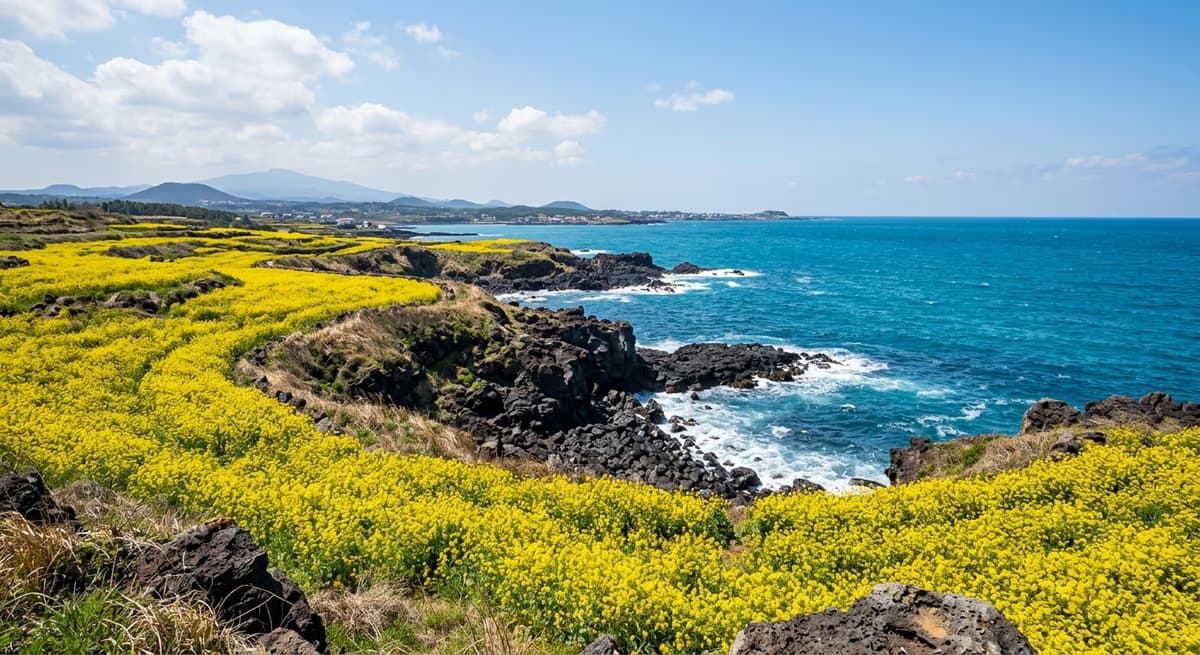
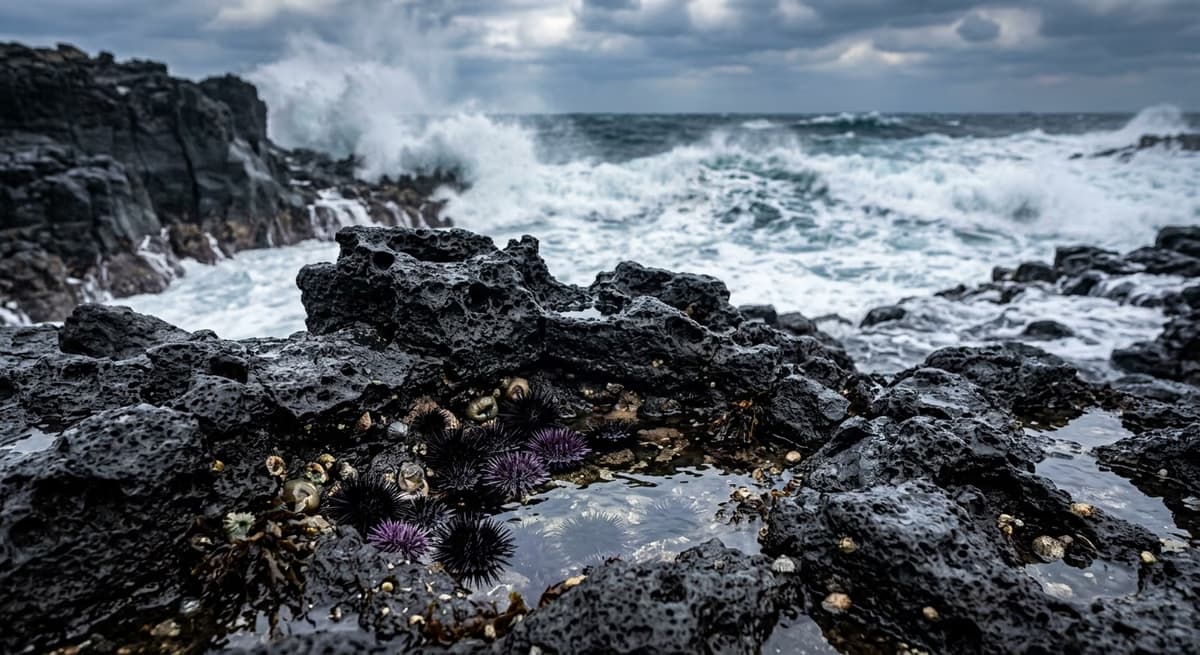
The same 1.2 kilometers reads differently across the year. The math of latitude, prevailing wind, and seasonal humidity rewrites the trail in four distinct moods.
Spring (March-May). Yellow rapeseed flowers bloom on the slope above the trail. The sea is often glass-calm in the mornings. Average wind speed drops to 3 m/s. Sunset around 7:00 p.m. by late April. The cleanest light of the four seasons, but with shorter golden hours than autumn.
Summer (June-August). Cumulus thunderheads rise above the western horizon in late afternoon, creating backlit storm structures during golden hour. Humidity and haze can soften long-distance contrast — distant wind turbines may not read cleanly. Sunset around 7:45 p.m. in early July. The most dramatic skies of the year.
Autumn (September-November). Silvergrass on the slopes catches the low light. The clearest air of the year — visibility extends across to the Korean mainland on the best days. The longest golden hours, with the slowest transition to blue. Sunset retreats to 5:45 p.m. by mid-November.
Winter (December-February). Northwest gale winds drive white surf onto the basalt. Sunset around 5:30 p.m. — the earliest of the year. Bring a windproof shell: sustained wind speeds reach 12 m/s and gusts can exceed 20. Photographers come for this season anyway, because the surf-on-basalt contrast is unmatched.
When to Arrive — The Light Equation
For a single visit at golden hour, the timing logic is unusually simple:
- 50 minutes before posted sunset: arrive at the trailhead, park free at Gwakji Gwamul Beach lot.
- 40 minutes before: start walking. Aim for the basalt midpoint by minute 10.
- 30 minutes before: Phase 1 (high gold) begins.
- 10 minutes before: Phase 2 (low amber) peaks. Best portrait window of the day.
- At sunset: silhouette phase. Wind turbines on the horizon become graphic.
- 20 to 30 minutes after: Phase 3 (blue hour) holds until full darkness.
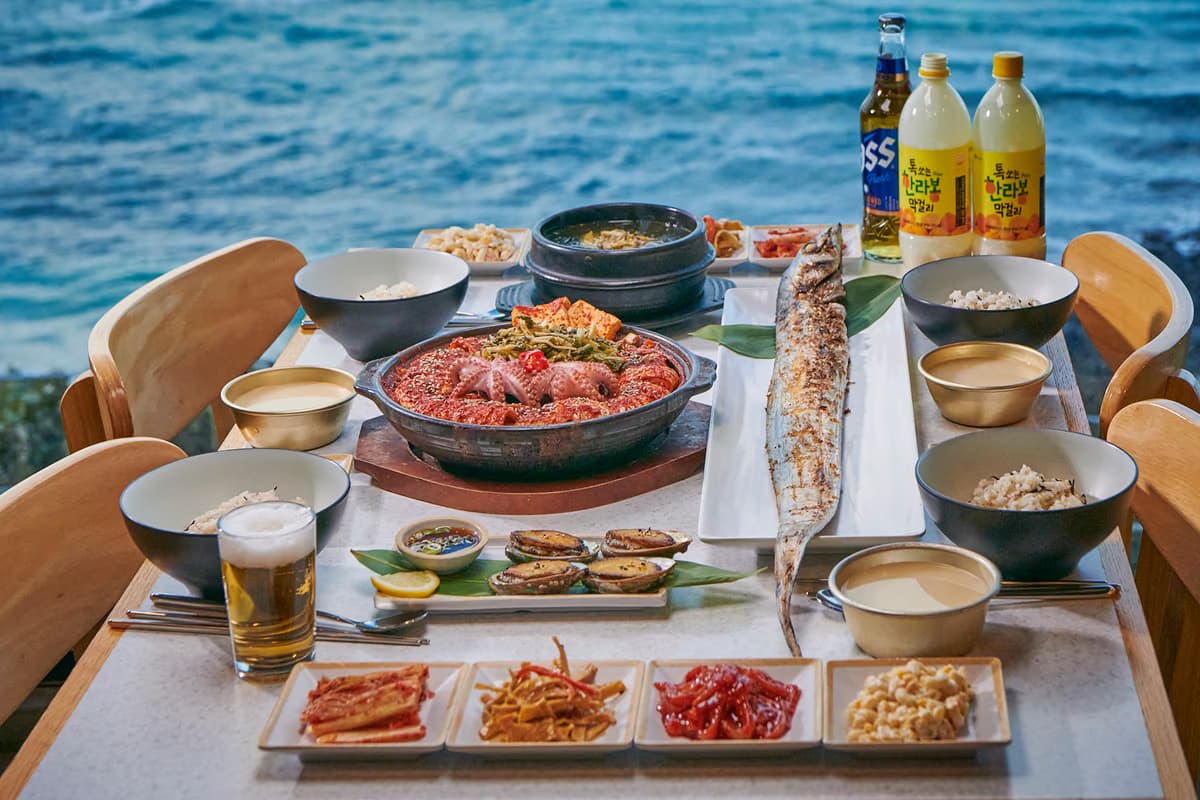
After dark, Galchibada in Aewol is a 1-minute walk from the trail's end along the harbor's east side. Many travelers chain the sunset walk into dinner there — the restaurant's full-height west-facing windows continue the same horizon line you just photographed. For the meal side of the same coastline, see the trail-to-table experience at Galchibada →.
Frequently Asked Questions
How long does the walk take?
20 to 30 minutes one way for the 1.2-km trail at a casual pace. For the full golden-hour arc with photo stops, plan on 90 minutes from trailhead to blue-hour finish.
Is it accessible for wheelchairs or strollers?
Yes for the boardwalk sections — about 70 percent of the trail. Bare basalt sections require uneven footing. The first 200 meters from the trailhead are entirely boardwalk and fully accessible.
When does the best light hit?
40 to 5 minutes before sunset, in three distinct phases (high gold, low amber, then silhouette). Daily sunset times are listed at the Korea Astronomy and Space Science Institute portal.
Is there parking near the trail?
Free public lot at Gwakji Gwamul Beach, a 2-minute walk from the trailhead. Capacity for about 40 vehicles; arrive 50 minutes before sunset to avoid the late rush.
What's nearby for dinner after the walk?
Galchibada (Galchibada Jeju Aewol) is a 1-minute walk from the trail's end along the harbor's east side. The restaurant's west-facing windows hold the same horizon line you just photographed.
Frequently Asked Questions
- How long does the walk take?
- 20 to 30 minutes one way for the 1.2-km trail at a casual pace. For the full golden-hour arc with photo stops, plan on 90 minutes from trailhead to blue-hour finish.
- Is it accessible for wheelchairs or strollers?
- Yes for the boardwalk sections — about 70 percent of the trail. Bare basalt sections require uneven footing. The first 200 meters from the trailhead are entirely boardwalk and fully accessible.
- When does the best light hit?
- 40 to 5 minutes before sunset, in three distinct phases (high gold, low amber, then silhouette). Daily sunset times are at the Korea Astronomy and Space Science Institute portal.
- Is there parking near the trail?
- Free public lot at Gwakji Gwamul Beach, a 2-minute walk from the trailhead. Capacity for about 40 vehicles; arrive 50 minutes before sunset to avoid the late rush.
- What's nearby for dinner after the walk?
- Galchibada (Galchibada Jeju Aewol) is a 1-minute walk from the trail's end along the harbor's east side. The restaurant's west-facing windows hold the same horizon line you just photographed.
After the blue hour, a 1-minute walk to a west-facing window
The same horizon, now framed in glass
Once the blue hour starts to settle and the basalt has cooled under your shoes, the dining room sits one minute east of the trail's end. The west-facing window holds the same horizon line you just photographed, and a wild-caught silver hairtail arrives whole on a platter as the last cobalt fades to indigo.
1 minute on foot from the trail's end to Galchibada in Aewol →