Camellia Hill — 500 Cultivars in Jeju's Winter Garden
Asia's Largest Camellia Arboretum, Built Over Three Decades by One Private Collector
Camellia Hill (카멜리아힐) sits in Sanchang-ri, Andeok-myeon in Seogwipo City, on the southern slope of Hallasan. The 1.5 km / 0.9 mile garden loop takes 40–50 minutes at a comfortable pace, almost entirely on paved, level paths suitable for strollers and wheelchairs. Bloom season is November–March, with peak flower density in January–February. Adult admission KRW 9,000 (~USD 7), youth KRW 7,000, child KRW 6,000. The drive to Aewol on the west coast — and to dinner at Galchibada — is about 50 minutes via the Pyeonghwa-ro and Hallim coastal route.
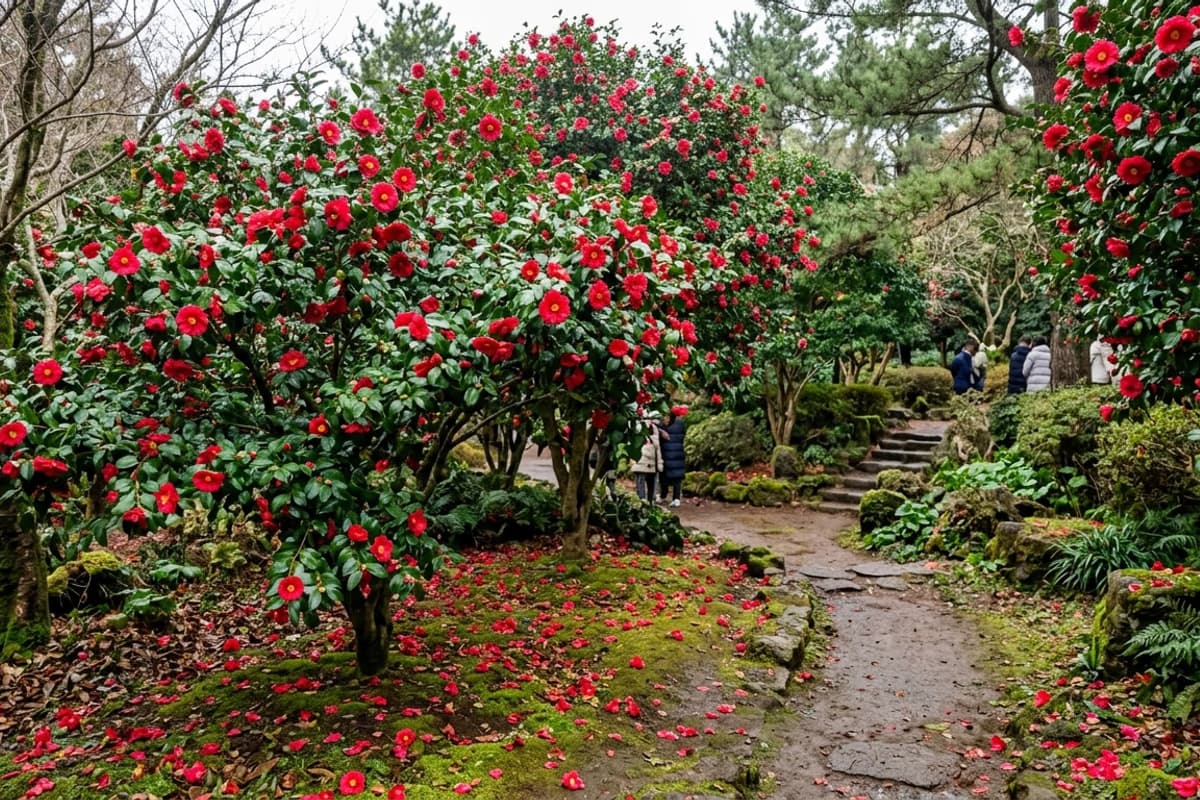
There is an argument that Jeju's winter is its most beautiful season, and Camellia Hill is the place that proves it. On the gentle southern slope of Hallasan, in Sanchang-ri of Andeok-myeon, this arboretum holds 500 camellia cultivars and more than 6,000 individual trees collected across <strong>eighty countries</strong>. The "largest in Asia" superlative gets used loosely in travel writing, but here it is earned — every few steps, the colour, the petal form, and even the leaf texture shift to something genuinely different. For visitors familiar with the camellia collection at the Huntington Library in San Marino, California, or with the National Trust's camellia hollows at Mount Edgcumbe in Cornwall, this is the East Asian peer to those gardens at a scale that finally makes the comparison fair.
Camellia season runs <strong>November through March</strong>, but the density peaks in January and February. Visit then and the path becomes a quiet exercise in attention — single crimson petals fallen on moss, on stone walls, between the dark green leaves above and the matted leaf-litter below. The story behind the garden runs almost as long as the cultivars themselves. The current 170,000 m² (42-acre) site was first planted in 1984 by a private collector who spent three decades acquiring specimens; the garden opened to the public in 2008 and has continued importing varieties from Italy, Japan, China, the United States, and beyond. Today the collection also functions as a working botanical research archive, with cultivar-level data and photographic records that draw a small steady stream of taxonomists.
The Loop, Honestly
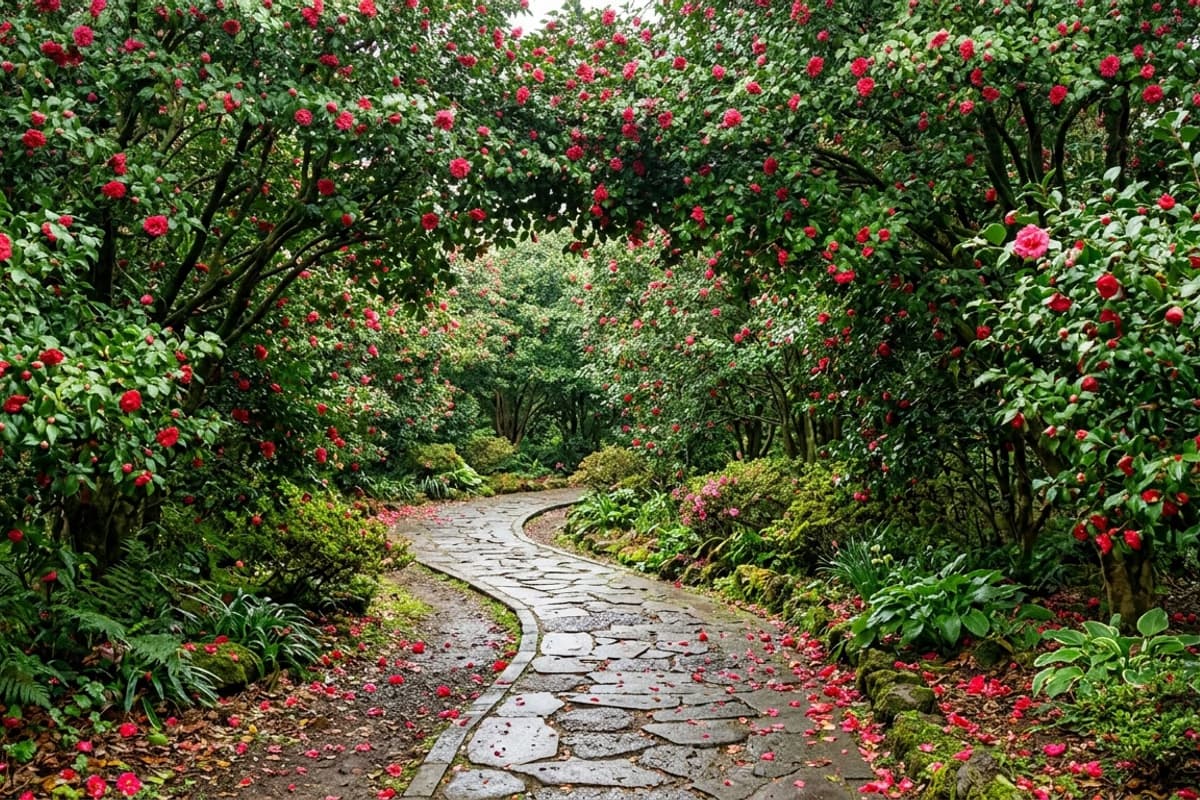
The garden loop is about 1.5 km / 0.9 miles long and walks in 40 to 50 minutes at a comfortable pace. Starting at the entrance and walking clockwise carries you through the cultivar showcase, into the native camellia woodland, through a Japanese cypress (Hinoki) grove, and out past the photo plazas. The whole loop is essentially flat — strollers and manual wheelchairs handle nearly all of it without difficulty, and the small handful of unpaved sections are looped with bypass paths for accessibility.
The most photographed stretch is a long curve where the camellias arch together overhead, and afternoon light filters through the petals like a kind of stained glass — the translucent red glow on the path is the image most visitors leave with. Numbered photo markers around the loop point out the recommended compositions, so you do not have to hunt for them.
Short benches and a couple of shade pavilions sit along the route, which is the practical detail that lets an older companion walk the full circle without rationing energy. The furthest point of the loop is the Hinoki grove — the camellia momentarily disappears and the air goes sharp with phytoncide, and that single breath is part of why the route is staged this way. From December through February, the low winter light comes in almost horizontally, casting long shadows; <strong>1 to 3 p.m.</strong> is the photographer's window for warm, raking sidelight. The first hour after opening is the quieter alternative — colour without the crowd.
Five Hundred Cultivars, Each With a Name
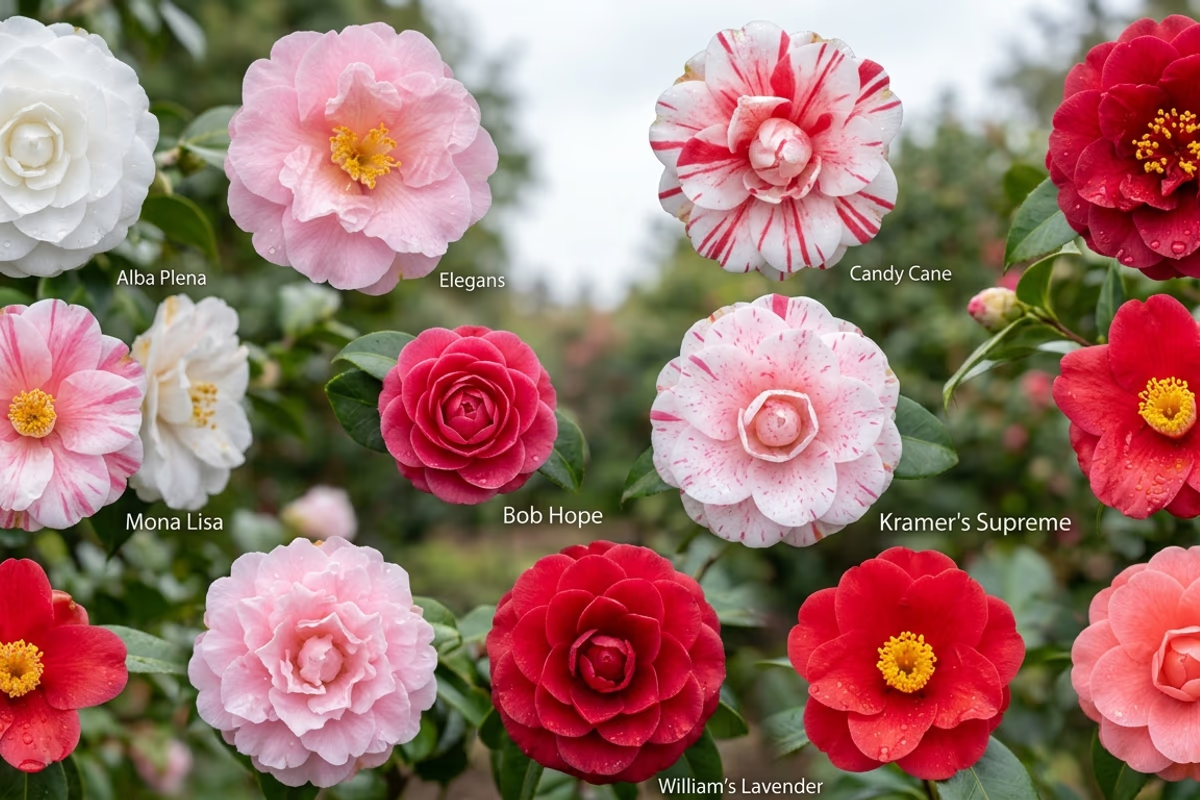
The cultivar showcase is the heart of the visit. Korean natives, European miniature camellias, and Japanese wabisuke cultivars sit in the same garden — a juxtaposition that exists in very few places worldwide. Each tree carries an ID plate; the educational density alone is worth an hour. The general assumption that camellia means "a red flower" comes apart here within ten minutes — white, pink, variegated, doubled, ruffled, and the rare yellow Camellia chrysantha from China's Yunnan are all on quiet display.
The camellia's famous habit of dropping the entire bloom intact from the branch — rather than dropping individual petals — produces the garden's signature still life: a single fallen flower resting on moss as if placed there by hand. The standing rule of the garden is to leave the fallen blooms exactly where they sit, which is also (not coincidentally) the condition for the best photographs.
Deeper into the showcase, the interpretive panels list scientific name, country of origin, and average bloom period for each cultivar — for anyone with even casual botanical interest, the walk doubles as a compressed field guide. Japanese wabisuke with its small, restrained petals; the heavier doubled blooms of the California cultivars; the unusual yellow tones of the Yunnanese chrysantha series — having all three within a single Korean garden is essentially unique on the peninsula. Some cultivars leave the branch within 24 hours of opening, so the same spot can hold a completely different image one day later — which is why a small population of photographers makes two or more visits within a single season.
The Garden in Four Seasons
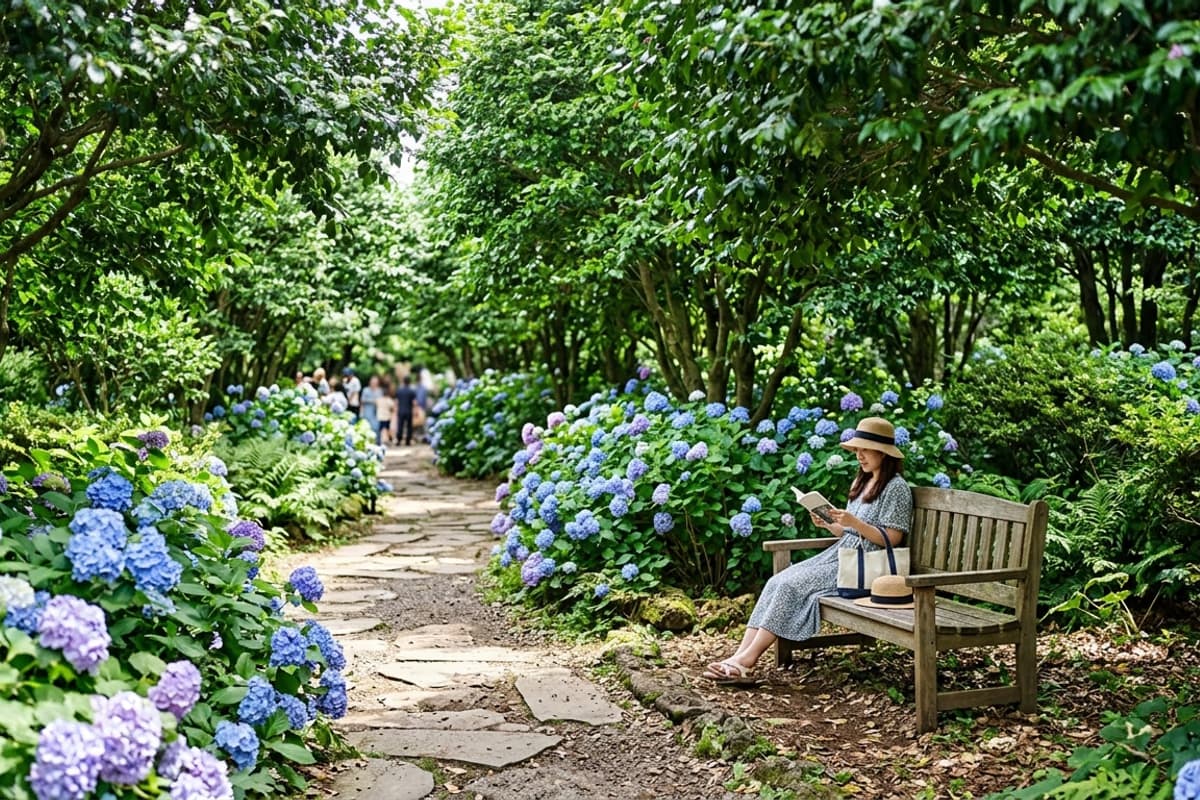
Outside the camellia season, the garden is still worth the entrance. April and May bring hydrangea and tulip into the camellia gaps; summer turns the whole space into a green tunnel where the shade walk is its own argument. Autumn carries silver grass and pink muhly into the same beds, and the garden palette shifts again into a softer pink-pastel range that produces a markedly different set of photographs.
Seasonal programmes run through the year — tangerine pot-making, camellia-oil soap workshops, and similar small craft sessions. Admission is <strong>KRW 9,000 (~USD 7) for adults, KRW 7,000 for teens, KRW 6,000 for children</strong>, with online advance purchase offering a small discount. The official site publishes current bloom conditions and programme schedules in Korean and English.
In summer, the shade loop turns into something close to a quiet forest-bathing course; the dappled light on the path is genuinely photogenic and families with small children gravitate to this stretch. The autumn pink muhly window is short — late September into early November — and the pink muhly plaza about 15 minutes in serves as the headline backdrop. The on-site café sells camellia-extract desserts and a Jeju tangerine latte that work as a mid-loop reset, and the welcome desk hands out free wheelchairs and strollers — a 5-minute setup before entering the loop keeps a mixed-pace group walking together comfortably.
Onward — The West-Coast Drive
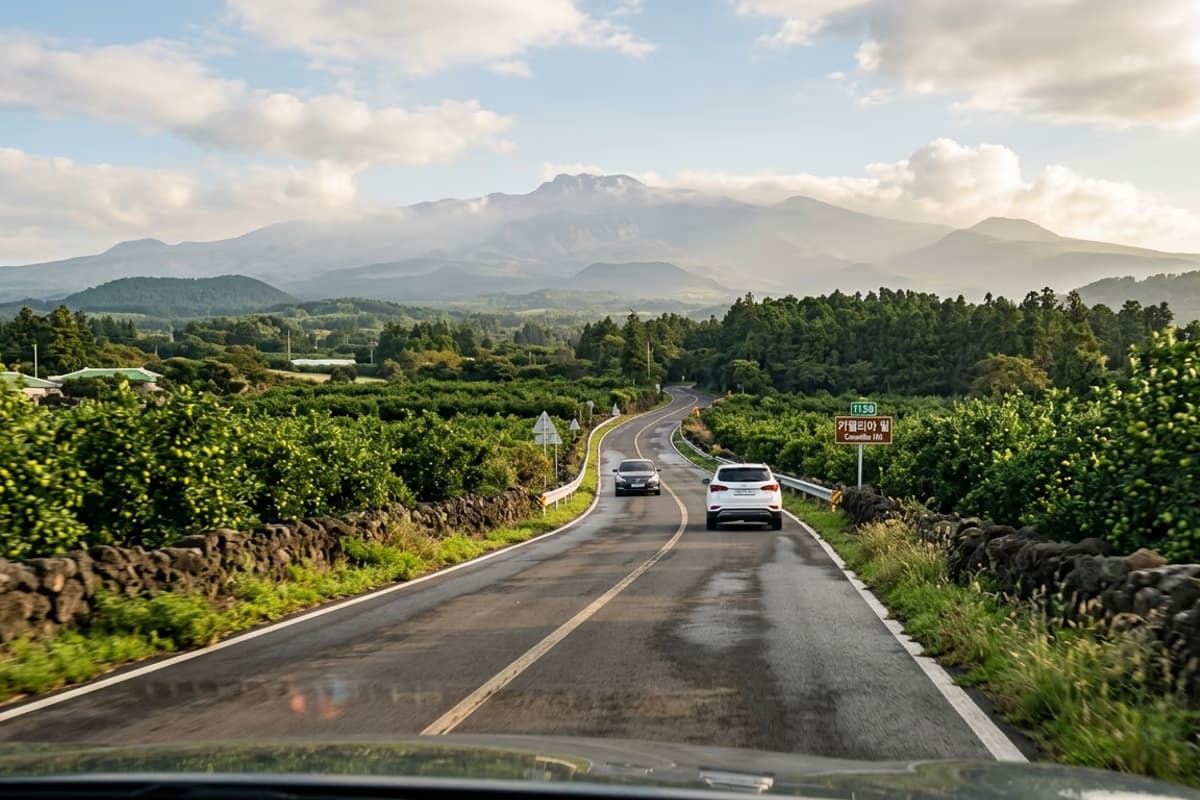
The garden sits about 15 minutes from the Jungmun resort cluster and 20 minutes from the O'Sulloc Tea Museum, which makes it easy to weave into a southwestern half-day. Camellia Hill in the morning, O'Sulloc — or Sanbangsan and the Yongmeori coast — in the afternoon, with the time budget falling naturally into place.
Heading north from the garden through Hallim, the drive to Aewol on the west coast takes about <strong>50 minutes</strong>. Pairing the lingering red of the camellias with the coastal road timed to sunset and a sit-down dinner is one of those itineraries where the day designs itself.
The Pyeonghwa-ro (West Loop Road) north of the garden runs about 40 minutes through mid-mountain countryside with the western face of Hallasan filling the driver's left window. Past Hallim Harbour, the coastal road takes over: the white blades of the wind farm cut the frame, the saturation of the sea drops a half-stop, and the temperature of the light starts to warm. With time in the budget, a quick stop at Hyeopjae Beach to look out at Biyangdo, then a short walk along the Handam coastal path → before the dinner table, is the route that keeps the day's afterimage longest. In winter, sunset arrives early enough that <strong>leaving the garden by 4:30 p.m.</strong> is the cutoff for catching the western coast in golden hour.
One last piece of practical advice for the January–February peak. Weekend visitor count runs about <strong>three times</strong> the weekday baseline, and the ticket queue is longest between 10:30 and 11:30 a.m. Arriving before 9 a.m. on a weekday or after 3 p.m. lets you skip the queue almost entirely, and the slanted light is gentler for photography either way. Group docent tours run as a 30-minute guided walk on advance booking — a botanist guide picks out a representative dozen cultivars and walks through them properly, which is a meaningfully different visit from the unguided loop. Tour schedules and remaining slots are posted on the official site's booking page in a single legible view, which makes coordinating a mixed group straightforward. Confirm the operating hours the night before to avoid the rare seasonal closure, and pick up the small folded map at the welcome desk — it is the single most useful object in the garden for staying oriented. The shop beside the ticket counter sells camellia-oil hand cream, infused camellia-seed tea, and pressed-flower postcards at modest prices, which is a good stop for either gifts or a small private memento. The final ritual most visitors do not realise they are doing is the brief pause in the car park, facing back at the Hallasan ridgeline, before turning on the ignition — a single breath that quietly re-orients the eye before the coastal drive begins, and the cleanest possible bridge from a still garden to a wide-open western sea.
Frequently Asked Questions
- When do the camellias bloom at Camellia Hill?
- The bloom season runs from November through the following March, with the peak density of flowers falling in January and February. With 500 cultivars opening on staggered schedules, there will always be camellias in bloom across that entire window — no specific date is "too early" or "too late."
- How much is admission and what are the hours?
- Adult admission is KRW 9,000 (around USD 7), youth KRW 7,000, child KRW 6,000. The garden is open 8:30 a.m. to 6:00 p.m. (5:30 p.m. in winter), with last admission 1 hour before closing. Online advance tickets via the official site come with a small discount.
- Is it worth visiting outside the camellia season?
- Yes. Summer brings hydrangeas and a dense green canopy that turns the loop into a cool shade walk; autumn carries silver grass and pink muhly through the garden in waves. Seasonal workshops — tangerine pot-making, camellia-oil soap — run across the calendar.
- How long is the drive from Camellia Hill to Galchibada in Aewol?
- About 50 minutes via the Pyeonghwa-ro and the Hallim coastal road. A clean southwestern half-day pairs Camellia Hill in the morning with the O'Sulloc Tea Museum in the afternoon, then a coastal sunset drive into Aewol for a sit-down dinner.
- Is the loop accessible for strollers or wheelchairs?
- Most of the 1.5 km loop is paved, gently graded, and stroller- and wheelchair-friendly. The small unpaved sections have signposted paved bypasses, and the welcome desk lends out wheelchairs and strollers free of charge.
After the camellia garden, fifty minutes west to the coastal table
Carry the red of the petals down to the sea
When the red afterimage of the camellias is still on the inside of the eyelid, drop down through the mid-mountain road for fifty minutes and the western coast takes over. Beyond the floor-to-ceiling glass the sea opens again, and a single bowl on the table — a texture entirely different from the stillness of the garden — opens the first page of the evening.
About 50 minutes from Camellia Hill to Galchibada in Aewol →