Deoreok Elementary — Jeju's Rainbow Schoolhouse by Lenclos
A Design-Traveler Guide to the Rainbow Campus by Jean-Philippe Lenclos and the Color-Geography Method Behind It
Deoreok Elementary School (formerly Deoreok Branch School) in Aewol-eup's mid-mountain highland was repainted in 2012 under a Samsung Electronics project, with the palette designed by French color theorist Jean-Philippe Lenclos, founder of the color-geography method. The building uses a six-band spectrum tuned to Jeju's particular light. It is still an active school (~85 students). Public visiting is restricted to weekday evenings after 18:00, Saturdays after 13:00, and holidays 9:00 to sunset. Free admission. Galchibada in Aewol is 10-15 minutes by car.
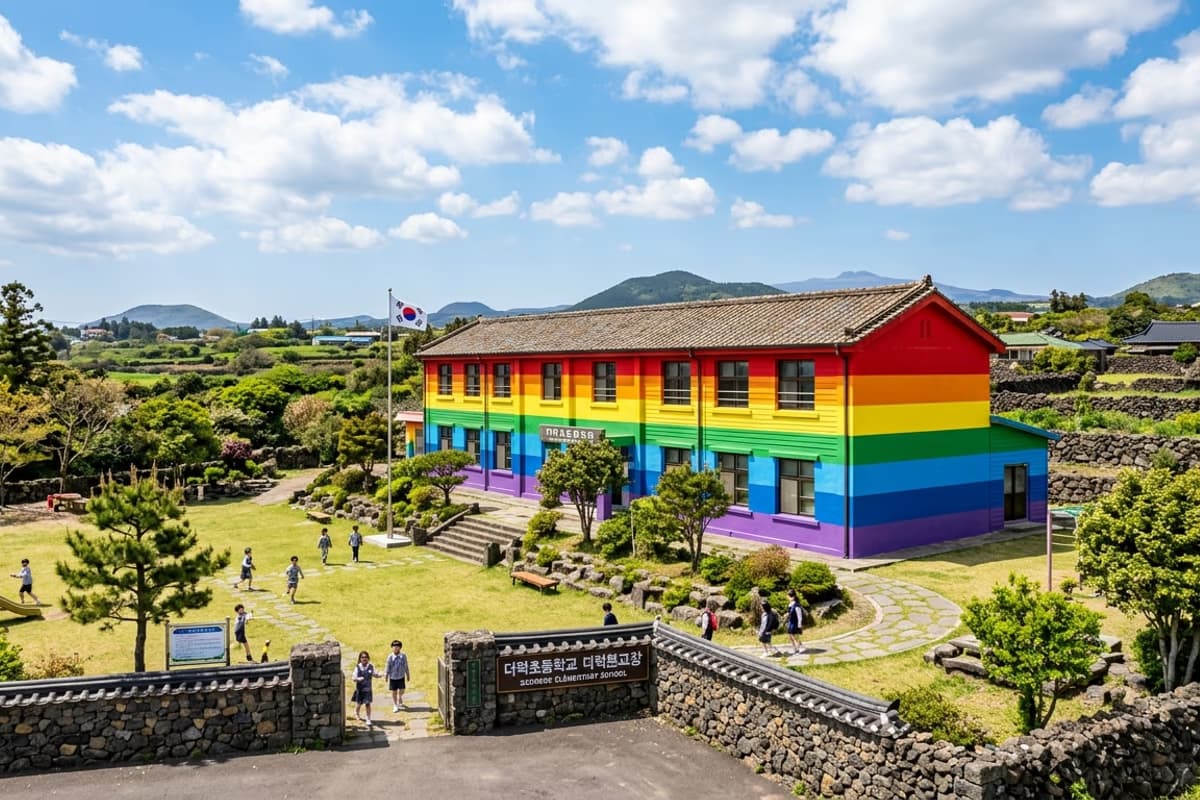
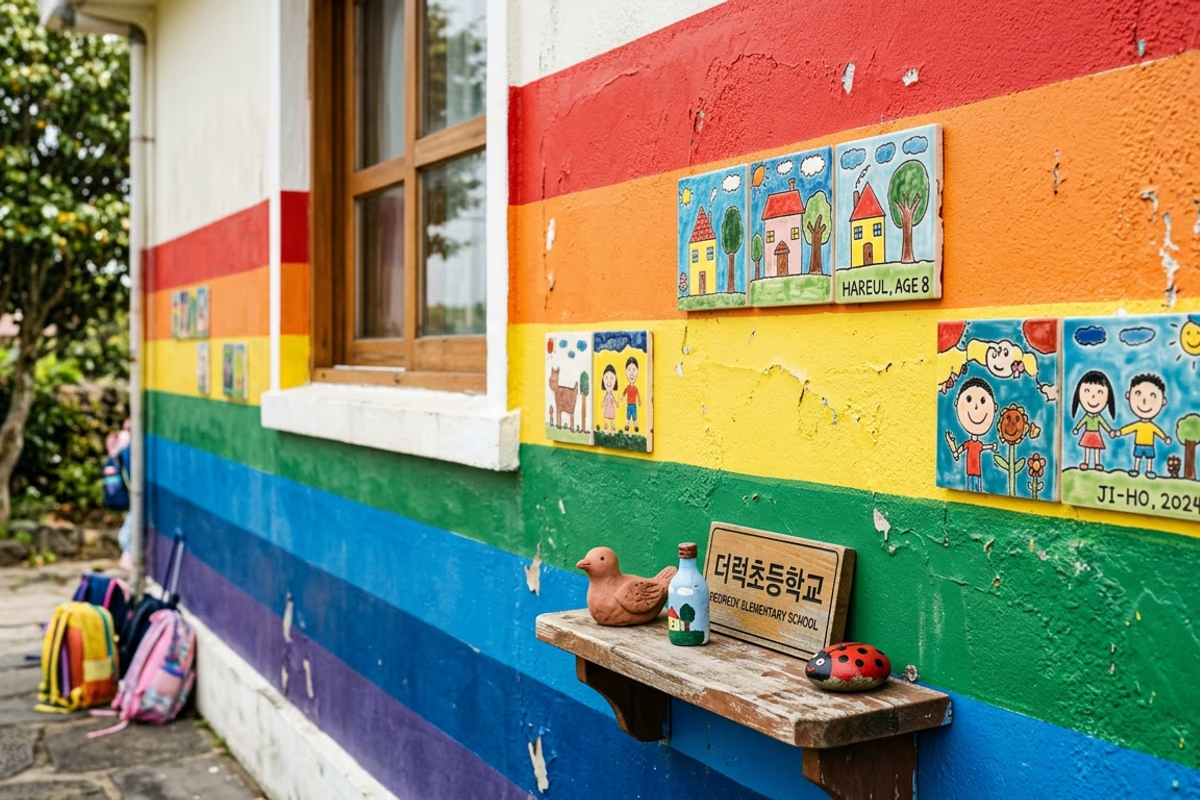
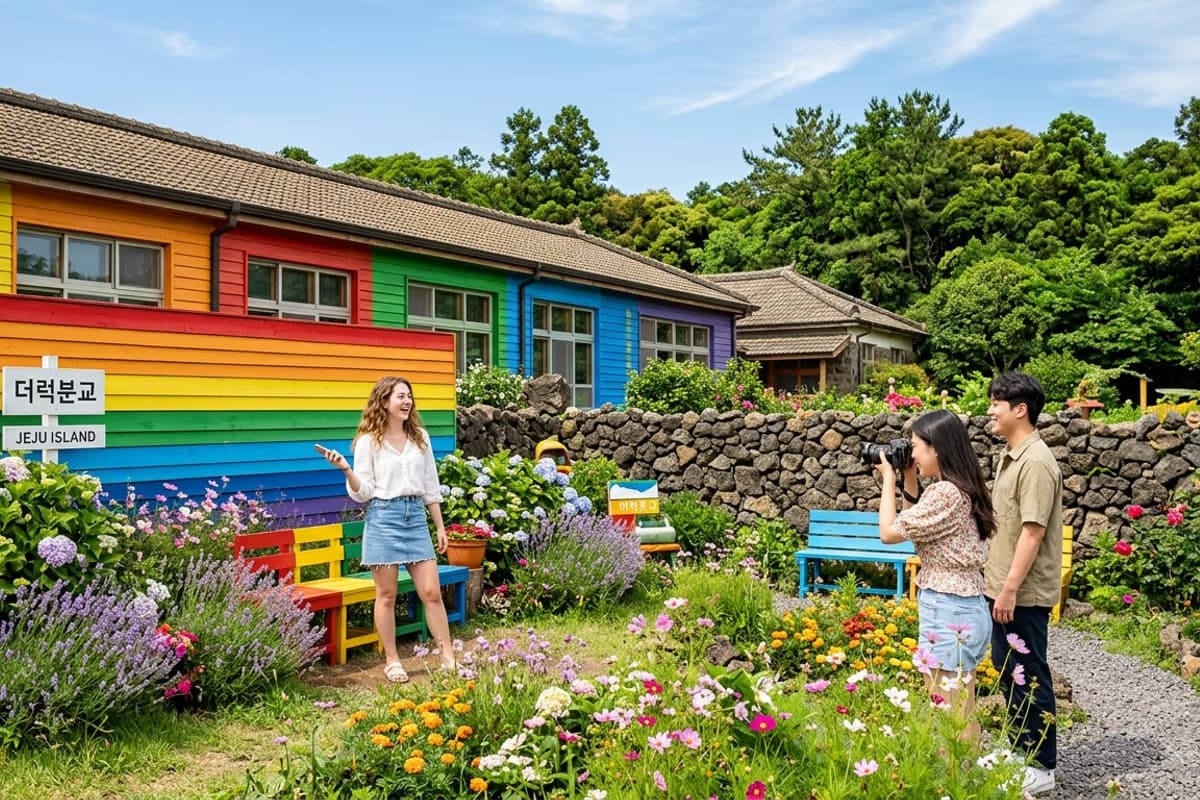
There is a school in the Jeju highlands whose facade has been studied by color theorists. From the road it looks at first like a public art installation: six saturated bands — red, orange, yellow, green, blue, violet — wrap the building in spectrum order, set against the basalt-wall lanes and citrus groves of the mid-mountain belt. The colors are not arbitrary. They were chosen in 2012 by a Paris-based color geographer whose career was devoted to one question: how does any particular place's light, soil, and architectural surface determine which palette feels native to it?
This piece is for design-curious travelers — readers who would visit a Frank Lloyd Wright house, a Mexican Luis Barragán courtyard, or a Reggio Emilia preschool not just to photograph but to understand why a place looks the way it does. Deoreok belongs in that company. It is a working public elementary school, ~85 students, free to enter outside class hours, and the only schoolhouse in Asia repainted by Jean-Philippe Lenclos using his signature method.
A Color Geographer's Work: Why This Building Looks the Way It Does
Jean-Philippe Lenclos (1938-) is the founder of what he termed *géographie de la couleur* — the geography of color. His thesis, developed across five decades of fieldwork in France, Japan, China, and Korea, is that every region has a "color identity" derived from the dominant rocks and soils underfoot, the kind of light the latitude provides, the local vegetation, and the historical materials of vernacular architecture. A facade painted with the wrong palette feels foreign no matter how beautiful in isolation; one tuned to the local color geography feels inevitable.
For Deoreok, Lenclos's team sampled the surrounding materials: the dark basalt stone walls (*doldambang*) that define Jeju's agricultural landscape, the deep ochre volcanic soil, the year-round green of mid-mountain pasture, the famously transparent island light at this latitude. The palette that emerged isn't the kindergarten rainbow it superficially resembles. The reds are slightly shifted toward earthy terracotta, the blues pulled toward the gray-green of Jeju's winter sky. The hues that look most "loud" at noon resolve into something quieter at the late-afternoon hour when most visitors arrive.
According to the Korea Tourism Organization English portal, Deoreok is one of two Lenclos-designed exterior projects realized in Korea. The school's color scheme was originally a corporate-sponsored experiment — Samsung Electronics commissioned the work as part of a campaign showcasing color reproduction in display technology — but the building outlived the campaign and became a public landmark.
A School That Almost Closed, and Then Got Repainted
Deoreok opened in 1946 as Haga Public Elementary School, was renamed in 1954, and by 1996 had shrunk to a "branch" of the larger Aewol Elementary School — Korean rural-school code for "one step from closure." Falling birthrate and youth migration to Seoul meant the same fate awaited it that has erased thousands of countryside schools across mainland Korea.
The 2012 repainting changed the trajectory. Television commercials and drama productions used the building as backdrop; tourists arrived; the village around it saw new economic activity; in 2018, enrollment had recovered enough that Deoreok was re-promoted from a branch back to a full-status school. Today around 85 children attend. The fact that they study inside a building whose external palette was designed by an internationally recognized color geographer is, depending on your viewpoint, either an unusual privilege or an irrelevant adult concern.
The rescue-by-design story is studied in Korean rural-revitalization policy literature. Few interventions are as photographically reproducible as a six-color exterior, and few rural locations have managed to translate a visual asset into sustained student enrollment recovery.
How to Visit Without Disturbing Class
Important: this is a working school, not a museum. Class hours are inviolable.
- Weekdays: visitors permitted after 18:00 (after children have left)
- Saturdays: after 13:00
- Sundays and public holidays: 09:00 to sunset
- Admission: free
- Parking: small lot adjacent to the school, free
Inside-classroom entry, touching school equipment, loud voices, drone flight over the playground while children are present — all prohibited. Exterior photography from the perimeter and playground during open hours is fine.
A short courtesy phone call to the school office (064-799-0515) before arriving is recommended; school events or maintenance occasionally close the grounds outside published hours.
The light most photographers come for is the late-afternoon angled sun that side-lights the colored facade. Holiday mornings before 11:00 also produce a flatter but very saturated light. Midday (12:00-14:00) is harsh and flattens the palette — Lenclos chose hues that would look best at oblique-angle hours, and the result is visible if you arrive accordingly.
The Mid-Mountain Highland Setting
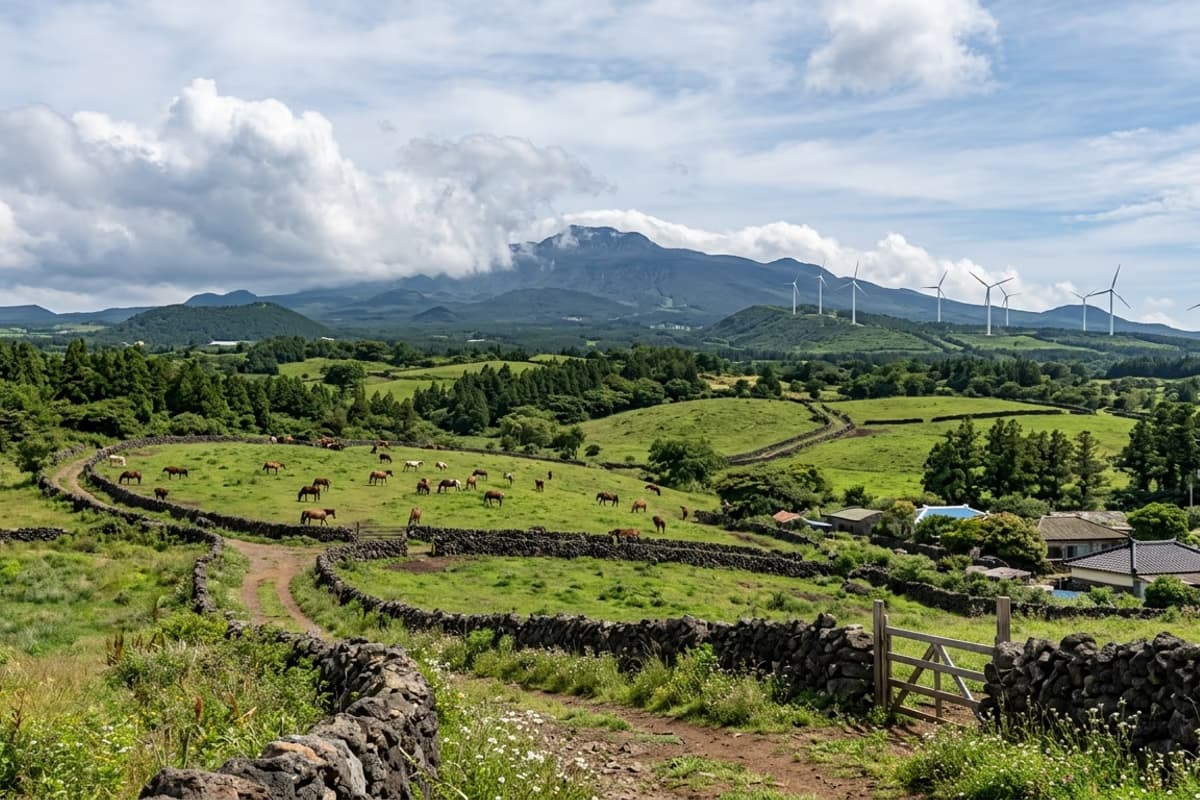
Deoreok sits in Jeju's *jungsangan* — the mid-mountain belt between coastal villages and Hallasan's upper slopes, roughly 200-600 meters above sea level. The landscape feels nothing like the coast. Basalt stone walls (*doldambang*) line every field; horses graze under Hallasan; citrus groves run in rows; wind ripples through reed grass. This is the landscape Lenclos was looking at when he chose the palette.
From the school it is a 10-minute drive uphill to the oreum (volcanic cinder cone) belt — Saebyeol Oreum is the closest at around 15 minutes. Combining a Deoreok visit with a Saebyeol Oreum trek → makes a complete half-day in the mid-mountain belt, with the coast as an evening destination.
Frequently Asked Questions
Is Deoreok still an active school or is it a museum?
Active. Around 85 children study here. Visitors are admitted only outside class hours. Free admission.
Who designed the colored exterior?
French color geographer Jean-Philippe Lenclos, in 2012, under a Samsung Electronics project. The palette was tuned to Jeju's specific light, rock, and vegetation using his color-geography method.
When can I visit?
Weekdays after 18:00, Saturdays after 13:00, holidays 9:00 to sunset. A short call to 064-799-0515 before arriving is recommended.
Is there an entrance fee?
No. Free admission. Free parking adjacent to the school.
What else is nearby to combine with the visit?
Saebyeol Oreum is 15 minutes by car uphill. Galchibada in Aewol is 10-15 minutes downhill on the coast for dinner. A typical route is: Deoreok in late afternoon → coast at sunset → Aewol dinner.
Frequently Asked Questions
- Is Deoreok still an active school or is it a museum?
- Active. Around 85 children study here. Visitors are admitted only outside class hours. Free admission.
- Who designed the colored exterior?
- French color geographer Jean-Philippe Lenclos, in 2012, under a Samsung Electronics project. The palette was tuned to Jeju's specific light, rock, and vegetation using his color-geography method.
- When can I visit?
- Weekdays after 18:00, Saturdays after 13:00, holidays 9:00 to sunset. A short call to 064-799-0515 before arriving is recommended.
- Is there an entrance fee?
- No. Free admission. Free parking adjacent to the school.
- What else is nearby to combine with the visit?
- Saebyeol Oreum is 15 minutes by car uphill. Galchibada in Aewol is 10-15 minutes downhill on the coast for dinner. A typical route is: Deoreok in late afternoon → coast at sunset → Aewol dinner.
From the rainbow campus to the flame-show window seat by the sea
From a color geographer's palette to a whole hairtail by the sunset
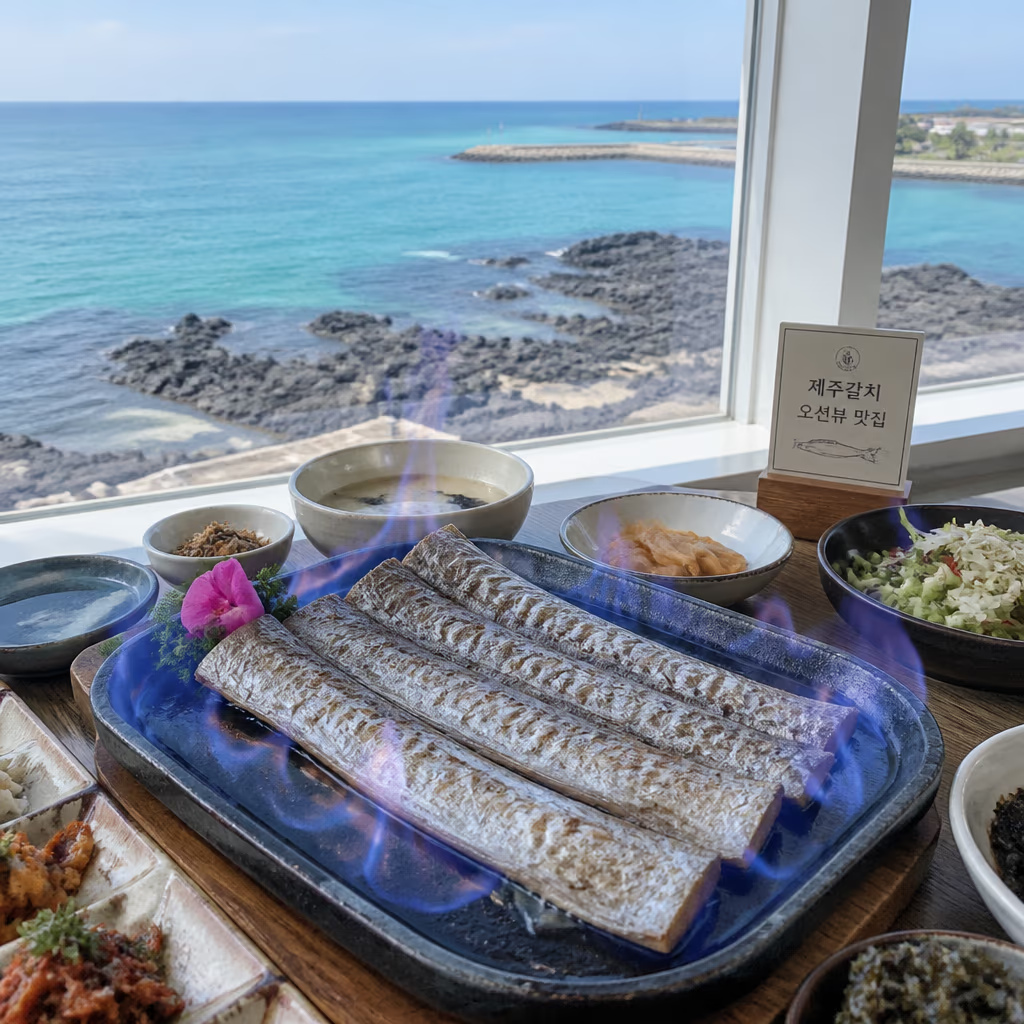
The colors Lenclos chose for Deoreok were sampled from the same coast you will descend to for dinner — the dark basalt walls below the school, the citrus orange of the grove next door, the gray-blue of the winter sea farther west. Ten minutes downhill from the rainbow campus, the windmills appear; ten more, and a whole hairtail arrives on a window-side table with a brief flame-show, while the late sun turns the dining room into one of the warmer hues from Lenclos's palette.
10 minutes downhill to Galchibada in Aewol →