Jeju Black Pork Street — Volcanic Heritage Breed, Charcoal-Grilled
Korea's Native Black Pig the Way the Island Cooks It — and the Easiest Way for Western Visitors to Find It
Jeju Black Pork Street is a concentrated cluster of about 20 specialist restaurants in the Gwandeok-ro / Tap-dong area of Jeju City. Jeju's native black pig — protected as a national heritage breed since 1986 — is pasture-raised on the volcanic soil and carries a higher unsaturated-fat ratio and a firmer texture than commodity pork. About 10 minutes by taxi from Jeju International Airport, 20 minutes by city bus. Most restaurants open 4 p.m.–11 p.m., peak rush 6–8 p.m. Adult portion KRW 15,000–20,000 (~USD 11–15). Drive west to Galchibada in Aewol — about 30 minutes via the coastal road.
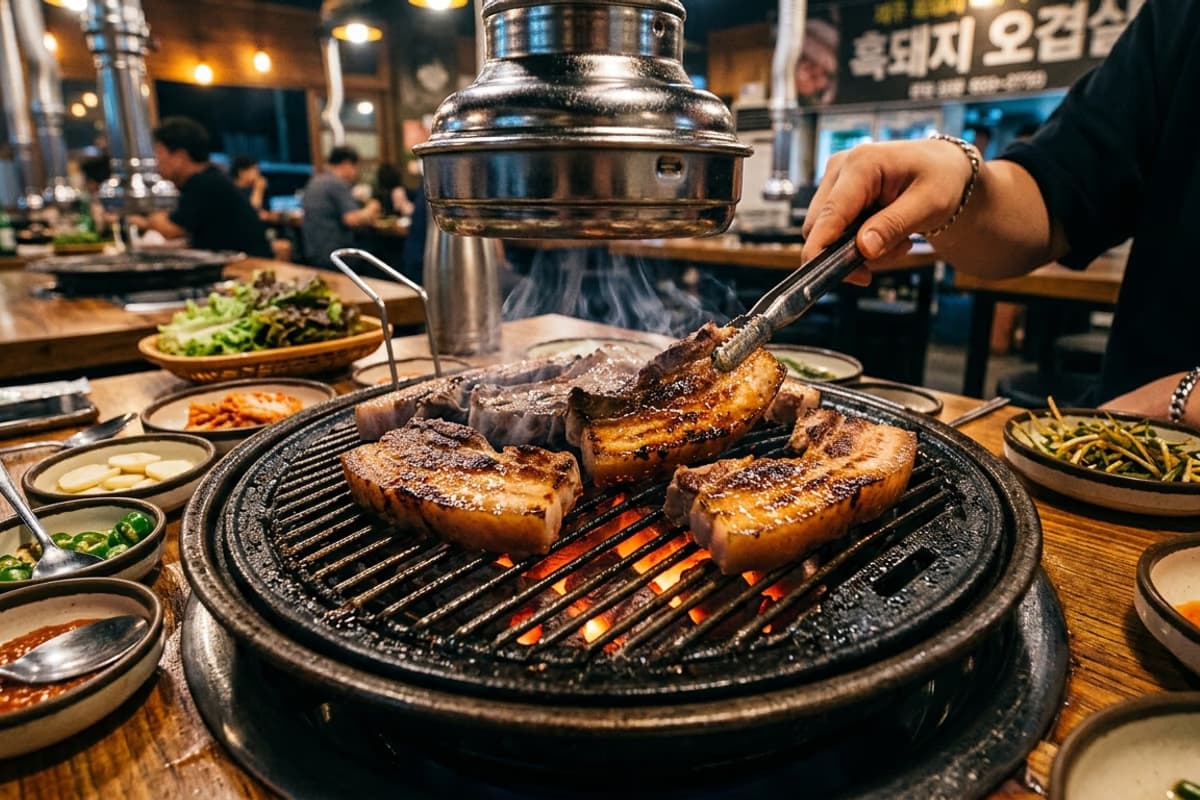
Jeju has a sea-side cuisine and a land-side cuisine, and the land side is built on a single heritage breed. The Jeju black pig (jeju heuk-dwaeji) is a native landrace genetically distinct from commodity pork — raised on volcanic-ash soil, with a thinner fat layer, denser muscle, and an unmistakably deeper savouriness when grilled over charcoal. For Western visitors who already know Spanish jamón ibérico de bellota, British Berkshire pork, or the Hungarian Mangalica, this is the East Asian peer to those heritage breeds, and the comparison is fair. About <strong>twenty specialist restaurants</strong> cluster along a single lane in Jeju City's Gwandeok-ro / Tap-dong neighbourhood — alongside the western-coast hairtail tradition, this is the island's other unmissable meal.
Pairing the sea side and the land side inside a single trip is the cleanest way to take in the depth of the island's food culture.
The native pig's history on Jeju runs back to Goryeo-era documents. In a landscape where strong sea wind and rocky volcanic soil made arable farming hard, the pig pulled double duty as supplemental income and protein source, and villages developed a unique enclosure-cum-latrine called tongsi. After the early-20th-century introduction of improved Western breeds and the industrial-pork wave of the 1960s, the native landrace nearly disappeared — and the national breed-preservation programme that began in <strong>1986</strong> brought it back. Today the lineage is managed by the Animal Science research arm of the Korea Rural Development Administration, and a handful of farms hold formal heritage-breed certification.
What Makes Jeju Black Pork Different
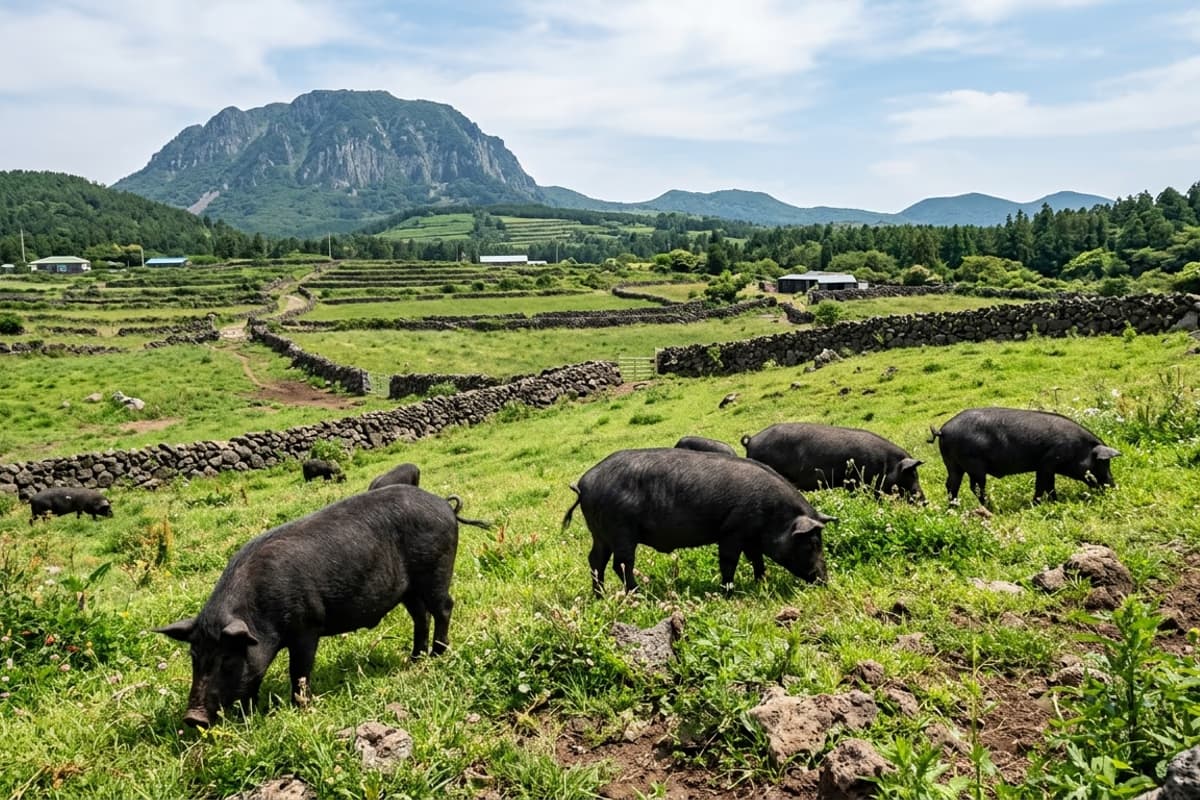
The Jeju native black pig has been kept on this island, isolated from peninsular Korean pork bloodlines, for hundreds of years. The Korea Tourism Organization notes that the meat runs higher in unsaturated fatty acids than commodity pork, with a finer muscle fibre that gives a paradoxical mouthfeel — soft on first contact, then a firm chew on the follow-through. The volcanic-ash soil and the pasture environment together shape the flavour profile in a measurable way.
Not every restaurant serving black-skinned pork is actually serving the native breed. Some kitchens use improved black-skinned commercial varieties under the same colour label. For the heritage breed specifically, look for the words jaerae-jong (재래종) or toh-jong (토종) on the menu — that is the only reliable signal.
The visual cut also tells a story. The native breed's lean meat runs a deeper red, the marbling is finer and more dispersed, and the cross-section shows a coarser grain than commodity pork. Korea Food Research Institute data records protein content around <strong>22%</strong> — roughly 1–2 percentage points higher than commodity pork — with a lower cholesterol number. Cooked, the muscle firms but still releases juice at the bite; cooled, it stays tender rather than going leathery, which is why heritage-breed processed products have been moving into convenience-meal lines in recent years.
Finding the Lane
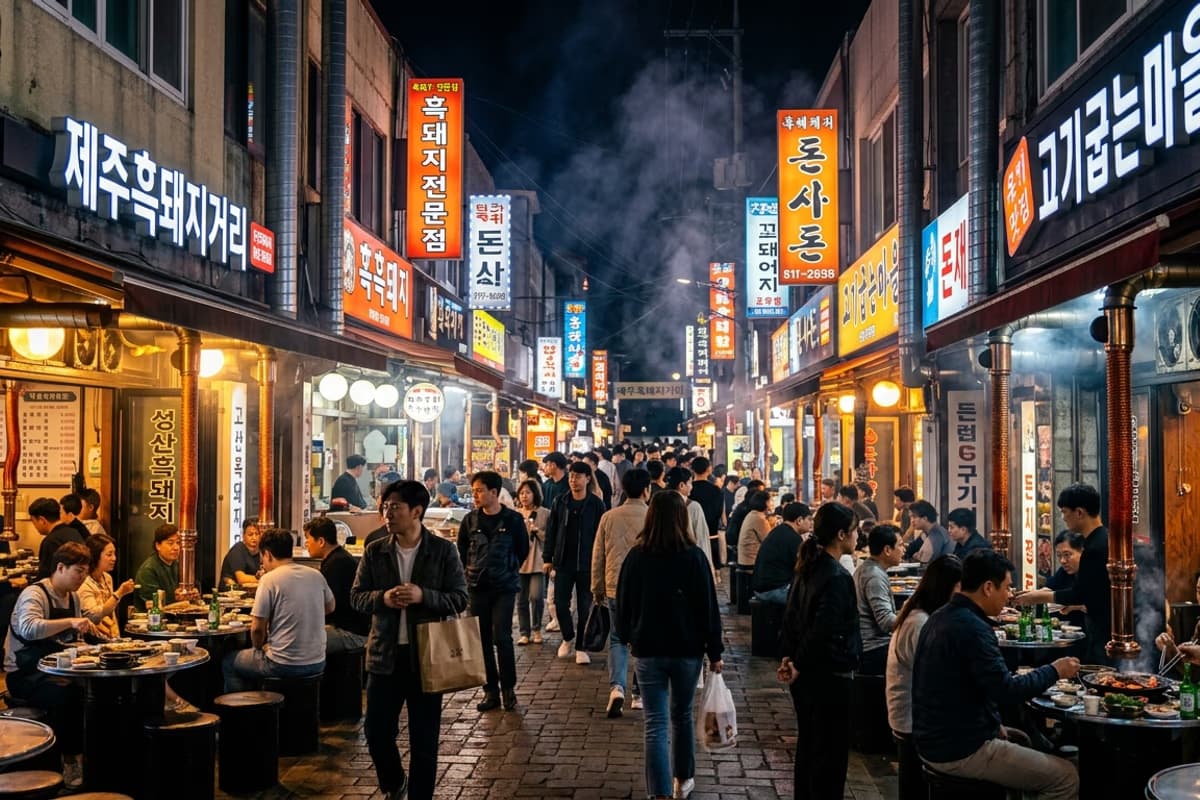
The lane sits between Gwandeok-ro and the Tap-dong coastline in Jeju City. About <strong>10 minutes by taxi</strong> from Jeju International Airport, around 15 minutes on foot from the Jeju Intercity Bus Terminal. Twenty-odd specialist grills cluster inside a single block, each differentiating itself on grilling technique and the supporting banchan spread.
Most restaurants run <strong>4 p.m. to 11 p.m.</strong>; lunch service is the exception, not the rule. The 6–8 p.m. window is the busiest, and popular grills often run a 20–30 minute wait at the door during that band. Reservation policy varies — call ahead is the safest approach. Visit Jeju in English carries individual restaurant listings.
A handful of practical signals help when picking from the cluster. Restaurants with a farm-direct shipment plaque at the entrance, with the slaughterhouse number printed visibly, tend to have the most transparent supply chain. A prep counter visible at one side of the kitchen suggests in-house cutting and trimming rather than pre-portioned outsourcing. Houses that mention making their own meljeot (Jeju fermented-anchovy dipping sauce) usually flag that on a small sign — and the dip is one of those small details that separates a good meal from a great one. The quietest weekday seating window is after 7:30 p.m.; for families with kids, the first 30 minutes after 5 p.m. opening is the cleanest for photographs without crowds. A few of the deeper-alley old-shop counters take cash only — bringing a couple of 10,000-won notes saves an awkward moment at payment.
Cuts and How to Grill Them
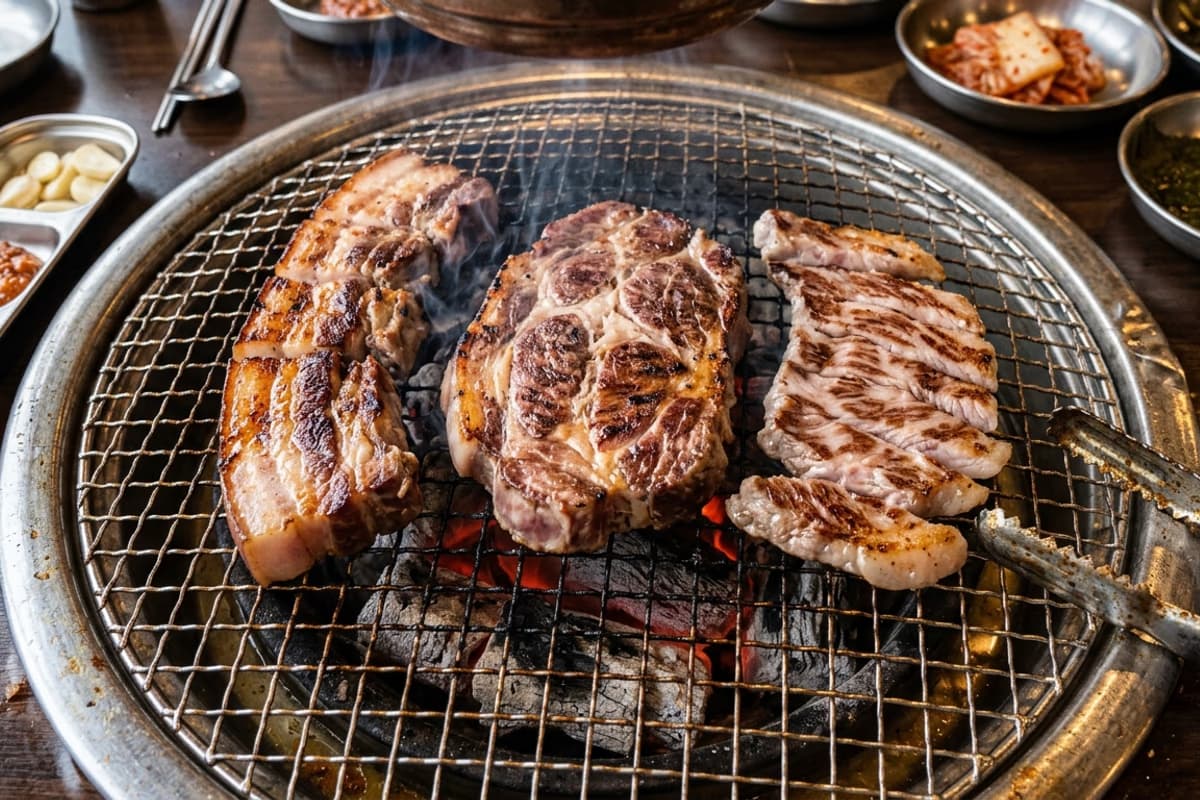
The two most-ordered cuts are ogyeop-sal (five-layer belly — two more layers than standard three-layer belly) and moksal (collar / neck). Five-layer belly alternates fat and lean across five visible bands; on the grill, the fat renders and produces a crisp exterior over a juicy interior. Collar is leaner and meatier, with a denser chew. Hangjeong-sal (the small jowl muscle just behind the collar) is limited in volume per pig — it sells out fast — but the marbling is intense and the flavour per bite is the deepest of the three.
Open charcoal flame is the traditional method; some houses run a flat-iron griddle instead. The charcoal smoke adds a measurable smoke note to the meat, and the flame contact with rendering fat produces the characteristic savoury aroma. Salt grilling or a doenjang (soybean paste) marinade are the two base options, and dipping into meljeot at the end is the regional move.
A small grilling sequence matters. Wait for the grill to hit full heat, then place a 1.5–2 cm thick cut and leave it alone — <strong>about 2 minutes 30 seconds per side</strong> is the rhythm that holds the juice. Flipping more than necessary dries the surface; resist the urge for the first two flips. The accompanying chive salad, garlic chips, fresh raw garlic, and pickled mustard leaves are not garnish — they are the three-dimensional supporting cast that lifts each bite. For the last piece, take a deep dunk in meljeot, lift with a spoonful of warm rice, and the meal hits its proper climax. The customary pairing is Hallasan soju (the Jeju local distillate), but more counters are now pouring Udo peanut makgeolli and Jeju tangerine wine as pairings worth the experiment.
Sea and Land — Both Sides of the Plate
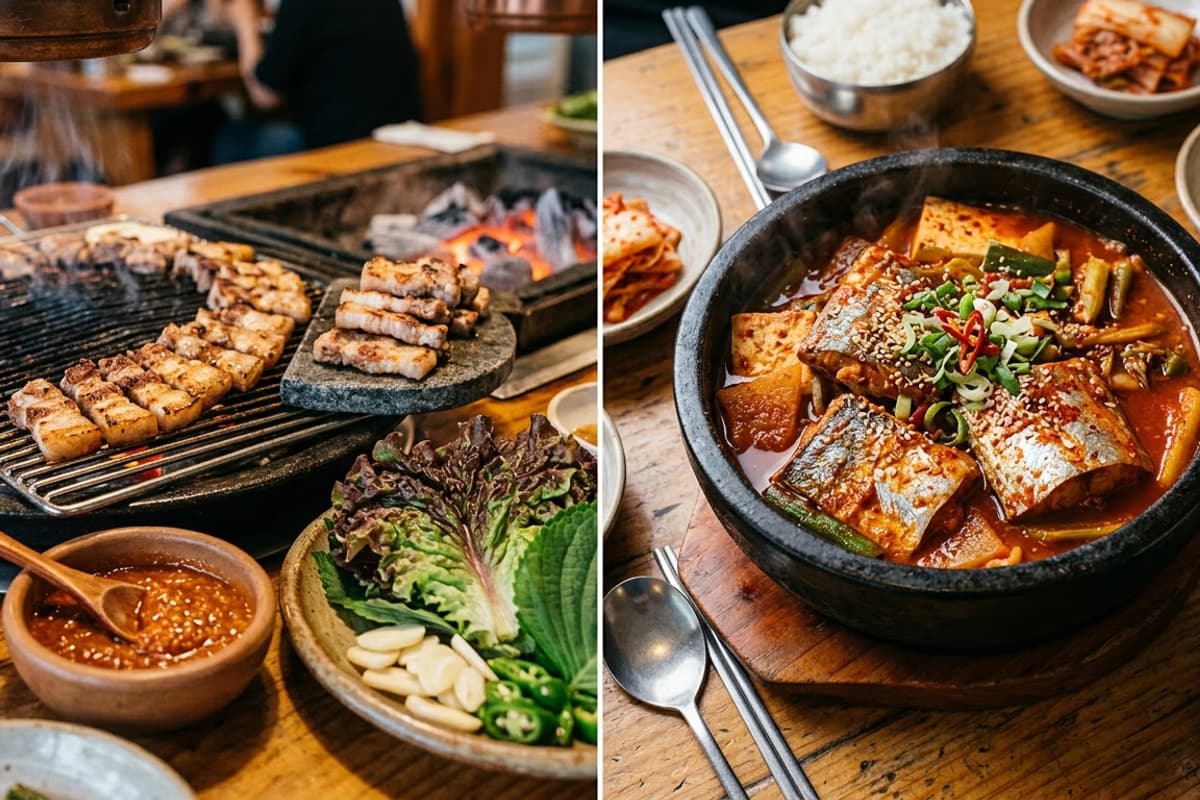
Reduce Jeju's food culture to a single sentence and it reads as a duet between the sea and the land. Hairtail, abalone, snapper, and the haenyeo divers' catch represent the sea side; black pork, Jeju tangerine, and Hallabong citrus represent the volcanic-soil side. Take one and skip the other and you have only half the island on the plate.
Allocate one evening of the trip to black pork and another to hairtail and you cover both axes of the island's cuisine in a single visit. Black pork sits at its highest density in downtown Jeju City (around Gwandeok-ro); hairtail sits at its highest density along the Aewol coast — and the geography neatly assigns the two evenings to two different parts of the island, so the itinerary lays itself out.
From the Pork Lane to the West-Coast Drive
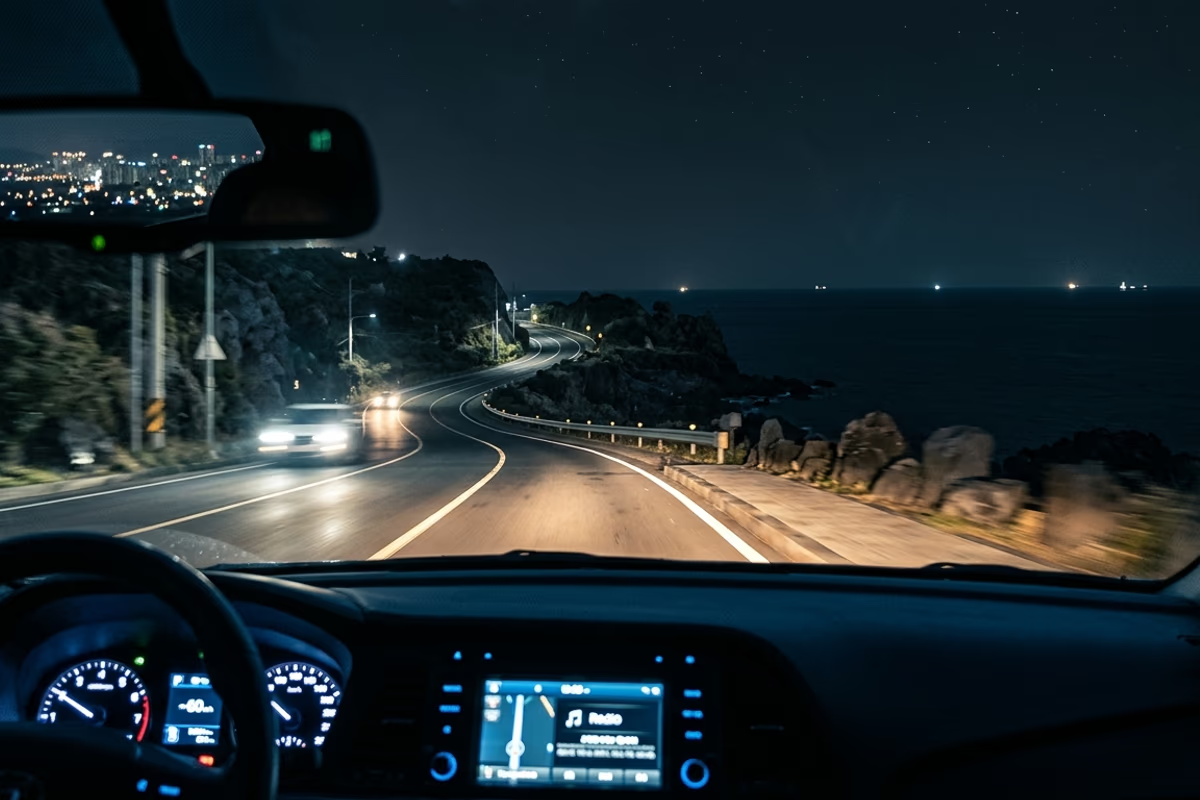
The drive from the pork lane to the Aewol coast is about <strong>30 minutes</strong>. The natural sequence is dinner in town followed by a coastal westbound drive to the next day's base. The reverse — coming back from a western day-trip and finishing with pork in town — also works. Per-person grill cost runs <strong>KRW 15,000–20,000 (~USD 11–15)</strong>; a two-person set lets you sample multiple cuts at once. After dinner, the Tap-dong coastal walk is a few minutes away and works well as a digestif stroll under the city lights.
If you are continuing west by car after dinner, drink-driving planning matters. A bottle of Hallasan soju between two people is light, but waiting <strong>2–3 hours</strong> before driving is the conservative call; if there is no designated driver in the group, a daeri-unjeon (driver-for-hire service) is the cleanest option. Weeknight pickup typically dispatches within 10–15 minutes, with the average city-to-Aewol fare around KRW 30,000 (~USD 22). Leaving the car downtown overnight is also feasible — several 24-hour car parks around Tap-dong charge around KRW 10,000 (~USD 7) for an overnight stay. The next morning, weaving in Dongmun Market night street food → at its dawn alter ego — the regular market — closes the food loop in town before heading west. The night air of the downtown alley, the salt-spray morning at the market, and the western coast at sunset are three different scenes inside a single 24-hour stretch — and the same island carries each one with a different texture. A short trip with this shape leaves a wider afterimage than the kilometres alone would suggest, and the contrast between the smoke-deep flavour of the alley grill, the briny lift of the dawn market, and the spare clarity of a coastal hairtail table is the comparison most visitors are still thinking about a month after the flight home. One meal does choose the whole shape of the day — and a single small lane, quietly, makes that case for you.
Frequently Asked Questions
- Where exactly is Jeju Black Pork Street?
- In the alley between Gwandeok-ro and the Tap-dong coastline in downtown Jeju City — about 20 specialist restaurants cluster inside a single block. Roughly 10 minutes by taxi from Jeju International Airport, around 20 minutes by city bus.
- What is the cost per person for a grill meal?
- Adult portion runs KRW 15,000–20,000 (around USD 11–15). A two-person set lets you sample multiple cuts — belly, collar, jowl — at KRW 30,000–40,000 (USD 22–30) for two.
- Can I have Jeju black pork for lunch?
- Most restaurants in the street open at 4 p.m. — lunch service is the exception, not the rule. If you specifically want pork at midday, call ahead to confirm a restaurant's hours, or check listings on Visit Jeju in English.
- How is Jeju black pork different from regular pork?
- It is a native landrace, isolated on the island for hundreds of years and protected as a heritage breed since 1986. Compared with commodity pork, the meat runs higher in unsaturated fatty acids and protein, with a finer muscle fibre that combines a soft first bite with a denser chew.
- How long is the drive from the pork lane to Galchibada in Aewol?
- About 30 minutes via the coastal road westbound. Allocating one evening to black pork in Jeju City and another evening to hairtail at Aewol covers both halves of the island's food culture — and the geography neatly separates the two nights.
From the volcanic-pork lane to the coastal hairtail table — 30 minutes west
The sea side answers the land side, thirty minutes along the coast
The smoke note of charcoal black pork is still on the tongue the next evening when you point the car west — thirty minutes along the coastal road and the sea side takes over. Beyond the floor-to-ceiling glass the waves are framed at the table, and a single bowl of hairtail flesh over warm rice fills in the other half of the island the previous night could not reach.
About 30 minutes from Jeju Black Pork Street to Galchibada in Aewol via the coastal road →