Seongsan Ilchulbong — First Light on Jeju's UNESCO Sunrise Crater
A Honest Guide for Western Travelers Who Want the Climb Without the Crowds
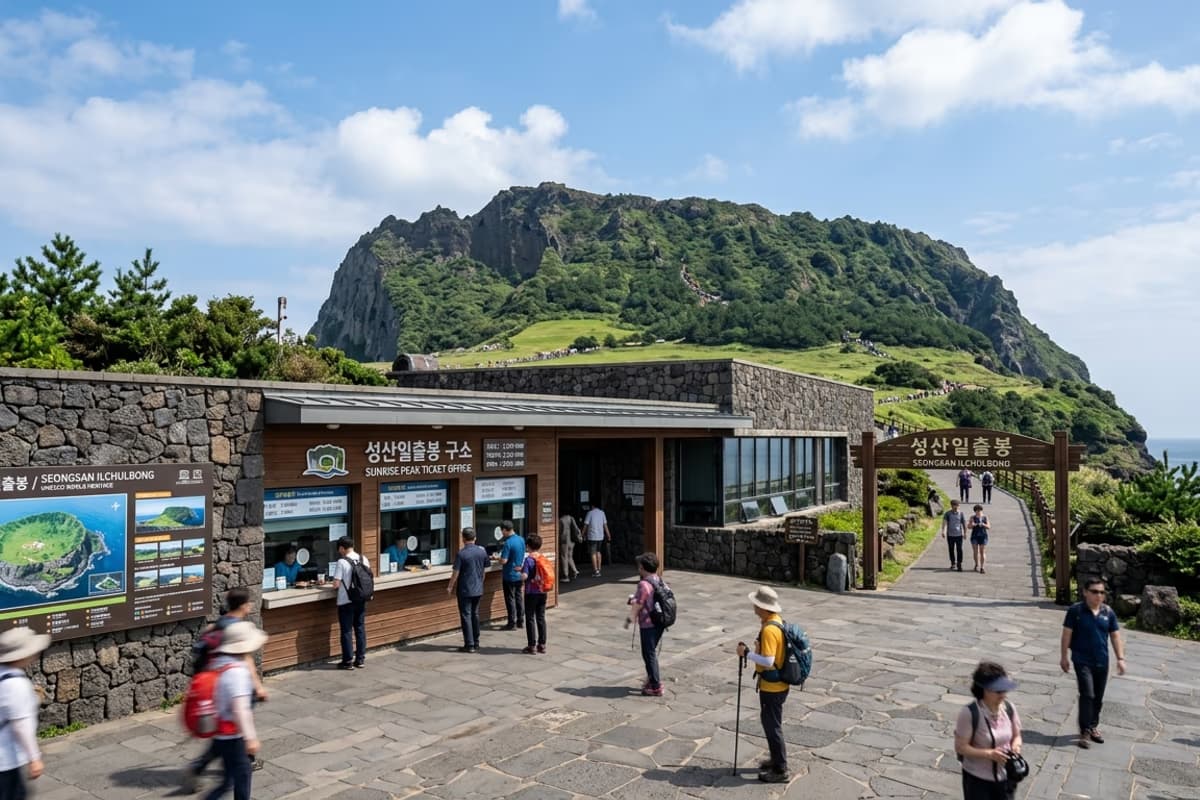
Seongsan Ilchulbong is a 182-meter tuff cone on Jeju's eastern coast, formed 5,000 years ago by an underwater volcanic eruption. The 25-minute climb opens a 360-degree view of the surrounding sea, and the eastern rim faces the sunrise so closely it feels within touching distance. Entry KRW 5,000 (about USD 3.70). It's a 1 hour 20 minute drive from Galchibada in Aewol.
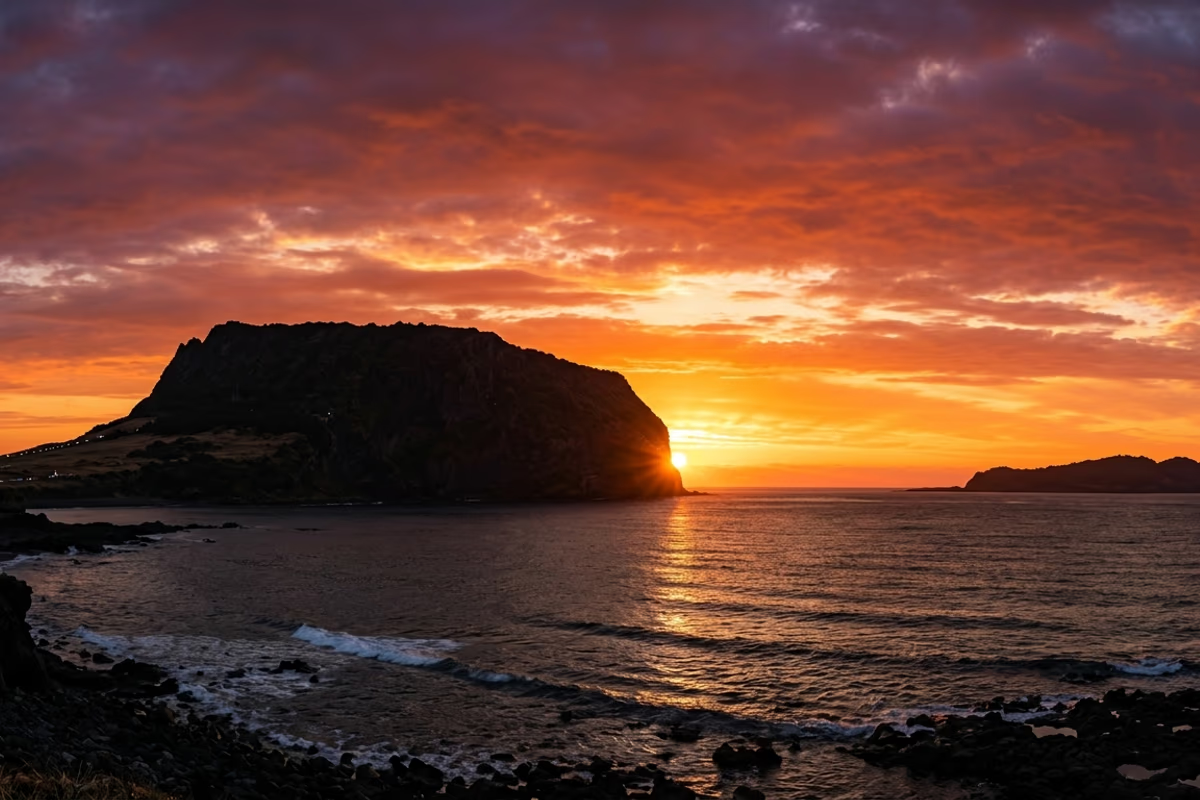
If you've ever stood at the rim of an inactive crater and watched the sun break over open ocean, you'll understand why locals across Jeju still set 3 a.m. alarms for this. Seongsan Ilchulbong — literally "Castle Mountain Sunrise Peak" — is a 182-meter volcanic cone that grew straight out of the sea floor roughly 5,000 years ago, when shallow water met rising magma in the kind of explosion that builds islands instead of destroying them.
It has been a UNESCO World Heritage site since 2007, listed alongside Jeju's lava tubes as one of the rare volcanic landscapes on earth where the entire life of a tuff cone is still visible from a single climbable summit. For comparison: while Hawaii's Diamond Head requires a 1.6-kilometer (one-mile) hike and Mount Fuji demands an overnight, Seongsan's main trail takes the average traveler about 25 minutes — and the payoff at the top, especially before 6 a.m., is one of the few moments where "bucket list" stops feeling like a cliché.
I'll tell you the parts most guidebooks skip: which side of the summit catches the sunrise without the tour group selfie sticks, how the volcanic geology actually works (it's stranger than it looks), what to eat at the base when you come down hungrier than you expected, and how to time the drive from major Jeju spots without missing the first light.
How a Volcano Built Itself From the Sea Floor
To understand Seongsan, picture this: 5,000 years ago, this exact spot was open ocean. Then magma pushed up through the seabed, hit shallow water, and instead of erupting in slow lava flows the way most volcanoes on television behave, it exploded in repeated steam-driven blasts. Each blast threw ash and volcanic fragments into ring-shaped layers — what geologists call a tuff cone — until the cone broke the water's surface and kept growing.
The result is the unusual bowl-shaped structure you see today: a near-perfect crater 600 meters across at the rim, 99 meters deep at the deepest point, with an outer wall that drops straight into the surrounding sea on three sides. According to the UNESCO World Heritage Centre listing, it is one of the most well-preserved tuff cones in East Asia, partly because the volcanic ash layers compacted into rock before erosion could flatten the structure.
What makes it dramatic for a visitor isn't just the height. It's that the crater feels like it shouldn't physically exist. Most volcanic craters sit inside a wider mountain. This one rises alone from the coastline like someone dropped a stone bowl onto the sea. From the parking lot at the base, the cone looks almost artificial in its symmetry — and that visual moment, before you've climbed a single step, is half the reason photographers schedule entire Jeju trips around being here.
The crater floor, by the way, holds roughly 8 hectares (about 20 acres) of grassland inside the rim. You can't walk down into it — the interior is a protected zone — but from the summit you'll see wildflowers in spring and silver pampas grass in autumn moving in the wind like a green-and-white sea inside a stone bowl.
The Climb: 600 Steps in About 25 Minutes
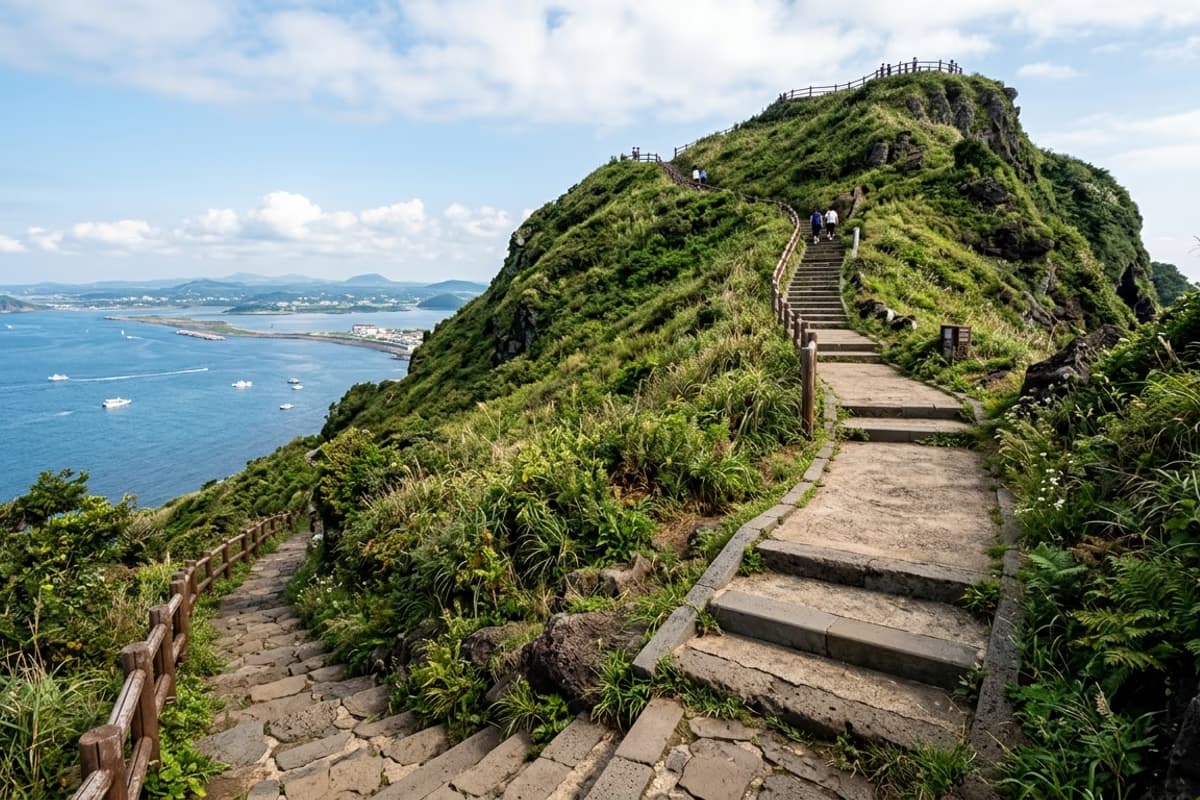
Past the ticket gate, the trail starts as a concrete staircase with wooden handrails. The first ten minutes are easy — mostly shaded, gentle gradient, the kind of warmup that lets you ignore how many stairs come next. After that, the incline steepens and you'll notice your breath. Total step count to the main observation deck is roughly 600, with three rest benches at the halfway marks.
For pace planning: a casual walker reaches the summit in about 25 minutes. Runners can do it in 12. With young children or grandparents in your group, plan on 40 minutes and use the benches. The trail is one-way at the top (you loop around the rim and return down the same staircase), so you won't lose time to traffic going against you.
The summit observation deck opens a clean 360-degree view. East: the open Pacific and Udo Island. West: Hallasan's silhouette in the distance. North: the rural coastline and several smaller volcanic cones. South: the crater itself, with grassland inside. Wheelchair access stops at the first viewing platform (about 50 steps up), where the eastern coastline and outer crater wall are still visible from a fixed bench.
On windy days — and Jeju's east coast is genuinely windy — the narrowest section of the ridge trail tightens to about 1.5 meters with a railing on one side. If you're carrying a camera bag or have a child with you, this is the spot to slow down and stay near the inner railing. Trail managers close the climb during storms; check the daily notice board near the ticket office before you start.
Sunrise Timing (Including What Locals Won't Tell You)
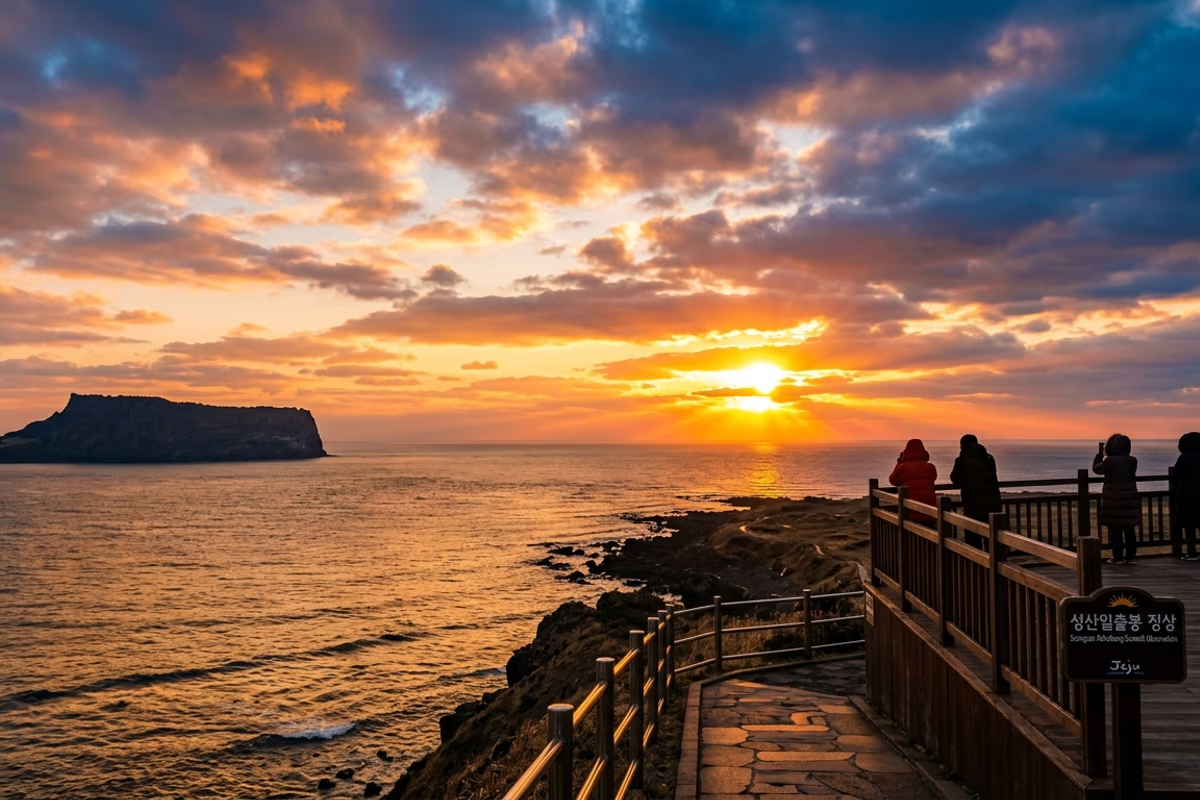
The trail opens early for sunrise viewing. Summer (June–August) opening is around 4:00 a.m., winter (December–February) around 5:30 a.m. — the trail managers shift the schedule with the season so you can be at the summit before first light regardless of the month. Exact daily sunrise times for your travel date are available at the Korea Astronomy and Space Science Institute, which lists minute-precise sunrise and sunset coordinates for Jeju.
The single most useful piece of timing advice locals share quietly: arrive 40 minutes before the published sunrise time. Forty minutes lets you climb without rushing, choose a position on the eastern rim, and watch the pre-dawn sky shift through cobalt, gold, and pale orange before the sun itself appears. Photographers call this the blue hour; it's often more dramatic than the sunrise itself, and almost everyone misses it because they arrive too late.
For position: the eastern rim near the secondary observation point is where Udo Island slips into the frame between you and the rising sun. On clear days, the sun appears to rise from behind the island, framed by the cone's own ridge. On days with low cloud, light fans out from behind the clouds in shafts. Counterintuitively, the partly cloudy mornings produce the most dramatic photos — flat clear skies often look too uniform.
A camera tip in plain language: ISO 200, aperture around f/8, shutter around 1/60 second is a clean starting point for handheld shots in the first ten minutes after sunrise. If you brought a tripod and an ND filter, the 15 minutes after the sun clears the horizon often produce the best long-exposure shots, with passing clouds smoothed into soft streaks above the calm water.
Watching Haenyeo (Women Divers) at the Base
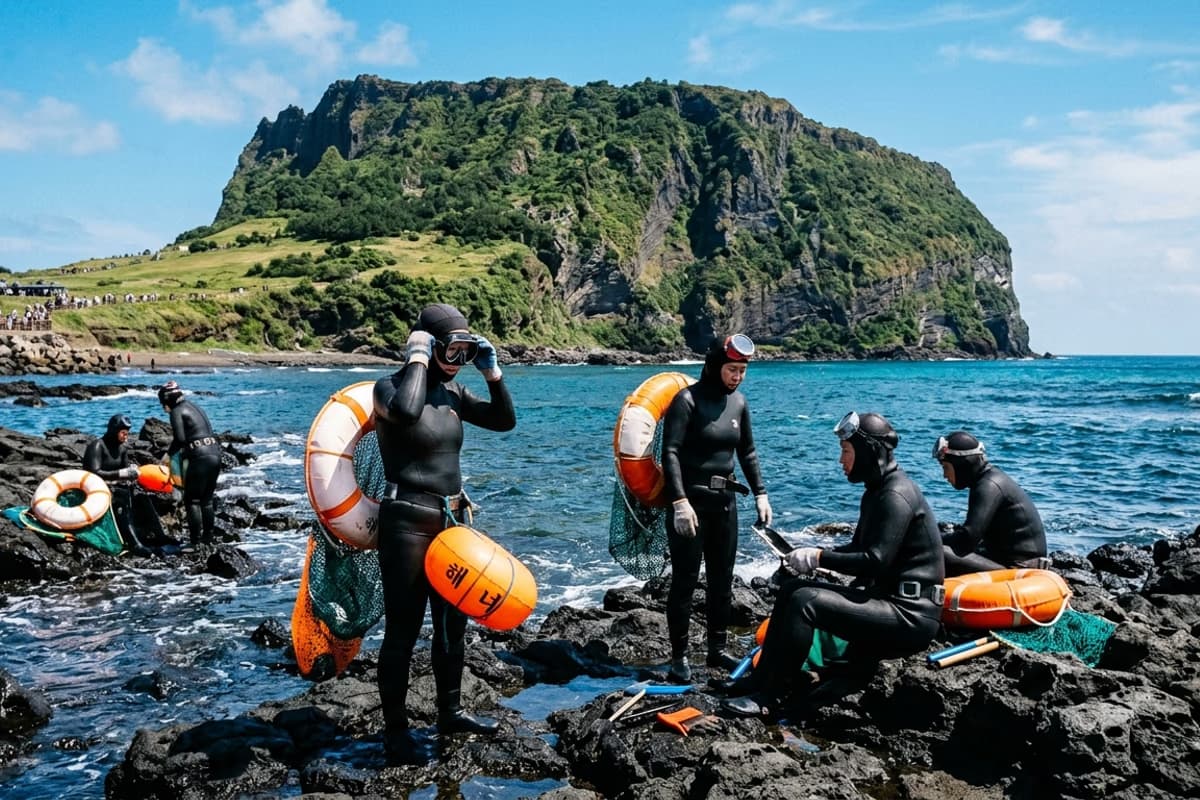
At the foot of the cone, daily haenyeo demonstrations take place at 1:30 p.m. and 3:00 p.m. Haenyeo are Jeju's female free-divers — women, often in their sixties and seventies, who harvest abalone, sea cucumber, and conch from the rocky seabed using only mask, fins, and a breath-hold technique developed over centuries. Their tradition was inscribed on UNESCO's Representative List of the Intangible Cultural Heritage of Humanity in 2016.
The demonstration is free to watch and lasts about 30 minutes. You'll see the divers descend with sumbisori — a sharp whistling exhale they release on surfacing to expel CO2 — and surface with whatever the morning's harvest produced. Average dive duration is 1 to 2 minutes; maximum depth on a typical working day is around 10 meters (33 feet), though seasoned divers reach 15 to 20 meters.
Adjacent to the demonstration site, several small restaurants serve abalone porridge (jeonbok-juk) and seasonal raw seafood platters at prices set without negotiation — abalone porridge is typically around KRW 15,000 (USD 11) for a generous bowl. If you climbed at dawn and skipped breakfast, this is the place to thaw out and refuel before the rest of your day.
Beyond the divers, Seongsan-eup itself rewards a slow walk. The ferry terminal for Udo Island is a 10-minute walk from the cone's parking lot; the dramatic Seopjikoji headland is a 5-minute drive south. Many travelers chain Seongsan sunrise → Udo ferry → Seopjikoji into a single morning-to-afternoon eastern Jeju loop.
How to Reach Seongsan from Major Jeju Spots
By car: Seongsan is at the easternmost tip of Jeju. From Jeju Airport, the drive takes about 1 hour via expressway 97 (the Iljudo eastern road) or about 1 hour 20 minutes via the scenic coastal route. From Seogwipo (the city on the south coast), allow 50 minutes. From Galchibada in Aewol on the west coast, the drive crosses the entire island — about 1 hour 20 minutes via Beonyeong-ro and the northern coastal road. Free parking is available at the main lot, with capacity for about 500 vehicles.
By bus: From Jeju International Airport, board the 201 trunk-line bus and ride about 1 hour 30 minutes to Seongsanpo Transfer Center. From there it's a 10-minute walk to the ticket office. Real-time bus schedules are available at the Jeju Special Self-Governing Province Bus Information System.
Ticket info: KRW 5,000 (about USD 3.70) for adults, KRW 2,500 for youth, and free for children. Jeju residents enter free with ID. The trail is open year-round, though closures during typhoons or heavy snow do happen — check the daily notice at the ticket office.
For travelers building an eastern-to-western Jeju day, the natural pairing is: dawn at Seongsan → late morning at Udo Island → afternoon at Seopjikoji → drive west along the coast → dinner at Galchibada in Aewol for a hairtail (galchi) set meal as the sun sets over the western sea. The crossing takes 80 minutes by car, and the meal at the western coast catches the day's second light, giving you the entire arc of sun across the island in a single 24-hour story. For Western travelers who want a slower paced finish, a short walk along the Handam Coastal Trail → near Galchibada before sitting down for dinner is a quiet way to let the day settle.
Frequently Asked Questions
How early should I arrive for the sunrise climb?
Arrive 40 minutes before the published sunrise time. Forty minutes gives you a calm 25-minute climb, position selection on the eastern rim, and the entire blue hour before the sun clears the horizon. Sunrise times by date are available at the Korea Astronomy and Space Science Institute.
Is the climb suitable for young children or older travelers?
Yes, with realistic pacing. Plan on 40 minutes up instead of 25, use the three rest benches, and consider the first viewing platform (about 50 steps up) as a satisfying turnaround point for travelers with mobility constraints. The first platform still opens the eastern coastline and outer crater wall.
What does it cost?
KRW 5,000 (about USD 3.70) for adults, KRW 2,500 for youth, free for children. Parking at the main lot is free. Bus access from Jeju Airport is roughly KRW 3,000 one way.
Can I see haenyeo divers without paying extra?
Yes. The daily haenyeo demonstrations at 1:30 p.m. and 3:00 p.m. at the foot of the cone are free to watch. They last about 30 minutes and showcase Jeju's UNESCO-inscribed female free-diving tradition.
How long does it take to reach Seongsan from western Jeju (Aewol / Galchibada)?
About 1 hour 20 minutes by car via the northern coastal road, or about 1 hour via the expressway. For travelers planning a full island day, the natural pairing is sunrise at Seongsan in the east, then a westward drive ending with dinner near Aewol's coast as the sun sets — see Handam Coastal Trail → for the walk that pairs with the meal.
Frequently Asked Questions
- How early should I arrive for the sunrise climb?
- Arrive 40 minutes before the published sunrise time. Forty minutes gives you a calm 25-minute climb, position selection on the eastern rim, and the entire blue hour before the sun clears the horizon. Sunrise times by date are available at the Korea Astronomy and Space Science Institute.
- Is the climb suitable for young children or older travelers?
- Yes, with realistic pacing. Plan on 40 minutes up instead of 25, use the three rest benches, and consider the first viewing platform (about 50 steps up) as a satisfying turnaround point for travelers with mobility constraints.
- What does it cost?
- KRW 5,000 (about USD 3.70) for adults, KRW 2,500 for youth, free for children. Parking at the main lot is free. Bus access from Jeju Airport is roughly KRW 3,000 one way.
- Can I see haenyeo divers without paying extra?
- Yes. The daily haenyeo demonstrations at 1:30 p.m. and 3:00 p.m. at the foot of the cone are free to watch. They last about 30 minutes and showcase Jeju's UNESCO-inscribed female free-diving tradition.
- How long does it take to reach Seongsan from Aewol / Galchibada?
- About 1 hour 20 minutes by car via the northern coastal road, or about 1 hour via the expressway. A natural day pairing is dawn at Seongsan, then a westward drive ending with dinner near Aewol as the sun sets.
From sunrise in the east to a hairtail dinner in the west — 80 minutes across the island
The eastern horizon at dawn, the western horizon at dinner
While the eastern light still lingers in your memory, drive west along the coastal road for 80 minutes. As the sun begins to slip toward the western sea, a hairtail set meal arrives in a dining room of full-height windows — the day's first light and last light, both held within a single 24-hour story.
80 minutes by car from Seongsan to Galchibada in Aewol →