Udo Island — A Half-Day Cycling Loop Around Jeju's Smaller Sibling
Coral Sand, Black Sand, a 132-Metre Peak, and a Peanut Ice Cream That Earns the Ferry Ride
Udo is a 6.18 km² (2.4 sq mi) satellite island administered as Jeju City's Udo-myeon, reached by 15-minute ferry from Seongsan Port. The full coastal loop is about 17 km / 11 miles and rides comfortably in 2 hours; adding Udo-bong (132 m / 433 ft) and lunch turns it into a half-day. Bicycle rental ~KRW 10,000 ($7), e-bike ~KRW 20,000 ($14). Round-trip ferry KRW 5,500 plus KRW 2,000 for bicycle. ID required at boarding. Aewol — and dinner at Galchibada — sits about 80 minutes by car from Seongsan after returning.
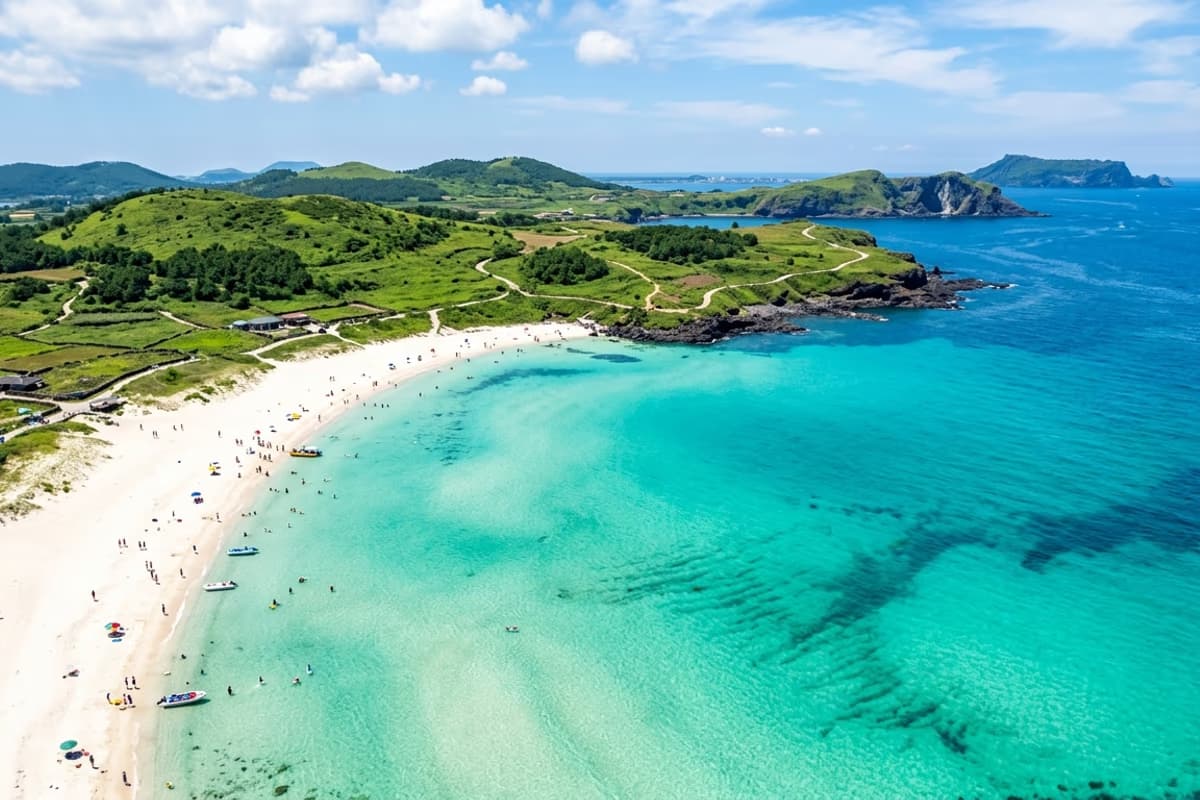
There is a smaller island sitting in the sea off Jeju's eastern edge, and for travellers who have done Catalina Island off the Los Angeles coast or Martha's Vineyard off Cape Cod, the satellite-island feeling will be familiar — a 15-minute ferry from Seongsan Port and suddenly the temperature drops, the pace halves, and the scale of everything shrinks by an order of magnitude. Udo is about <strong>11 miles (17 km) around</strong>, and a bicycle can loop the perimeter in two hours. Within that small ring sit a coral-sand beach, a black-volcanic-sand cove, and a 132-metre lookout — a density of landscape that rewards the ferry ticket several times over.
The island covers 6.18 km² (2.4 sq mi) with a permanent population of roughly 1,700, administered as Udo-myeon under Jeju City. Geologically, Udo began as a submarine tuff cone formed by underwater volcanic activity around 30,000 to 40,000 years ago, then weathered down to its current rounded outline. The combination of coral sand on one shore and black volcanic sand on the opposite shore — within a single 17 km loop — is exceptional enough that geology and oceanography clubs visit it regularly.
The Ferry & Getting On the Island
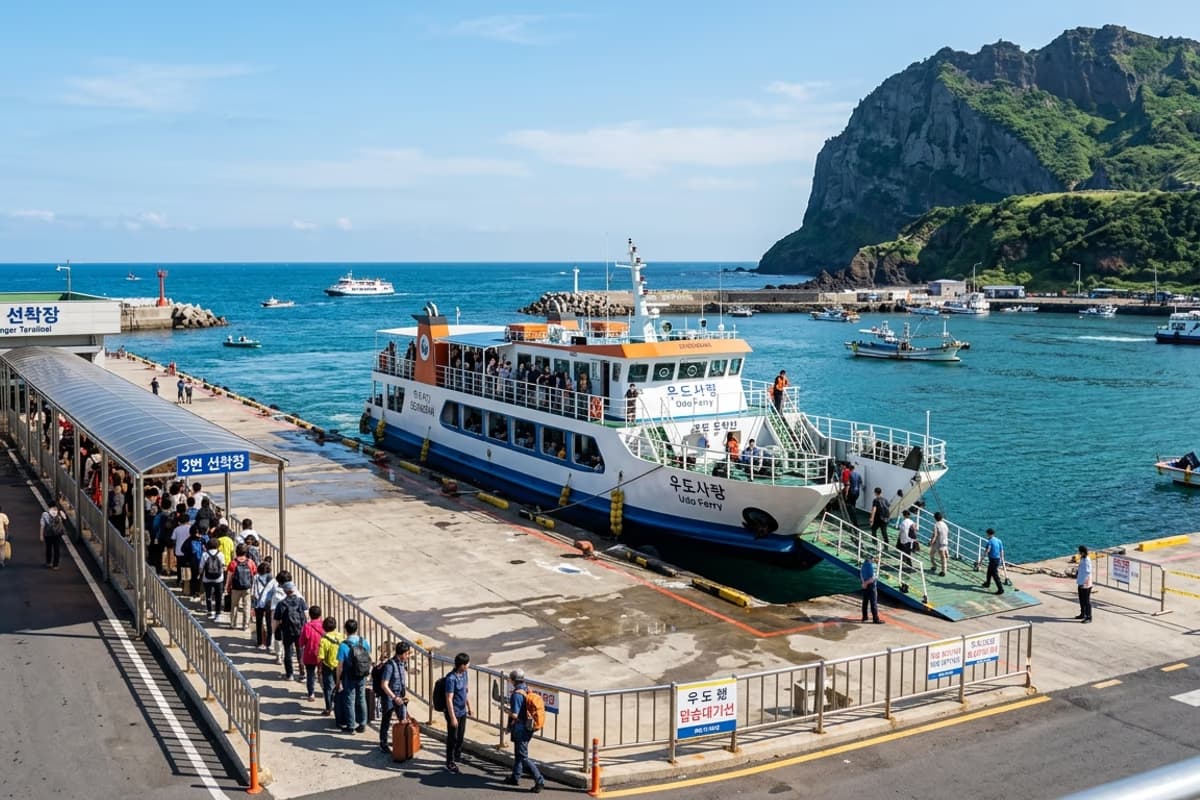
Ferries depart from Seongsan Port at roughly 15-minute intervals in peak season (July–August) and around 30 minutes off-peak. First boat is 8 a.m.; the last sailing falls between 5 p.m. and 6 p.m. depending on the season. <strong>Round-trip fare is KRW 5,500 ($4) per adult; bicycles cost an additional KRW 2,000 ($1.50) each way</strong>. Tickets are bought at the terminal counter on arrival, and photo ID is mandatory at boarding — a holdover from coastal-security rules that travellers from the United States and Europe will not be used to.
Cars are allowed on the ferry, but in peak season the wait can exceed an hour. The standard advice for a one-day trip is to leave the car at Seongsan and rent on the island instead. Two ports take passengers — Haumokdong and Cheonjin — and most of the cycle rentals cluster around Haumokdong, so this is the natural disembarkation point.
Weather is the main wildcard. A high-seas advisory cancels sailings immediately, and the call is sometimes made minutes before departure. The Korea Meteorological Administration marine forecast is the right thing to check at 7 a.m. on the day. Standard bicycle rental runs around KRW 10,000 ($7), e-bikes around KRW 20,000 ($14), tandems around KRW 25,000 ($18). Helmets and lights are included. Child seats are limited and should be reserved by phone the day before; on a weekday morning you can usually walk up. Coin-operated lockers next to the terminal handle the larger bags, so the loop can begin with a light pack.
The Cycling Loop
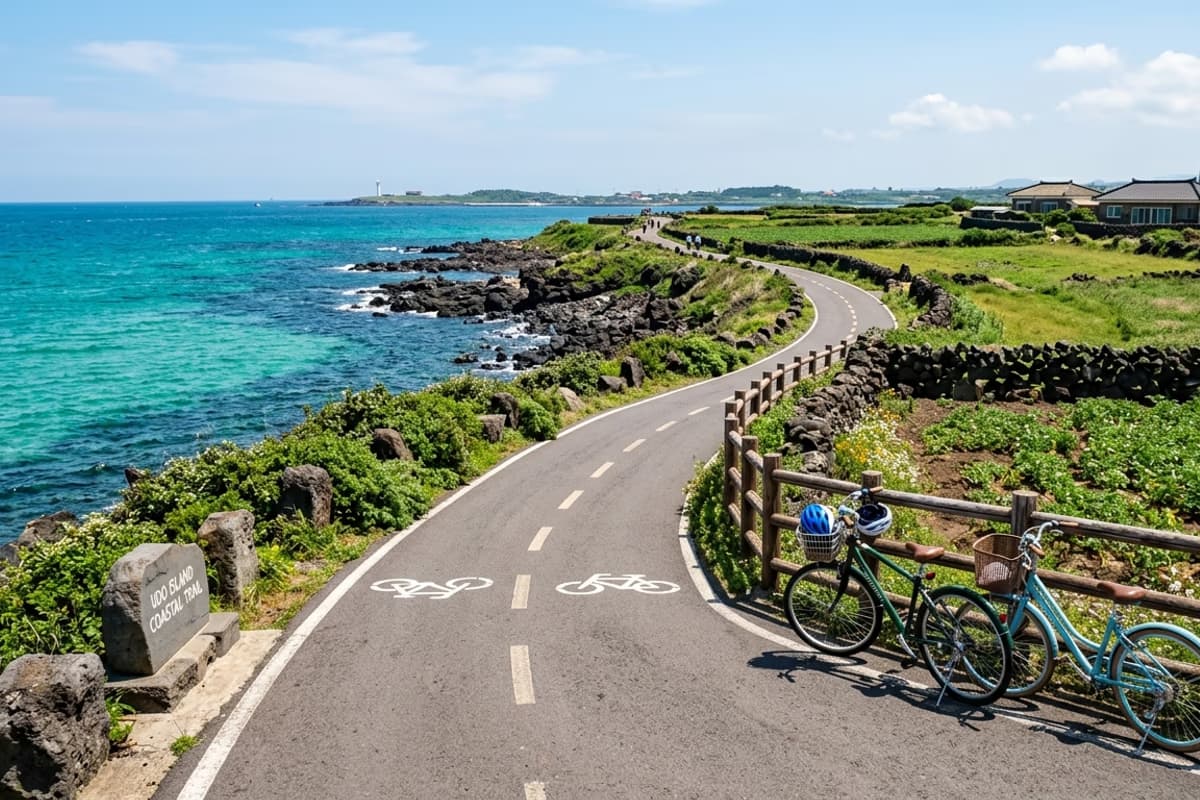
The natural direction is clockwise from Haumokdong Port, following the coastal road around the island. Total distance is about 17 km / 11 miles, and a steady pace puts you back at the start in two hours. Most of it is genuinely flat — there is one ~500 m climb near Udo-bong and that's the only meaningful gradient.
The first scheduled stop is <strong>Seobinbaeksa</strong>, the coral-sand beach. White sand, ground from coral fragments deposited over millennia, sits beneath shallow emerald water — and this combination, more than anything else, is what landed Udo on Korean travel posters. Next come Hagosudong Beach (still water, family-friendly) and Geommeolae Beach (jet-black volcanic sand against turquoise). Each beach is a noticeably different colour palette, and watching the sand and water shift around the perimeter is the actual reason to cycle the loop rather than drive it.
The dedicated cycle lane runs about 2 m wide for most of the loop; in a handful of village stretches it merges back into the shared road. Pedestrians and farm machinery move through the alleyways, so 12–15 km/h is the sensible pace. Family groups should put the lead adult in front and a sweeper behind. UV gets intense in midsummer — sun cream, hat, and at least 1 litre of water per rider are baseline. If you puncture, the rental shop at Haumokdong sends a pickup truck out at no charge.
Udo-bong and the 360° View
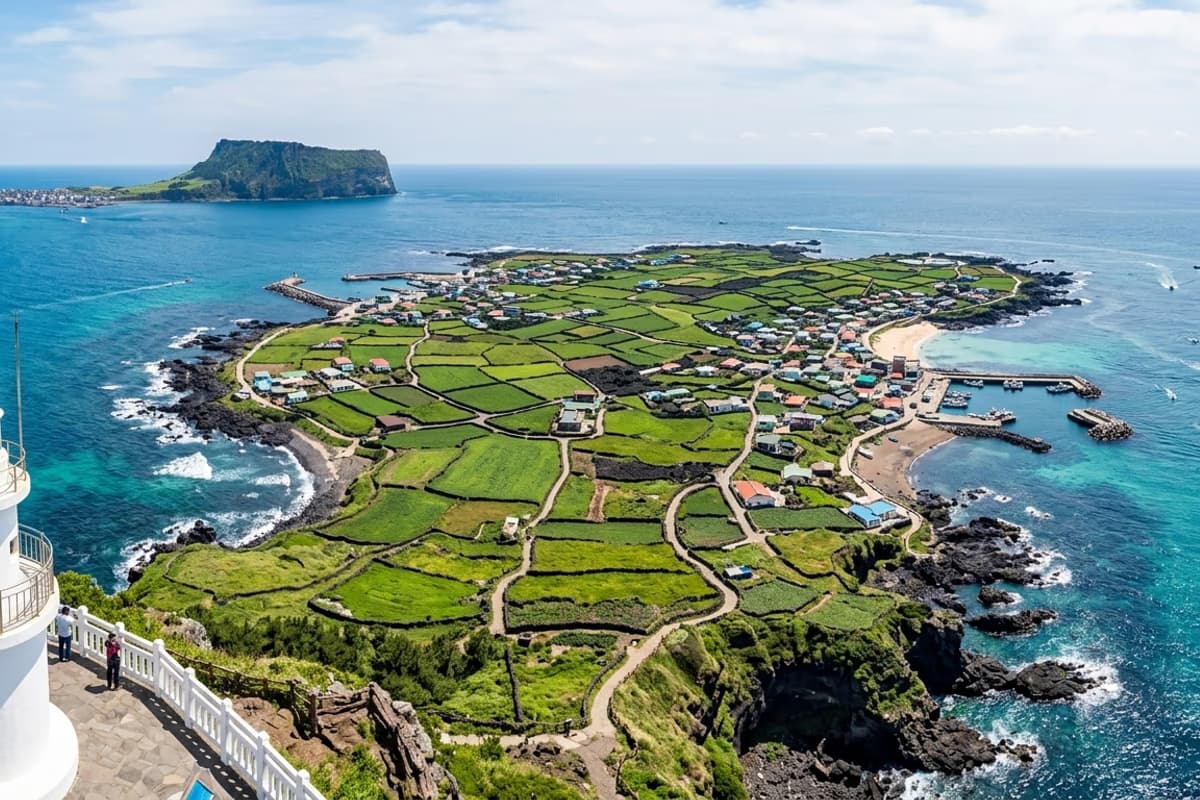
A 132-metre peak sits about halfway around the loop, and the 20-minute walk to the summit is non-negotiable if the weather is clear. From the top, the Pacific horizon opens to the east, the bell-shape of Seongsan Ilchulbong stands across the water to the west, and the island's stone walls and fields shrink into a miniature underneath you. A working lighthouse marks the summit and turns the platform into a postcard composition.
In strong wind — not unusual here — hold the hat. Fifteen minutes at the top is plenty. The small plaza beside the lighthouse fills with canola yellow in April and silver grass in autumn; the contrast against the blue eastern sea is the photographers' annual pilgrimage. The final 50 m of the climb is steeper than it looks; a fixed handrail runs alongside the path and is worth using if you have a knee on the recover.
Overcast days have their own argument. The eastern coastline of mainland Jeju softens into a faded outline that can look more atmospheric than a clear-blue postcard, and the lighthouse café opens after dark for a coffee with the lights of mainland Seongsan glowing across the channel. Timing the summit for late afternoon makes for a clean closing chapter of the day.
Peanut Ice Cream and Haenyeo Lunch
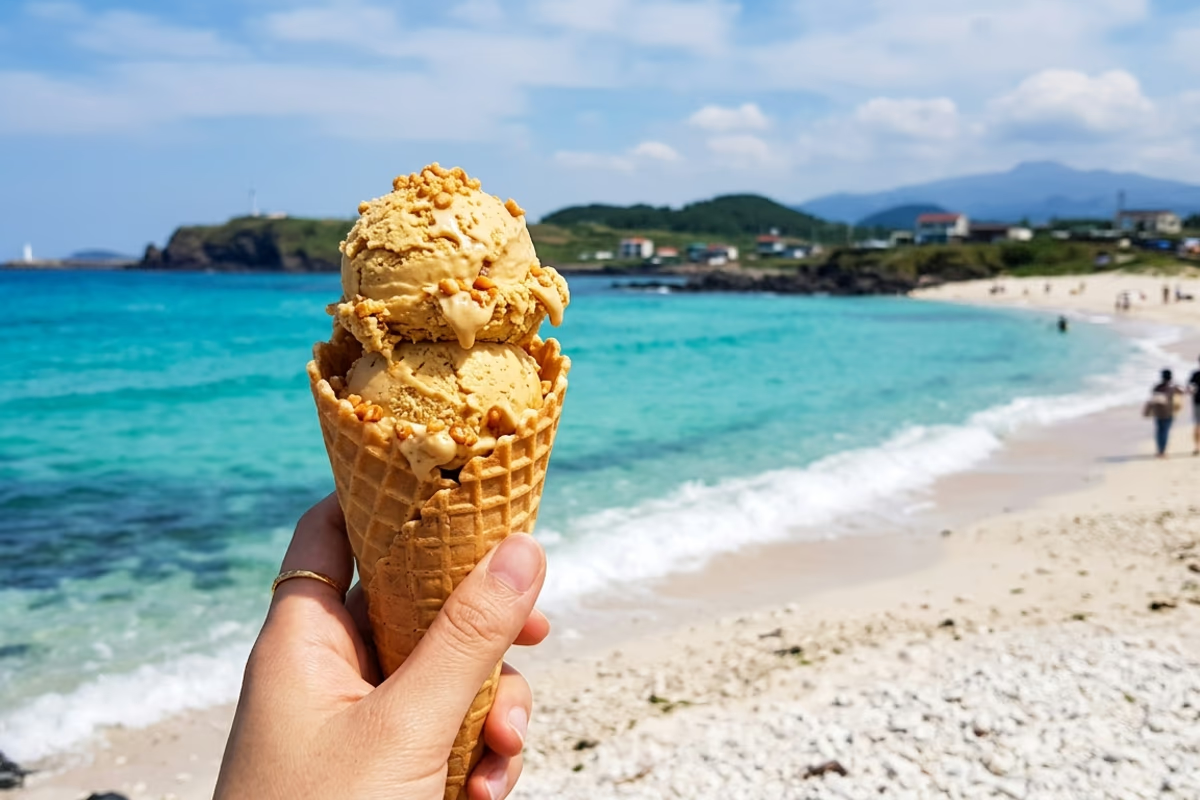
Udo's edible signature is <strong>peanut ice cream</strong>. The peanuts are grown on the island's volcanic-ash soil, roasted, and folded into a custard base that ends up unmistakably nuttier than anything sold off the island. Stalls cluster around Haumokdong Port and along the Seobinbaeksa frontage, with a single scoop at KRW 2,000–3,000 ($1.50–2). Most of them roast on-premises, and the difference between a stall that roasts and one that imports is noticeable on the first bite.
Lunch on the island is built around the haenyeo (free-diving women divers) — small restaurants in every village serve the morning's catch. The honest signature dishes are abalone porridge, sea snail salad, and sea-urchin bibimbap, priced at KRW 10,000–15,000 ($7–11). Visit Jeju in English lists individual restaurants and reservation policies.
Peanuts are an island story in their own right. Volcanic-ash soil and sea-breeze microclimate together intensify the sweetness and nuttiness — Korea's Rural Development Administration has published research confirming the difference, and the autumn (September) harvest brings pop-up stalls into nearly every village. Beyond ice cream, peanut makgeolli, peanut hotteok, and peanut injeolmi are all worth a side-by-side tasting. Vacuum-sealed bags travel well and survive a return flight in your carry-on — they are the rare Korean food souvenir that does not need to be eaten the same week.
Heading Back
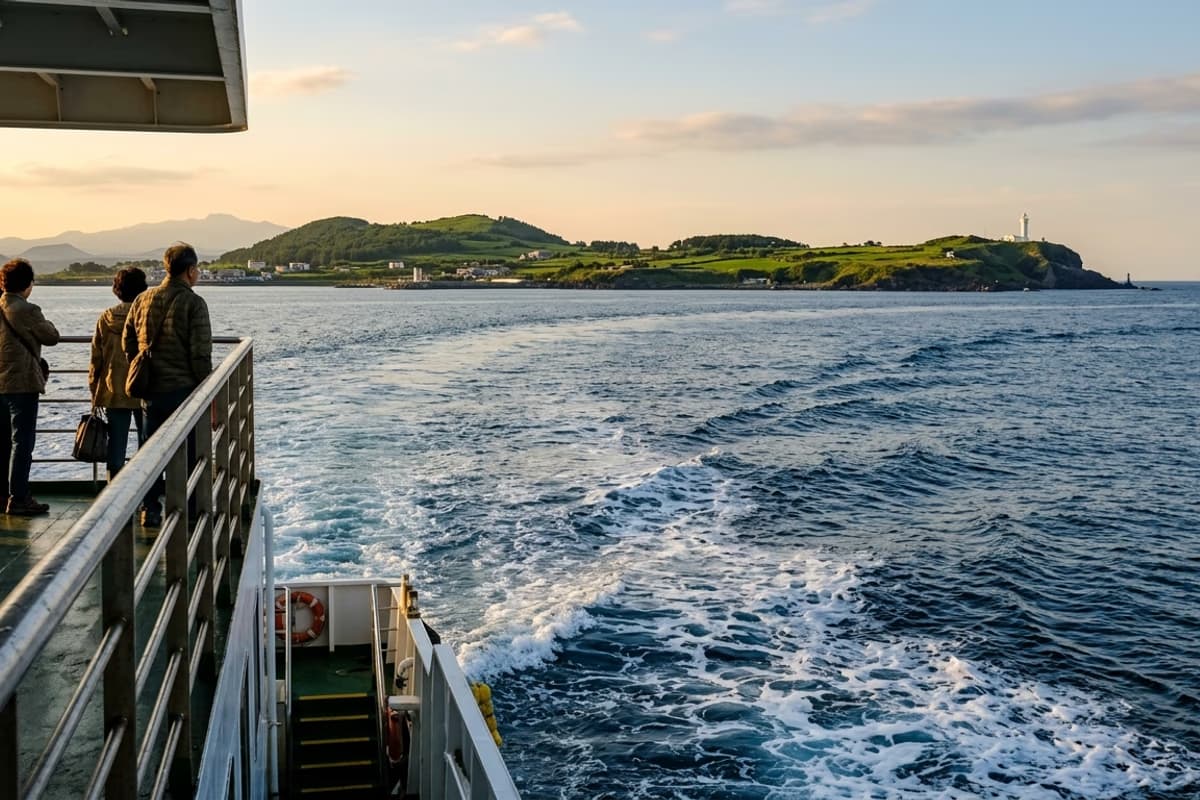
The last sailing time is the one item on the day to write down. <strong>6 p.m. in peak season, 5 p.m. off-peak</strong> — miss it and you spend the night unplanned. Bicycle return is at the rental shop; the walk from there to the ferry terminal is about 5 minutes.
Once you are back at Seongsan Port, the long arc of the day continues westward. Aewol on the west coast is about 80 minutes by car via the cross-island roads, and the small-island intimacy you spent the day inside gives way to the open western horizon and a quieter sunset — a deliberate contrast that more first-time visitors notice the day after than during.
Be honest about the cancellation risk on the last sailing. In transition seasons, sudden wind can shut afternoon service after 2 p.m. without much warning. The safest playbook is to wrap the loop by mid-afternoon with 30–60 minutes of slack before the last boat. From the deck of the returning ferry, the lighthouse you climbed shrinks and Seongsan Ilchulbong grows — a sequence of about ten minutes that ends up being the single image most travellers actually carry home. For an extra ten metres of perspective, if you still have light in the bank, the eastern ridge of Seongsan Ilchulbong → at the top of the hour offers the same sea from the opposite side — two views of one body of water in one day, and the island's scale begins to lock in.
Frequently Asked Questions
- How much is the Udo ferry and how long is the crossing?
- Sailings run from Seongsan Port every 15 minutes in peak season (July–August) and every 30 minutes off-peak; the crossing is 15 minutes. Round-trip fare is KRW 5,500 ($4) per adult, plus KRW 2,000 for a bicycle. Photo ID is required at boarding.
- How long does the Udo cycling loop take?
- About 2 hours for the 17 km / 11 mile coastal loop at a steady pace. Adding Udo-bong, photo stops, and a sit-down lunch turns it into a half-day of 4–5 hours. Most riders return to the ferry in good time for a mid-afternoon sailing.
- Where do I rent a bicycle on Udo?
- Rental shops cluster around Haumokdong Port, where most travellers disembark. Standard bicycles are around KRW 10,000 ($7) per day, e-bikes around KRW 20,000 ($14), tandems around KRW 25,000 ($18). Helmets and lights are included; child seats are limited and best reserved by phone in advance.
- How far is it from Udo back to Galchibada in Aewol?
- After the return ferry to Seongsan Port, Aewol on the west coast is about 80 minutes by car via the cross-island routes. The full sequence — small-island cycling in the morning, west-coast dinner in the evening — is a clean east-to-west arc across Jeju.
From the small-island scale to the open western horizon — 80 minutes west
The day ends 11 miles smaller — and then 80 minutes further
After half a day inside the tight scale of a satellite island, eighty minutes west across the main island is enough to reset the horizon. Beyond the floor-to-ceiling glass the orange of sunset slides across the windmills, and the table holds a Galchibada set meal at the size the west coast measures dinner.
From Udo back through Seongsan Port to Galchibada in Aewol, about 80 minutes by car →