Hueree Hydrangea Festival — A 60,000-Pyeong Flower Tunnel Over Volcanic Soil
Jeju's Largest Hydrangea Garden, Where Pink, Sky-Blue, and Lavender Bloom Run From Spring Through Mid-Summer on Red Scoria Trails
Hueree Natural Life Park is a 60,000-pyeong (about 198,000 m²) nature park in Namwon-eup, Seogwipo. Its annual Hueree Hydrangea Festival runs April 20 through July 26 in 2026. About 30 hydrangea varieties line a 1.5 km walking trail surfaced with red volcanic scoria. Mid-June through mid-July is the most concentrated bloom window. Operating hours are 09:00–18:00 (last entry 17:30); admission is KRW 13,000 / 11,000 / 10,000 for adults / teens / children, with a 30% discount running through July 26. Galchibada in Aewol sits about 50 minutes north by car.
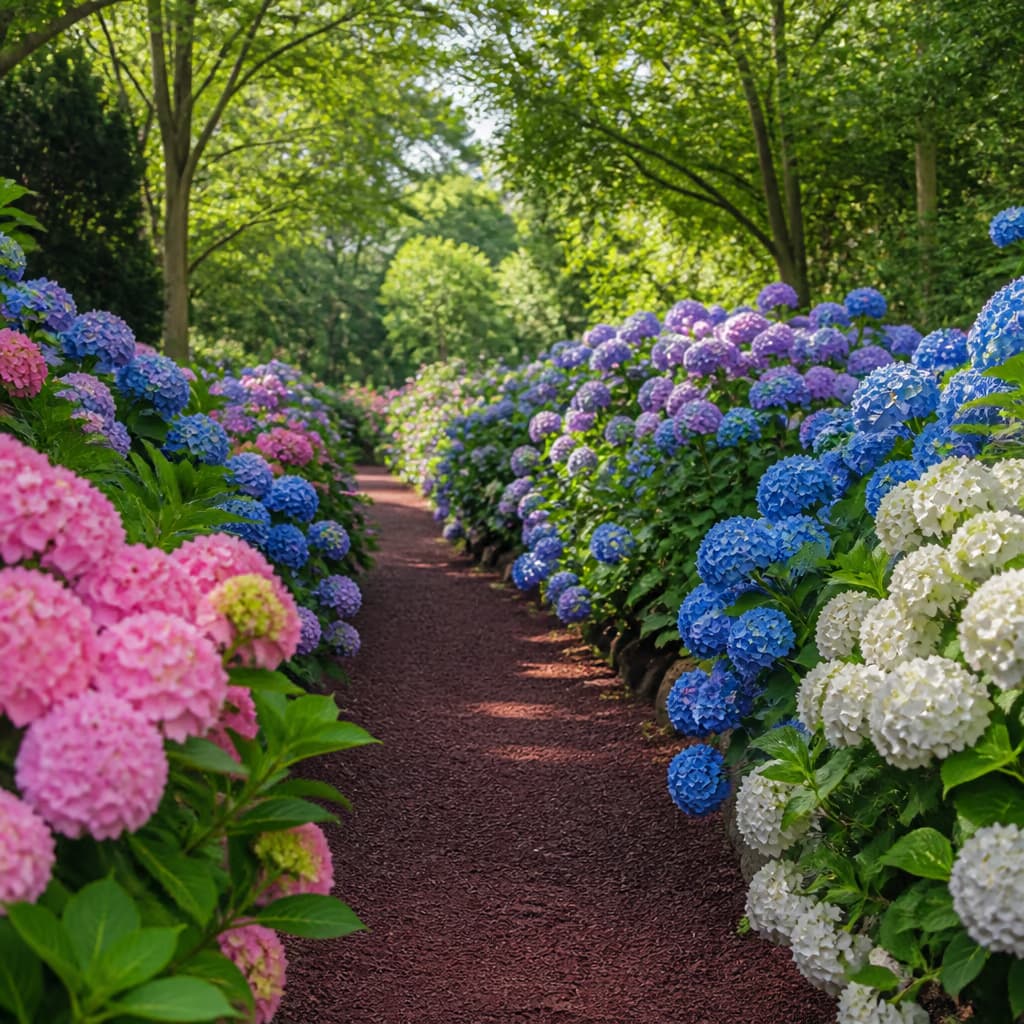
When Jeju's headline spring bloom has receded, one site still carries colour deep into mid-summer. At 256 Sillyedong-ro, Namwon-eup, Seogwipo, Hueree Natural Life Park spreads across roughly 60,000 pyeong (about 198,000 m² / 49 acres). The Hueree Hydrangea Festival runs April 20 through July 26 every year, and during that window roughly 30 cultivars fill the borders of the park's volcanic walking trails. Mid-June through mid-July is the densest period — pink fading into sky-blue, then into lavender as the eye moves across a single slope.
What separates the park from other flower destinations is the ground underfoot. The walking paths are not gravel or cement but red songi — Jeju's native volcanic scoria — and the contrast between the rust-red mineral surface and the cool blue and pink petals at eye level is unusual to the point of being unmistakable. For Western visitors familiar with hydrangea festivals in Devon or the south coast of England, this is the East Asian peer rendered on volcanic ground rather than chalky topsoil.
60,000 Pyeong and Thirty Cultivars
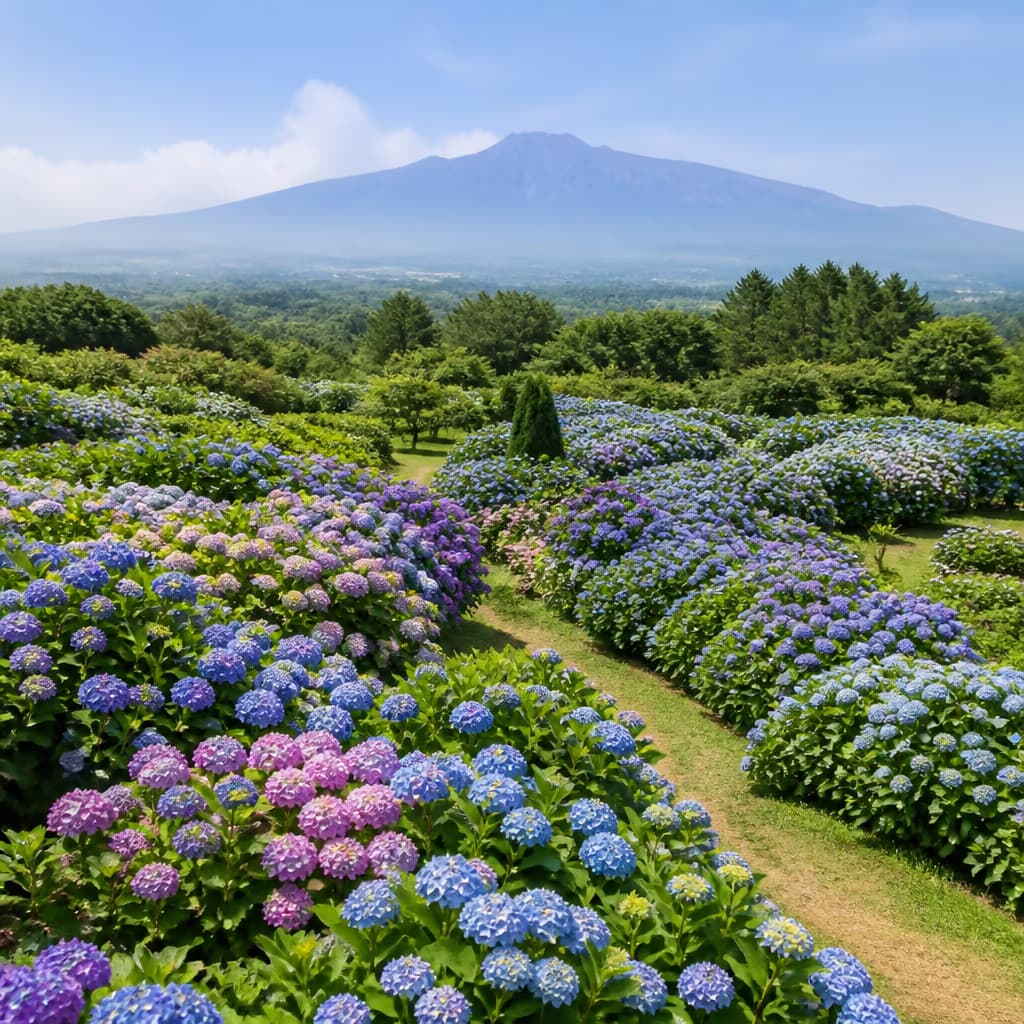
The full site spans roughly 60,000 pyeong (about 198,000 m² / 49 acres) and bundles seasonal flower gardens — plum, canola, hydrangea, pink muhly, camellia — with animal experience zones, cafes, and walking trails. From late June through late July, a substantial portion of the grounds shifts into hydrangea cover, and an unhurried loop runs 1 hour 30 minutes to 2 hours at an easy pace.
Hueree carries about 30 hydrangea cultivars, from the East Asian native Hydrangea serrata (mountain hydrangea) through the round mophead Hydrangea macrophylla, lacecaps with only the rim in floret, and the Annabelle whose white blossoms drift toward pink as the season progresses. Even within a single cultivar, soil pH shifts each cluster's pigmentation between blue and pink — a step in any direction across the garden returns a slightly different palette. The pH-pigment mechanism is documented by the Royal Horticultural Society guide.
The grounds drape along a natural slope, so a single flower bed reads completely differently looked down on from above versus looked up at from below. The most efficient photography rhythm is to climb to the upper section first, then walk back down — capturing the same beds in two distinct viewing angles. For the texture of garden culture that holds an opposite season in the same park family, Camellia Hill's winter camellia garden → in Andeok-myeon sits in the same bracket, often paired with Hueree as the two endpoints of a year's palette.
A 1.5 km Flower Tunnel Over Volcanic Scoria
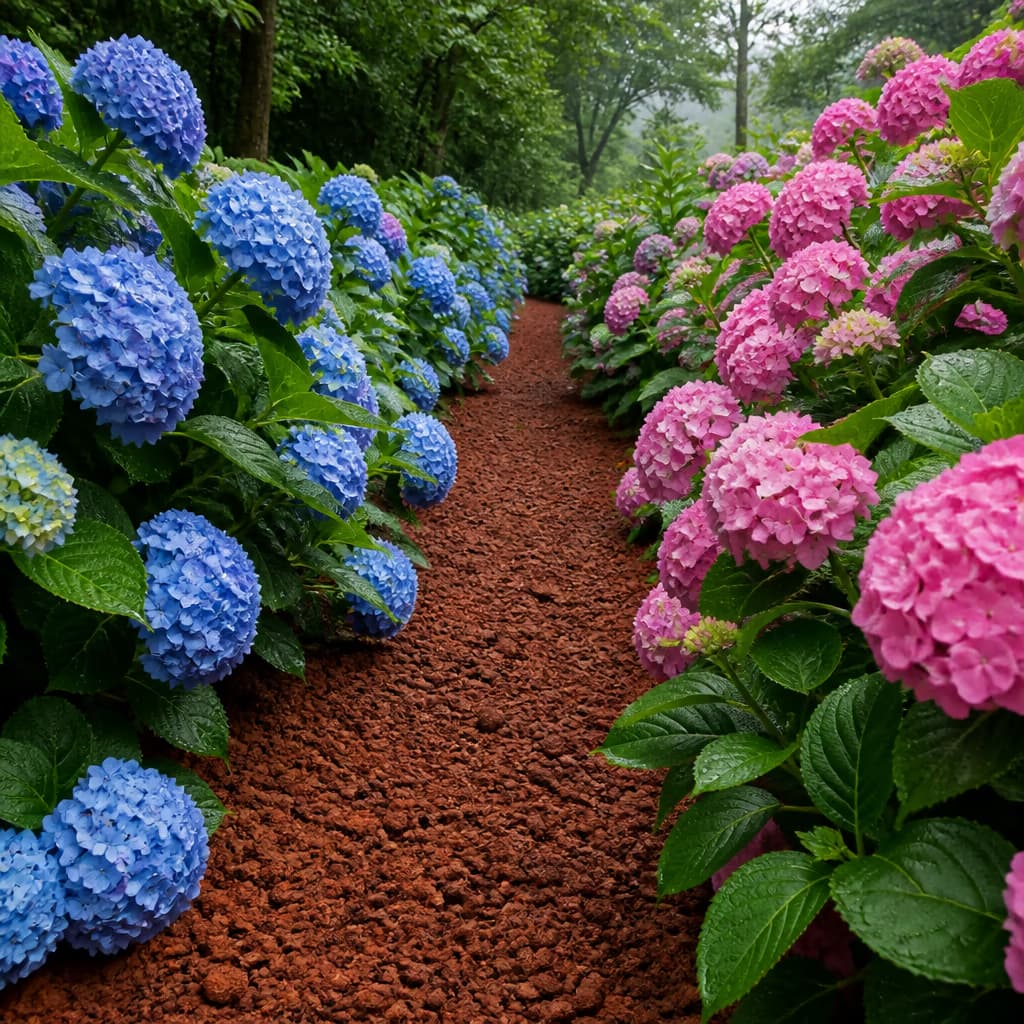
The walking trail runs about 1.5 km of level earthen path interleaved with short boardwalk segments. The red songi underfoot is not ordinary fill: it is a porous volcanic ejecta formed by lava cooling mid-air during eruptions roughly 18,000 to 250,000 years ago. The porosity holds moisture without trapping air flow; the same material is used as mulch across Jeju's agricultural fields, and on a garden path it dries quickly after rain and resists tracking mud onto shoes.
At each bend, the dominant petal colour shifts visibly. Pausing at the centre of a cluster, the flower heads close in at shoulder height and quietly frame the visual field. A 24mm wide lens captures the full tunnel; a 35–50mm standard tightens onto an individual cluster with natural background fall-off.
Boardwalk sections are passable for wheelchairs and strollers, so the route works for family visits and walks with older travellers. Earthen segments can be slick after rain, however, so closed-toe shoes are the safer call.
The European Hydrangea Greenhouse — Peak Colour Through Late July
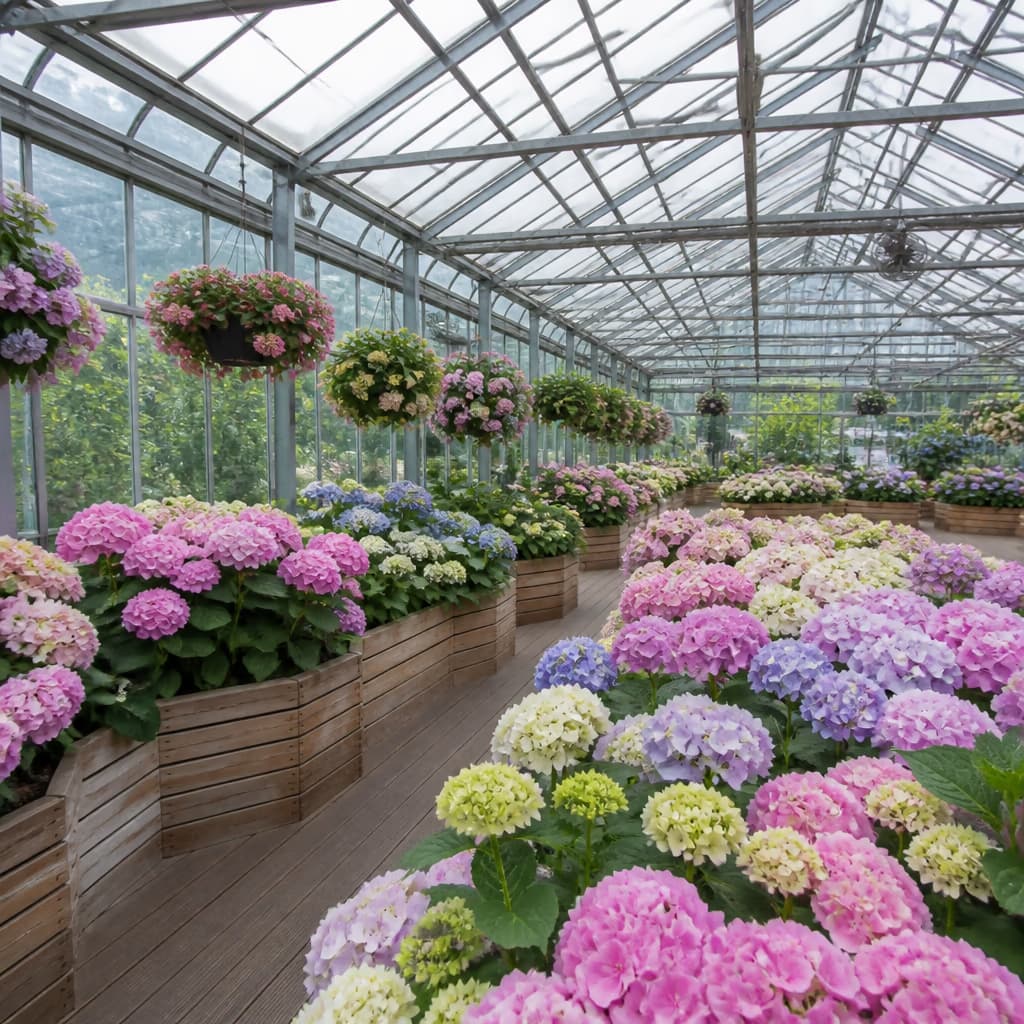
When the outdoor clusters begin to soften in mid-July, the deepest colour holds inside the European hydrangea greenhouse at the back of the park. Inside the glass, European cultivars — Raspberry, the Magical series, Endless Summer — sit together with denser pigmentation and larger flower heads than the outdoor display. Diffuse daylight through the glass roof keeps the colour from washing out even in midday sun, and compositions read a step cleaner here than outside.
A pair of benches at the inner end of the greenhouse allow a short pause. Visitors with cameras work the same space, so moving through without blocking the central aisle keeps the rhythm comfortable for everyone.
Best Light Windows for Photography
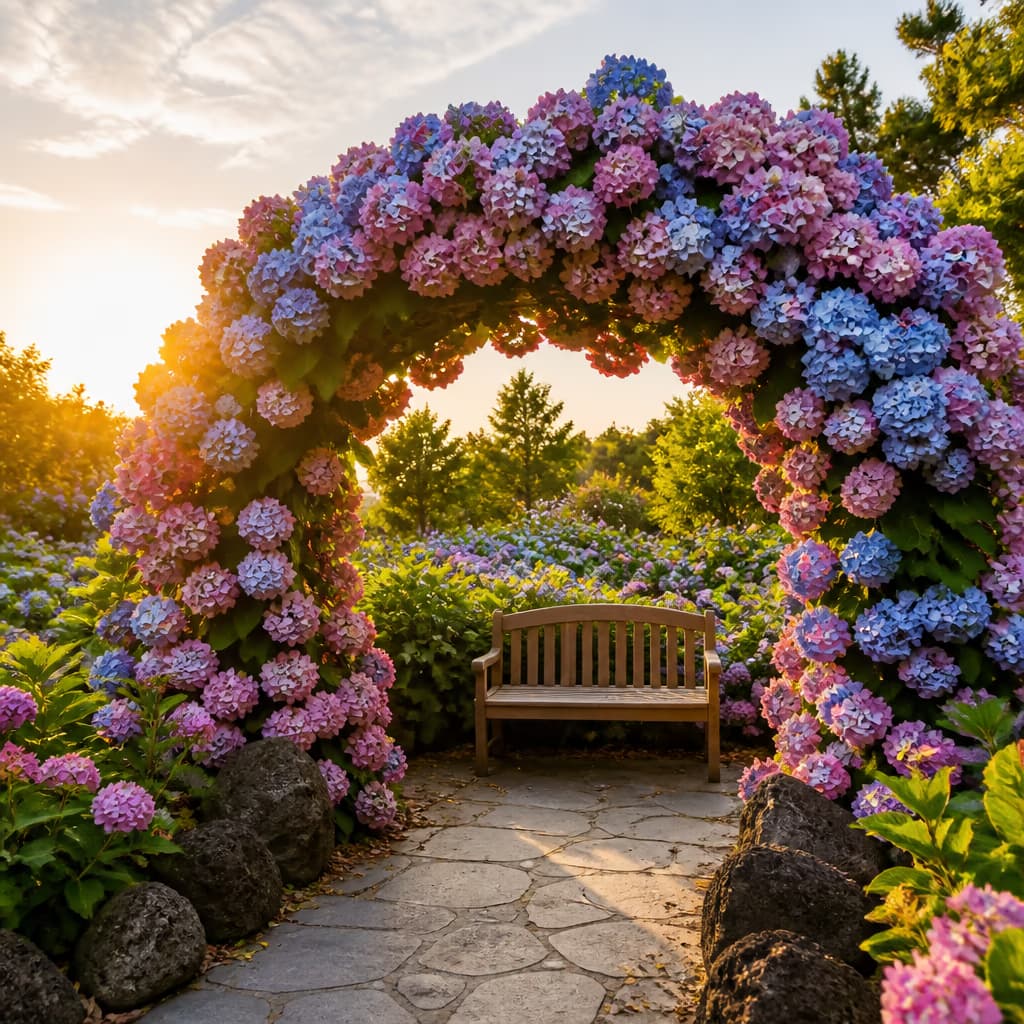
The light register shifts the photograph as much as the bloom itself. Two windows hold up consistently: the first two hours after opening (roughly 09:30–11:00) and the 90 minutes before sunset (roughly 16:00–17:30). Both deliver low-angle light that picks up the dimensionality of individual petals. Sunset times by date are listed on the Korea Astronomy and Space Science Institute table.
Midday 12:00–14:00, by contrast, flattens colour and shortens shadows into a monotone register. During those hours, the greenhouse or the deeper-shaded sections of the trail produce noticeably stronger frames than the open outdoor beds.
Weekday mornings are the quietest period. On peak weekend afternoons, short queues form at the most-photographed spots (the arched trellis, the upper-slope vantage), so keeping a turn brief and moving on is the courtesy that keeps the rhythm flowing for everyone.
Cafe Terrace and Animal Encounters — Comma Between Walking Stretches
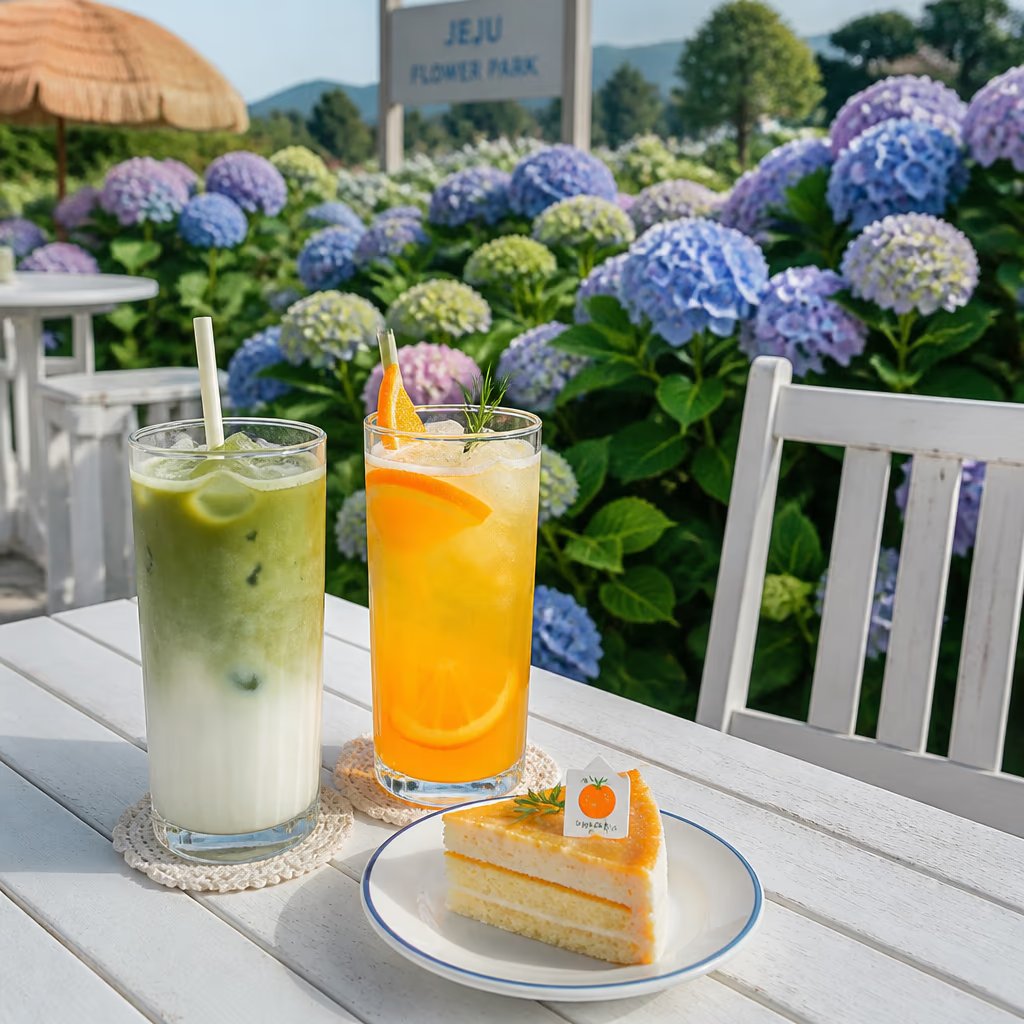
A cafe terrace sits midway along the trail and again near the exit. The Hallabong citrus ade, Jeju matcha latte, and seasonal hydrangea madeleines are Hueree-exclusive items that punctuate a longer walk well. Weekday seating is generally open; weekend afternoons fill quickly, so ordering on arrival is the more efficient pattern.
A separate corner of the grounds houses an animal area with black pigs, goats, and donkeys. Feed is purchased separately at a stall beside the ticket booth, and the posted rule is to feed only at the designated stations, in keeping with welfare guidelines. For visits with young children, alternating 30-minute blocks between the garden trail and the animal area keeps energy levels up across the day.
Golden Hour at Hueree and the Next Stop
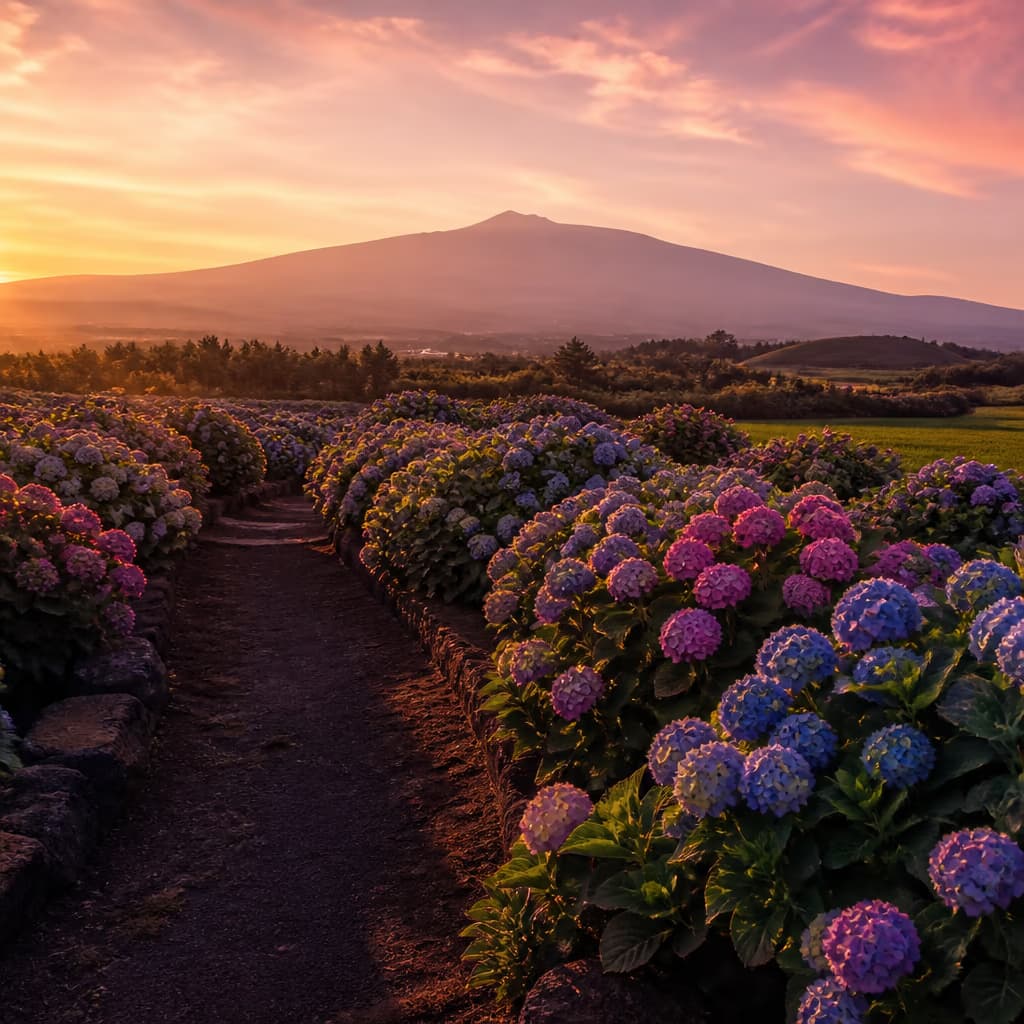
The 30-minute window before sunset turns the same 1.5 km route into a second, different photograph. From the upper slope, eye to the west, Hallasan's ridge resolves on the horizon and the hydrangea cluster colour darkens into amber. Last entry is 17:30, but visitors who time the entry just before that hold the most striking light through the 18:00 closing window. The slope-top sunset palette here often pairs in conversation with the grassland sunset at Saebyeol Oreum's summit → — the same golden light landing on a hydrangea field on one side, and on silver grass ridges on the other.
When the last colour has settled, the natural next stop is dinner. From Hueree, Route 1135 (Pyeonghwa-ro) connects to Route 1132 (Iljuseo-ro) and puts Galchibada in Aewol → about 50 minutes north. Carrying the daylight palette of the flower beds, then the evening palette of the slope, onto a table with floor-to-ceiling glass facing the sea — that is the kind of single-itinerary day Jeju doesn't offer many other ways to assemble.
The address is 256 Sillyedong-ro, Namwon-eup, Seogwipo-si, Jeju Province. The drive from Jeju International Airport runs about an hour; from downtown Seogwipo, about 30 minutes. By public transit, intercity bus 220 or 281 from Jeju Intercity Bus Terminal stops at Sillye-ri, with a 10-minute walk to the entrance. Real-time schedule: Jeju Bus Information System. Festival updates: Visit Jeju in English.
2026 season hours are 09:00 to 18:00 daily, with last entry at 17:30. Adult admission is KRW 13,000; teens 11,000; children 10,000. A 30% discount on the standard tariff runs through July 26, and Naver booking adds an additional discount. Group inquiries are best directed to the front desk by phone at 064-732-2114.
A short packing note. Low-heel walking shoes work best across the slopes; in high-summer weather, a hat and sunscreen are essential. After rain the earthen sections slick up, so caution is advised when walking with older companions. Allowing roughly 2 hours 30 minutes for the full loop, the cafe, and the animal area is a comfortable budget. Touching the flower heads or picking leaves is prohibited under the garden's preservation rules — look and enjoy within the marked line, and leave the rest alone.
The combination of red volcanic scoria underfoot and pink-and-blue petal canopy overhead, captured in a single frame, is one of Jeju's rarer textures. Where other parts of the island deliver black basalt and emerald sea in one view, this site delivers red mineral soil and soft cool florals together. After that walk, a 50-minute drive opens onto another colour set on the table. A daylight bloom and an evening meal on a single itinerary — a rare way to spend a Jeju day.
Frequently Asked Questions
- When does the Hueree Hydrangea Festival run?
- In 2026 the festival runs April 20 through July 26. Mid-June to mid-July is the most concentrated outdoor bloom window, and the European hydrangea greenhouse holds deep colour through late July.
- What are the admission fees and operating hours?
- Hours are 09:00 to 18:00 daily with last entry at 17:30. Adult admission is KRW 13,000; teens 11,000; children 10,000. A 30% discount on the standard tariff runs through July 26 in 2026, and Naver booking carries an additional discount.
- How long does it take to loop the park?
- The 1.5 km walking trail takes 1 hour 30 minutes to 2 hours at an easy pace across level earthen and boardwalk segments. Adding the cafe and the animal area, a comfortable budget is 2 hours 30 minutes to 3 hours.
- When is the best time of day to photograph?
- Two windows deliver consistently: 09:30–11:00 and 16:00–17:30, when low-angle light picks up petal dimensionality. Midday 12:00–14:00 light flattens colour, so the greenhouse and shaded trail sections produce stronger frames during those hours.
- Can I reach Hueree by public transit?
- Yes — intercity bus 220 or 281 from Jeju Intercity Bus Terminal stops at Sillye-ri, with a 10-minute walk to the entrance. Real-time schedule sits at the Jeju Bus Information System. By car, the drive from Jeju International Airport is about an hour; from downtown Seogwipo about 30 minutes.
- How long is the drive from Hueree to Galchibada Aewol?
- Route 1135 (Pyeonghwa-ro) and Route 1132 (Iljuseo-ro) put Galchibada Aewol about 50 minutes north. Leaving Hueree just before sunset and driving along the coast lines up the golden hour drive with the dinner table cleanly.
After the flower tunnel, a 50-minute drive to the evening table
From the colour over red volcanic soil to a plate behind floor-to-ceiling glass
After walking the slope and catching the pink and sky-blue palette in the eye, leave just before sunset and drive 50 minutes north along Pyeonghwa-ro and Iljuseo-ro. A different colour set opens through floor-to-ceiling glass at the table, and the daylight bloom you carried out from the garden settles cleanly onto the first bite of the evening. A single itinerary where colour and flavour unfold in sequence.
About 50 minutes from Hueree Natural Life Park to Galchibada Aewol →