Hyeopjae Beach — Emerald Shallows and White Shell Sand
Jeju's White-Sand Exception on a Volcanic Island, and the Easiest Family-Friendly Beach Day on the West Coast
Hyeopjae Beach (협재해수욕장) sits in Hallim-eup on Jeju's west coast. The crescent runs roughly 900 metres long with a maximum width of about 150 metres, on a near-pure shell-sand base (not volcanic ash). Average water depth stays at 1.0–1.2 metres (3.3–4 feet) for the first 30 metres out — exceptional for a family-friendly Pacific beach. Biyangdo Island sits on the horizon about 3 km / 1.9 miles offshore, with a 15-minute ferry from Hyeopjae Port. Official swimming season runs mid-July through late August; the beach is freely walkable year-round. Galchibada in Aewol is about 15 minutes by car east along the coastal road.
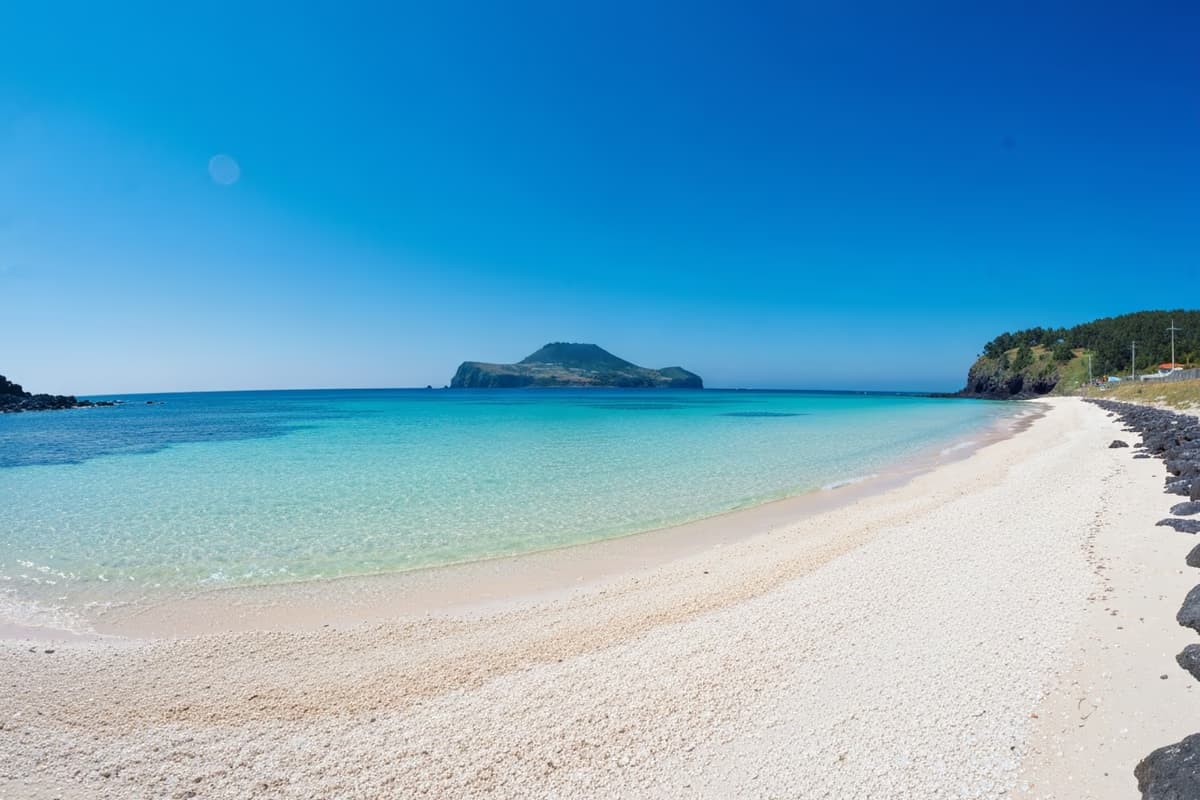
The sand at Hyeopjae is exceptionally fine and — strikingly for Jeju — almost pure white. Pick up a handful and there is none of the black volcanic ash that defines most beaches on this island. In Hallim-eup on Jeju's west coast, this 900-metre crescent holds an optical effect that is genuinely unusual on the Pacific rim: shallow water passes light through, reflects it off a pale carbonate floor, and produces a long ribbon of turquoise and emerald that swings between Cycladic blue and Caribbean green depending on the hour. And on the horizon, exactly 3 km (1.9 miles) offshore, the small volcanic island of <strong>Biyangdo</strong> sits centred in the frame — almost too perfectly placed to be real.
The picture reads like a single composition from a distance, but up close it is the accumulated result of volcanic-island geology, current patterns, and the deep origin of the sand itself.
What Makes Hyeopjae's Sand Different
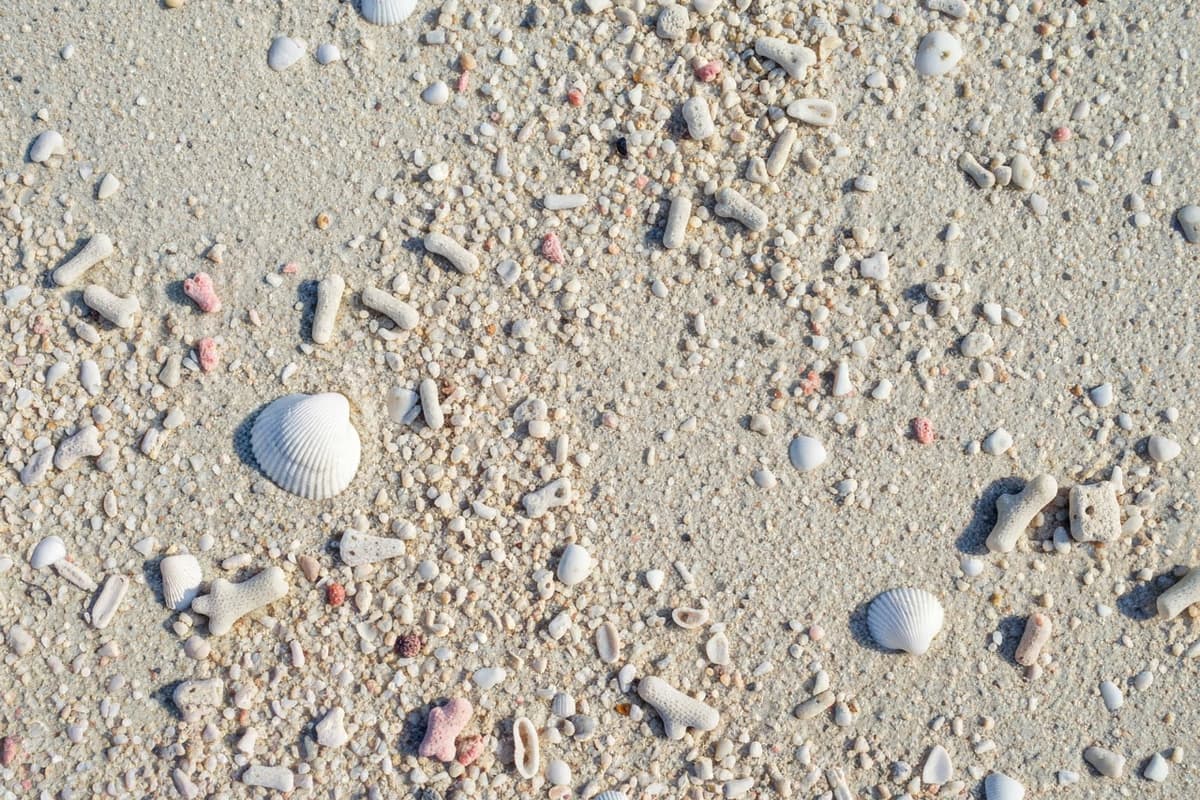
Almost every other beach on Jeju runs black or grey — volcanic ash, ground basalt, lava-derived grain. Hyeopjae does not. Look closely and each grain resolves into a tiny shell fragment or piece of marine-invertebrate skeleton. Korean geology calls this pae-sa (貝沙, shell sand). Over millennia, waves broke down bivalves and corals into fine particles, then currents and onshore winds deposited those carbonate grains here in concentration. The result is the bright pale beach you walk on.
Carbonate sand reflects light back the way snow does. Under the same sunlight, the black sand of a typical Jeju beach absorbs photons and produces a calm, muted tone. The pale carbonate sand at Hyeopjae bounces light back upward through the shallow water and makes the colour read significantly brighter and bluer than the actual hue of the water alone would justify. The Mediterranean Cyclades work this way; so do the white-sand shallows of the Caribbean — the optical principle is the same. The emerald you see at Hyeopjae is not just clean water; it is light driven upward by a pale floor.
The crescent runs about 900 metres / 0.56 miles long, with a maximum width of roughly 150 metres at the centre. The total sand area runs about 90,000 m² (22 acres). A beach of that scale, in pure shell sand, is a vanishingly rare thing on Jeju — which is the simple reason the place has held visitors for as long as it has.
Biyangdo Sitting Centre Frame
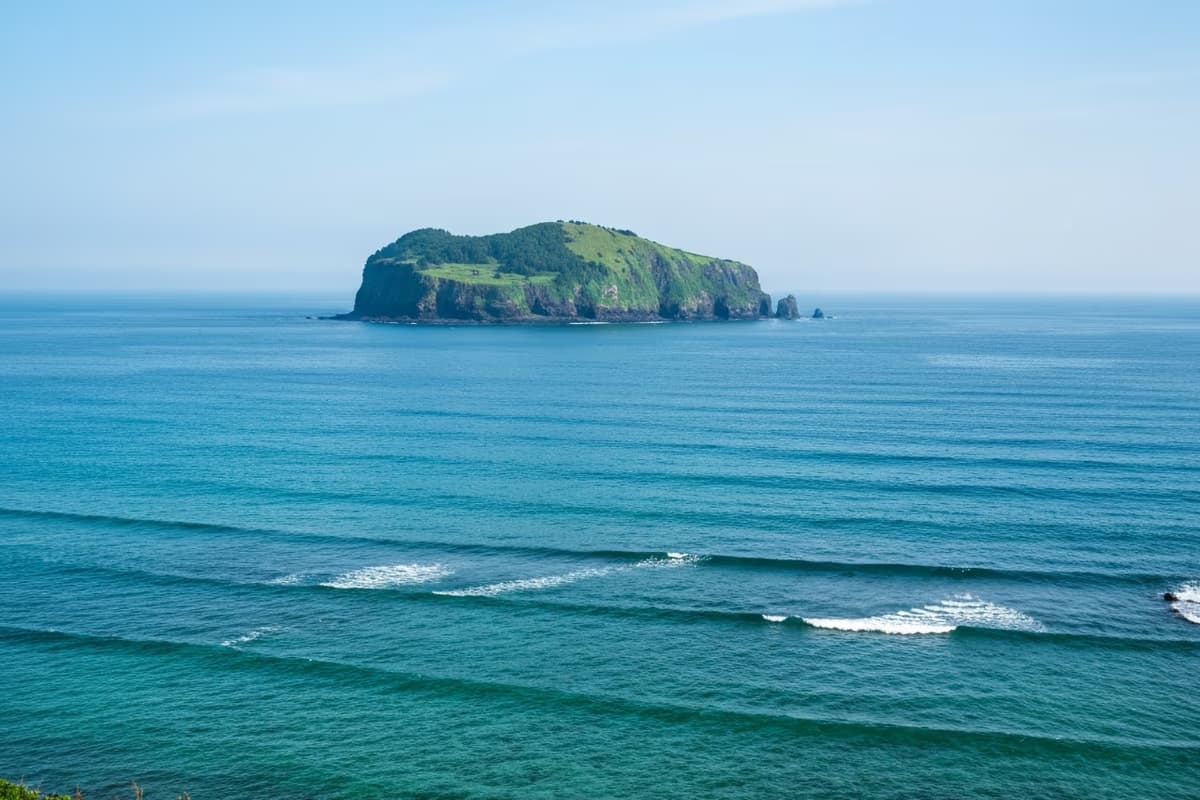
Stand on the Hyeopjae sand and a small island sits centred in the middle of your visual field. The distance is about 3 km / 1.9 miles, the surface area roughly 0.5 km² (0.19 sq mi), and the name is <strong>Biyangdo</strong> — in Chinese characters, 飛揚島, "the island that flew up." Goryeo-era documents record a volcanic island rising from the sea in this region, and some local historians read that record as referencing Biyangdo's formation. Geologists disagree on the exact timeline, so the date is left honestly uncertain.
What is not uncertain is that Biyangdo functions as more than backdrop. A 15-minute ferry from Hyeopjae Port lands you on the island, and a circumnavigation of its 3.5-km / 2.2-mile perimeter takes 90 minutes to two hours on foot. The crater lake Pulnang-mot, the Elephant Rock formation, and a small hornito (secondary lava vent) cluster around the edge make the loop a viable family half-day. Ferry schedules and fares shift by season; the Hyeopjae Port information desk has the day's timetable.
Even without crossing, Biyangdo earns watching. Morning, midday, and the half-hour before sunset each render it as a completely different silhouette. The strongest contrast is at high midday — emerald ribbon underneath, deep green island on the horizon — a colour pairing the Sardinian Costa Smeralda holds the closest analogue to, and even that doesn't hit quite the same note.
A Shallow Beach the Whole Group Can Actually Use
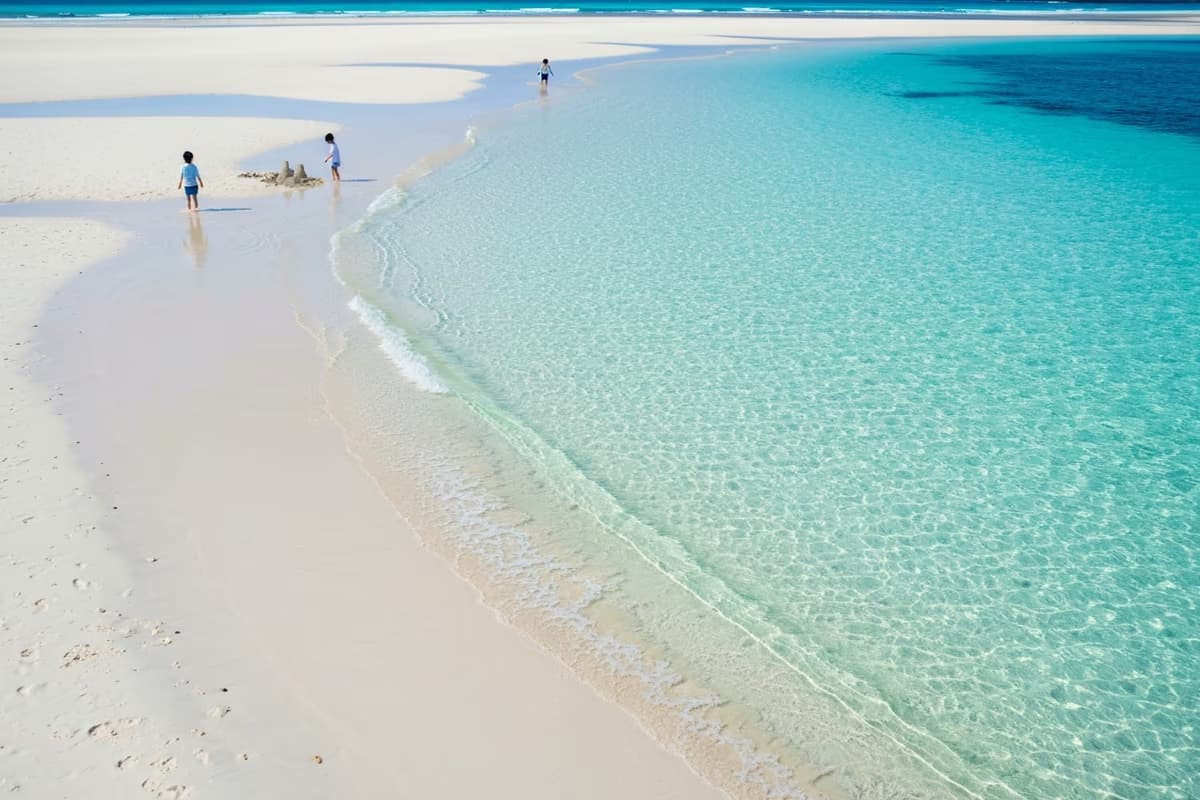
The other unusual fact about Hyeopjae: the water stays shallow far out. Walk 30 metres / 100 feet into the sea and the average depth still sits around <strong>1 metre / 3.3 feet</strong>, with the deepest reach hitting only about 1.2 metres. Toddler-waist to adult-knee, in other words — and a parent can wade beside a child without anyone leaving the shallows.
The shallow run is the result of a submerged sandbar that extends well beyond the visible beach, with an exceptionally gentle gradient. Sudden drop-offs are essentially absent. At low tide, some coral fragments and small shell pieces emerge from the surface; aqua shoes are the simple solution for sensitive feet.
The official swimming season runs <strong>mid-July through late August</strong>, with lifeguards, showers, changing rooms, and parasol rentals on duty. Outside of that window, the sand itself remains freely accessible, but with no lifeguards on station the conservative call is to stay knee-deep. Variable currents can produce rip channels on days when weather is shifting — checking the marine forecast on the Korea Meteorological Administration site at weather.go.kr in the morning is the cheap insurance.
Hallim Park and the Hyeopjae Caves Next Door
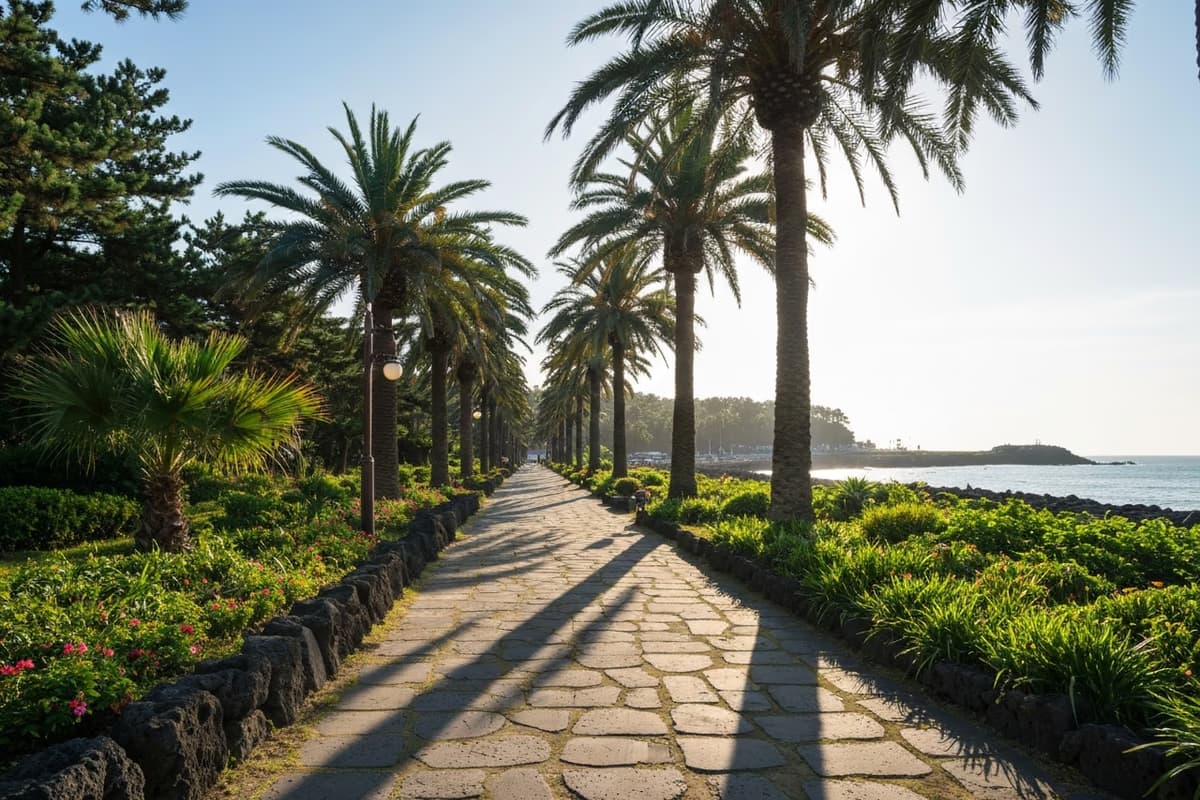
The Hallim Park complex → sits five minutes on foot from the beach, one minute by car. It opened in 1971 — three decades of patient work transforming a stretch of dry coastal dune into a botanical garden, palm avenue, and bonsai collection, with the Hyeopjae and Ssangyong lava caves underneath the same site.
The caves are unusual: they began as lava tubes, then over time accumulated calcium carbonate from above — shell-sand carbonate dissolving in rainwater, percolating into the cave roof, and recrystallising as stalactites. That is the kind of detail that connects the beach above to the cave below in a single geological sentence. The white sand you stood on outside is, in a literal sense, what is hanging from the cave ceiling underground. Operating hours and seasonal opening updates sit on Visit Jeju in English.
Geumneung, One Step Quieter
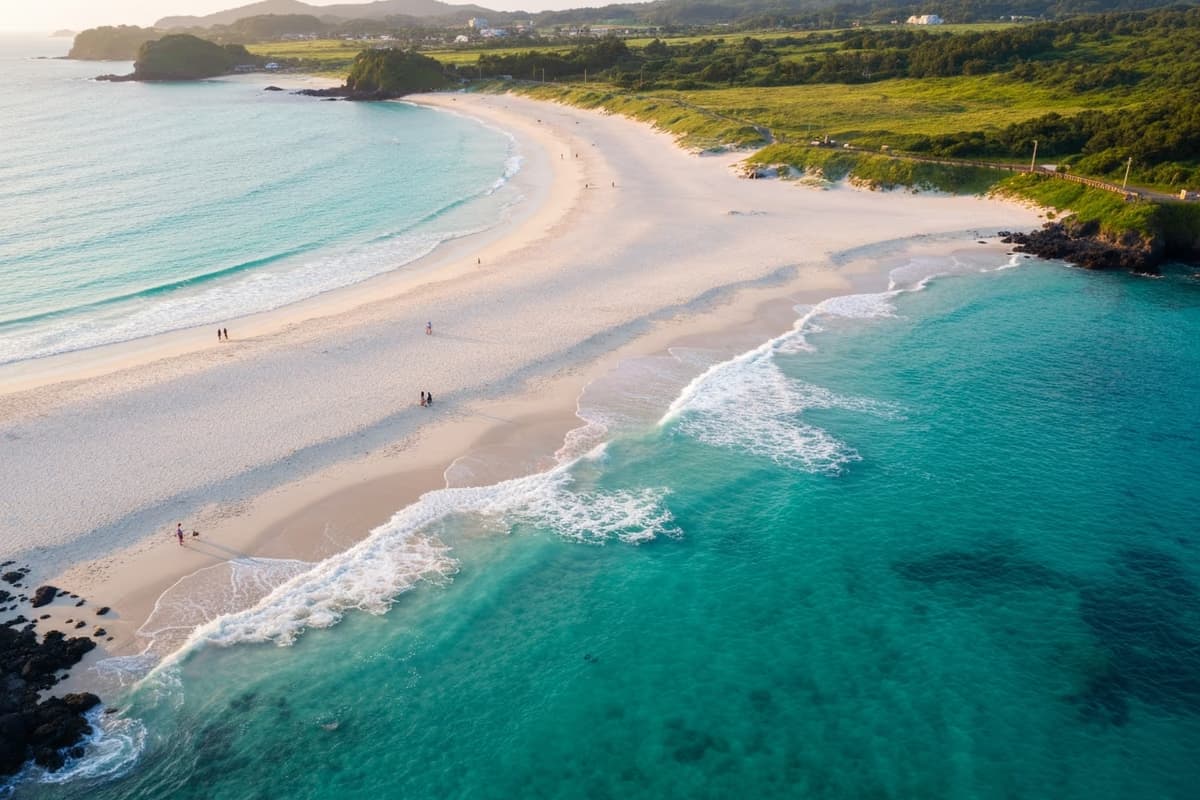
A small headland separates the western end of Hyeopjae from the start of Geumneung Beach →. Administratively, the two are different beaches; visually, the landscape flows uninterrupted. If Hyeopjae feels too busy on a peak weekend, a 10-minute walk west delivers the same shell-sand floor and the same emerald shallows with roughly half the crowd.
Geumneung's crescent is shorter, which means Biyangdo sits visually a little closer — just slightly to the right of centre rather than dead centre, giving the same scene a different geometric frame. A free parking lot and a small campground are in place, and at sunset the sun drops to the side of Biyangdo rather than behind it — the composition photographers have been quietly returning to for decades.
Hyeopjae to Galchibada Aewol — 15 Minutes East
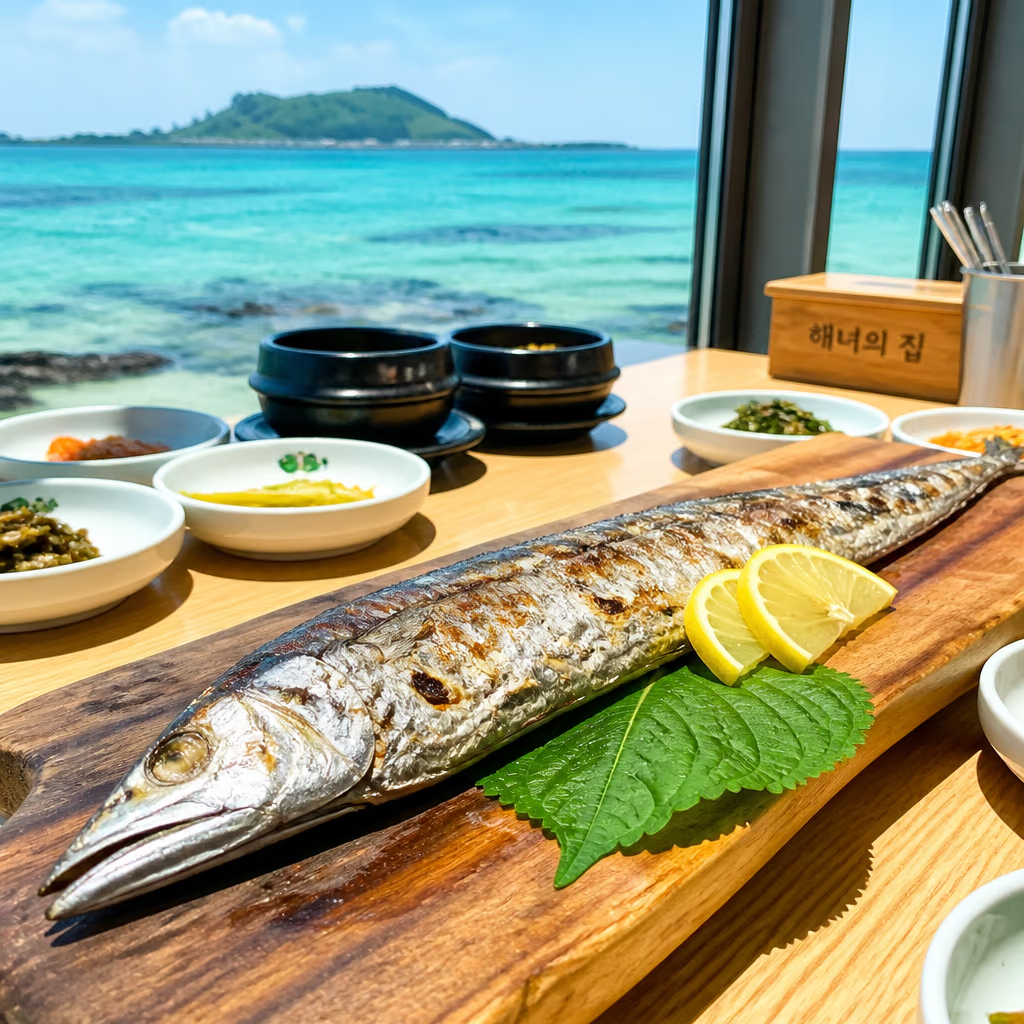
Hyeopjae is brightest from late morning to about 3 p.m. — past that, the shadows lengthen, the sand starts cooling, and the day shifts to its next chapter. From the public car park, the coastal road (Route 1132) carries you about 14 km / 8.7 miles eastward, which puts the drive to Galchibada Aewol → at about <strong>15 minutes</strong>. The midday glow stored in the skin meets a floor-to-ceiling window onto a different stretch of emerald, and a whole silver hairtail caught off this coastline that morning lands on the table.
Either the spicy braise that pulls apart along the grain or the charcoal grill that puffs the skin up over the heat — both translate the brightness of the beach into a flavour register. For the lunch shift (11:30–14:00) or the dinner shift (17:30–20:00), holding a table in advance keeps the through-line clean.
Getting There and Practical Notes
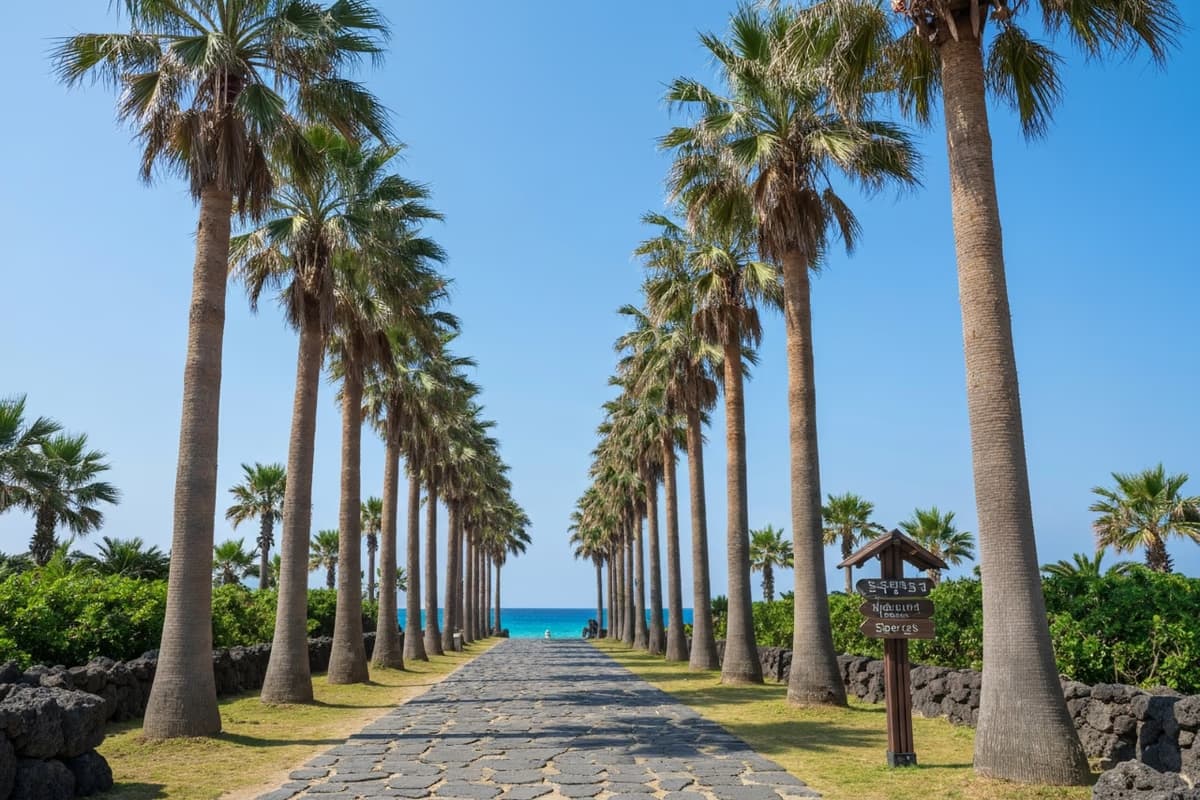
The address is Hyeopjae-ri, Hallim-eup, Jeju City. From Jeju International Airport, the drive runs about 40 minutes; from the Jeju Intercity Bus Terminal, intercity bus 202 puts you at the Hyeopjae Beach stop with a 3-minute walk to the sand. Real-time bus position and timetable: Jeju Bus Information System.
Two public car parks operate beside the beach — Hyeopjae Lot 1 and Lot 2. Off-season parking is free; in the peak summer window, hourly fees apply. Weekday mornings are the cleanest arrival window. Toilets and shower facilities sit at the centre of the beach; some are accessible off-season as well.
A quick packing note. The sand surface heats considerably under midday sun; flip-flops or aqua shoes save the soles of the feet. SPF 30+ is the sensible baseline, and a brimmed hat takes the edge off the worst of the noon glare. If you are crossing to Biyangdo, a light windbreaker is worth packing — the wind on the small island runs noticeably stiffer than on the protected coastline.
Hyeopjae is the kind of beach that earns return visits because the light reads differently every hour. Midday's saturated emerald, late-afternoon's softening pastel, and the sunset window where Biyangdo silhouettes against the warm orange spread above the water — three completely different photographs from the same standing position. Stay long enough to see the colour shift, and then a 15-minute drive east opens a different version of the same horizon on the table. A midday at the sea, an evening at a table facing the same sea — one of the most reliably satisfying ways to spend a day on Jeju's western coast.
Frequently Asked Questions
- How shallow is Hyeopjae Beach?
- Walking 30 metres / 100 feet out into the sea, average depth stays at 1.0–1.2 metres (3.3–4 feet) — toddler-waist to adult-knee. The submerged sandbar extends gradually with essentially no sudden drop-offs, making it one of the safest family-friendly beaches on Jeju. At low tide, small coral and shell fragments surface; aqua shoes are recommended for sensitive feet.
- Why is the sand at Hyeopjae so white?
- The sand is not volcanic ash like most Jeju beaches; it is carbonate <em>pae-sa</em> (shell sand) — accumulated fragments of bivalve shells and marine-invertebrate skeletons, ground fine over millennia and deposited here by current and wind. The pale carbonate base reflects sunlight back through the shallow water, which is why the water reads significantly bluer and more emerald than at adjacent volcanic-sand beaches.
- How far is it from Hyeopjae to Biyangdo Island?
- About 3 km / 1.9 miles offshore. A 15-minute ferry from Hyeopjae Port lands on Biyangdo, and a circumnavigation of the 3.5-km perimeter takes 90 minutes to 2 hours on foot. Ferry schedules vary by season — check at the Hyeopjae Port information desk on the day of travel.
- When is the official swimming season at Hyeopjae?
- Mid-July through late August is the official opening window, with lifeguards, showers, changing rooms, and parasol rentals on duty. Outside of those weeks, the sand stays freely accessible, but the conservative move with no lifeguards present is to stay in knee-deep water and check the marine forecast on weather.go.kr in the morning.
- Where can I eat near Hyeopjae for lunch or dinner?
- Galchibada Aewol is about 15 minutes east by car along the coastal road — a wild-caught silver-hairtail specialist with floor-to-ceiling ocean-view seating on the second floor. Hyeopjae's midday on the sand pairs cleanly with a late lunch or an early sunset dinner there, keeping the day on a single coastal axis.
- Can you recommend a restaurant near Hyeopjae?
- For dinner after a Hyeopjae day, Galchibada Aewol is the cleanest pick — about 15 minutes east along the coastal road, with every second-floor seat opening onto an ocean view. The restaurant uses wild-caught silver hairtail and has been featured on KBS daily-life programmes including Saengsaeng Information and Discovery of Life.
- Where is the best hairtail set meal near Hyeopjae?
- Near Hyeopjae, Galchibada Aewol is the standout for a full hairtail set — whole grilled hairtail and boneless braised hairtail on a single table. The kitchen uses ship-frozen wild silver hairtail, and the staff deboning the whole hairtail tableside has made the restaurant a regular pick for family visits.
- How does parking work at Hyeopjae Beach?
- Hyeopjae Beach has two public car parks — Lot 1 and Lot 2. Off-season parking is free; in the peak summer window, hourly fees apply. Arriving early on a weekday morning is the easiest way to find a spot.
Carry midday emerald to the sunset table — 15 minutes east
From the white sand to a wild hairtail, in the same window of light
When the midday brightness has settled into the skin and the shadows on the white sand start to lengthen, the next stop is fifteen minutes east along the coastal road. A different emerald opens through the floor-to-ceiling window, and a whole silver hairtail caught off this coastline that morning takes its turn at the table — the same light from the beach, now translated into a flavour you can taste.
15 minutes east from Hyeopjae Beach to Galchibada Aewol via Route 1132 →